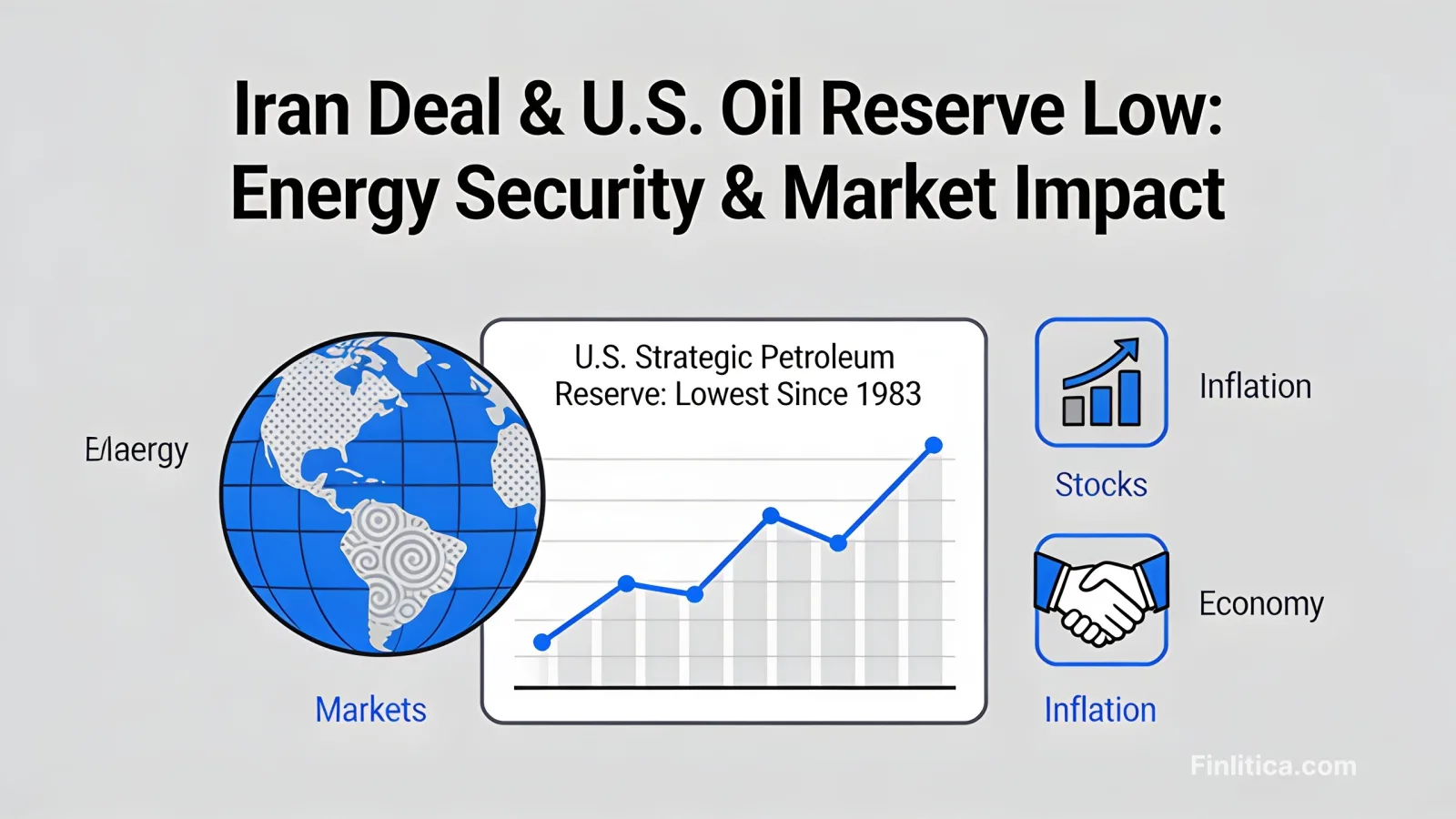
Iran deal lands as U.S. oil reserve hits lowest since 1983, sharpening focus on energy security and markets
A diplomatic breakthrough with Iran arrives as the U.S. Strategic Petroleum Reserve falls to its lowest since 1983, heightening attention on energy security, markets, and potential inflation ripple effects.
A diplomatic deal involving Iran arrived just as the U.S. Strategic Petroleum Reserve (SPR) dropped to its lowest level since 1983, a convergence that places energy security squarely back on the market agenda. With oil executives warning that global inventories are being drawn down by supply disruptions linked to the conflict involving Iran, investors across stocks, credit, ETFs, and commodities are reassessing risk, inflation trajectories, and rate expectations.
The timing matters for markets because crude balances influence inflation, earnings margins, and portfolio positioning. The SPR, created in 1975 to buffer supply shocks, is a key policy tool; its trough relative to historical norms narrows Washington’s flexibility if new disruptions emerge. For equities, especially energy and transport, the path of oil prices can alter earnings outlooks quickly, while fixed income and currency markets recalibrate to potential inflation and growth effects.
What changed vs prior baseline
- SPR at multi-decade low: Inventories in the reserve are at the weakest level since 1983-roughly a 40-plus-year low-reducing immediate policy headroom compared with recent years.
- Geopolitical pressure point: Supply disruptions tied to the conflict involving Iran have accelerated global inventory draws, tightening balances versus earlier expectations of gradual normalization.
- Diplomatic inflection: The new Iran deal could, if sustained, temper risk premia embedded in energy markets compared with the pre-deal baseline, though its efficacy depends on compliance and enforcement.
- Corporate signaling: Oil executives’ warnings about rapid stock draws have shifted the narrative from ample supply to fragile buffers, raising the bar for demand-side slowdowns to offset tightness.
Market implications
Equities and sector allocation
- Energy producers: A tighter supply backdrop can support upstream cash flows and capital returns, but volatility around geopolitics and policy releases from reserves may complicate valuation multiples.
- Transportation and chemicals: Higher or more volatile feedstock costs could pressure margins; firms with hedging discipline and flexible pricing power may fare better.
- Broader indices: Inflation sensitivity increases. If energy costs lift headline inflation, equities tied to discretionary spending or rate-sensitive themes may see multiple compression.
Credit and rates
- High yield energy credit: Potentially supportive near-term cash generation, yet refinancing windows could be influenced by rate volatility if inflation expectations drift higher.
- Investment grade/sovereigns: A prolonged energy tightness could nudge inflation expectations, complicating central bank rate paths and term premia in bond markets.
ETFs and commodities
- Energy and commodity ETFs: Positioning may tilt toward energy exposure as a hedge against tighter balances, but headline-driven swings increase tracking error and roll costs.
- Broad-market and factor ETFs: Value and quality tilts might outperform if inflation stays sticky and earnings dispersion widens.
Why it matters
Energy price swings feed through to inflation, growth, and corporate earnings. With the SPR at a multi-decade low and geopolitical risk elevated, the margin for error is smaller, raising the stakes for markets, policy, and the real economy.
Key numbers in context
- 1983: The last time SPR levels were this low, underscoring a more than four-decade nadir in U.S. emergency crude buffers. This constrains rapid-response capacity during shocks.
- 1975: The year the SPR was established, highlighting its long-standing role as a stabilization tool during supply disruptions.
- Approximately 714 million barrels: The SPR’s designed storage capacity, a reference point showing how current inventories compare to maximum potential protection.
- Four storage sites: The reserve is spread across facilities in the U.S. Gulf Coast, a geographic concentration that is efficient for logistics but still vulnerable to regional disruptions.
- Mid-June 2026: The Iran deal’s timing coincides with accelerating inventory draws, making any diplomatic de-escalation potentially market-relevant in the near term.
Risks and alternative scenario
- Compliance and enforcement risk: If the Iran deal falters or implementation lags, risk premia could rebuild and inventory draws may persist.
- Supply chain fragility: Weather events or infrastructure outages along the Gulf Coast could impair SPR logistics, limiting its effectiveness despite available barrels.
- Demand surprises: A stronger-than-expected global economy or seasonal demand spikes could tighten balances further, amplifying price volatility.
- Policy uncertainty: Conflicting policy goals-lower pump prices vs. reserve replenishment-could create stop-start interventions that unsettle markets.
What investors are watching
- Inventory data and refinery runs for signs of balance tightening or relief.
- Official guidance on SPR replenishment cadence and release policies.
- Corporate commentary from oil producers and refiners on capital spending, hedging, and margin outlook.
- Inflation readings and rate expectations that filter into equity valuations and credit spreads.
FAQ
What is the Strategic Petroleum Reserve?
The SPR is the U.S. government’s emergency crude oil stockpile, created in 1975 to cushion supply shocks. It is stored across four Gulf Coast sites with capacity of roughly 714 million barrels.
Why is the SPR’s current level important for markets?
A low reserve reduces the government’s ability to smooth supply disruptions, potentially increasing oil price volatility. That can influence inflation, interest rate expectations, and sector earnings.
How does the Iran deal affect energy markets?
If the agreement lowers geopolitical tensions and stabilizes flows, risk premia in oil could ease. The impact depends on implementation and whether broader supply lines normalize.
Which investor groups are most exposed?
Energy equity and credit investors, commodity traders, and sector-focused ETFs have the most direct exposure. Rate-sensitive assets may also react via inflation expectations.
What should investors monitor next?
Weekly inventory reports, guidance on SPR management, company earnings updates, and inflation data that could shift central bank policy paths.
Sources & Verification
-
View sourceCNBC Top Newswww.cnbc.com