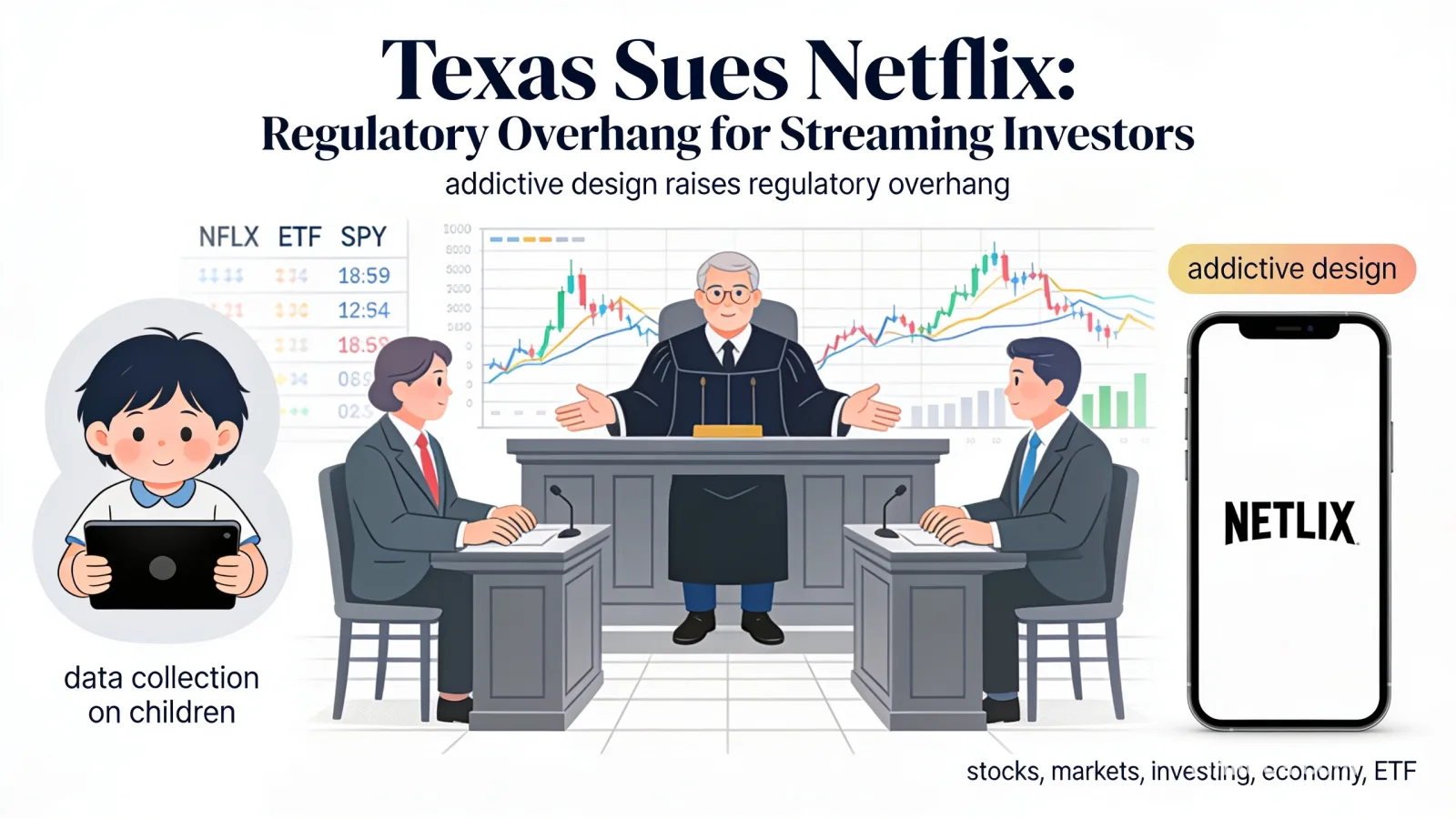
Texas sues Netflix over alleged data collection on children and addictive design, raising regulatory overhang for streaming investors
Texas filed a lawsuit accusing Netflix of unlawfully collecting data from minors and using addictive design features, adding a new layer of regulatory risk for streaming stocks and broader markets.
Texas has filed a lawsuit against Netflix, accusing the streaming giant of illegally collecting data on children and deploying product features designed to keep users hooked. The case adds another front to the scrutiny of large consumer tech platforms and introduces a fresh regulatory overhang for Netflix shares within broader markets as investors reassess legal and compliance risks.
The complaint, brought by the Texas Attorney General, alleges violations of state consumer protection and privacy laws. The state is seeking civil penalties and changes to Netflix’s practices, asserting that the company’s design and data policies harm young users and mislead consumers. Netflix did not immediately respond publicly to the filing at the time of publication.
What changed vs prior baseline
- Texas targets streaming platform design: State-level litigation now reaches a major subscription streaming service, expanding a wave of youth-harm and data-privacy actions previously centered on social media.
- Product design under legal lens: Allegations focus on engagement tools and data handling-not just content-which could push the sector toward design and governance reforms.
- State enforcement momentum: A single-state action can catalyze parallel investigations elsewhere, increasing the probability of multi-jurisdictional scrutiny.
- Compliance cost trajectory: Companies may need to enhance age-gating, parental controls, and data minimization, raising operating expenses compared with prior expectations.
Key details and context
Regulators in the U.S. have tightened focus on youth protections online. Federal rules such as the Children’s Online Privacy Protection Act apply to users under 13 years old, a threshold that frequently shapes how platforms structure sign-up flows and parental consent. The Texas case claims Netflix’s practices fall short of these expectations under state law, even as the company maintains extensive parental controls and viewing profiles.
Netflix moved decisively into streaming in 2007, transforming how video is delivered at scale and setting the template for binge viewing. That evolution matters for legal risk: engagement-centric features built over more than a decade are now being evaluated through newer privacy and child-safety standards.
The company’s global subscriber base exceeds 200 million accounts, underscoring why any mandated design or policy shifts can have material operational impact. Even incremental changes-such as age verification or data retention limits-can ripple across customer onboarding, advertising technology, and recommendation systems.
Market implications
Equity investors
- Valuation multiple sensitivity: Litigation and compliance uncertainty can compress growth premiums for content platforms, particularly those priced on engagement and margin expansion.
- Operating margin headwinds: Additional spending on trust-and-safety, legal, and engineering (for age gating, consent flows, logging) could dilute margins near term, offsetting gains from pricing actions or ad-tier uptake.
- Headline risk: Stock reactions may skew to news flow around motions, discovery, or settlements. Investors should track court deadlines and any signals of multi-state coordination.
Credit and fixed income
- Leverage stability vs. tail risk: While typical state-level penalties are unlikely to strain liquidity, the cumulative effect of multi-jurisdiction actions could influence legal reserves and free cash flow timing.
- Refinancing optics: For issuers with upcoming maturities, sustained legal overhang may marginally widen spreads relative to media peers with lower regulatory exposure.
ETFs and sector allocation
- Streaming-heavy and mega-cap tech funds: Funds concentrated in large-cap media/tech may see incremental volatility from legal headlines, especially those overweight a small cluster of platform names.
- Sector rotation considerations: If regulatory risk reprices engagement-led platforms, investors may tilt toward content libraries, sports rights holders, or communications names with lower youth-data exposure.
Why it matters
State enforcement actions can force product changes with cost and growth implications, even without outsized monetary penalties. For a platform scaled since 2007 and serving over 200 million accounts, compliance mandates can materially affect churn dynamics, advertising roadmaps, and capital allocation-key inputs to stocks and multi-asset portfolios.
What regulators are focused on
- Data minimization and consent: Whether platforms collect only what is necessary and obtain proper permissions, especially for users under 13.
- Design nudges and engagement loops: If features materially encourage prolonged use by minors or obscure parental oversight tools.
- Transparency in communications: Clarity of disclosures around data practices, privacy settings, and recommendation logic.
Risks and alternative scenario
- Case narrowed or dismissed: Courts could limit claims or dismiss parts of the suit, reducing potential penalties and compliance burdens.
- Settlement without admission: A negotiated outcome could impose practice changes and monitoring while capping fines, curbing long litigation timelines.
- Broader coalition risk: Other states or federal agencies may mirror the Texas approach, elevating cumulative legal exposure and compliance complexity.
- Discovery risk: Internal documents revealed in litigation could heighten reputational pressures and invite copycat suits.
What to watch next
- Court calendar: Initial hearings, motions to dismiss, and any requests for preliminary injunctions.
- Product updates: Changes to age verification, defaults for teen profiles, data retention periods, or parental controls.
- Regulatory spillover: Signs of coordination among state attorneys general or interest from federal regulators on youth protections.
FAQ
What is Texas alleging?
The state alleges Netflix violated consumer protection and privacy laws by collecting data from children and using design features that encourage prolonged use, seeking penalties and practice changes.
What could Netflix face?
Potential outcomes include civil penalties, mandated product and policy changes, third-party monitoring, or-in an alternative scenario-partial dismissal or settlement.
Does this affect Netflix’s advertising strategy?
Yes, to the extent ad-supported tiers require precise consent, age checks, and data handling controls. Enhanced compliance can affect targeting, measurement, and monetization efficiency.
Why do the numbers matter?
The under-13 threshold anchors legal obligations; Netflix’s streaming pivot in 2007 frames how long engagement features have matured; and a subscriber base exceeding 200 million amplifies the operational and financial impact of any mandated changes.
Sources & Verification
-
View sourceInvesting.comwww.investing.com