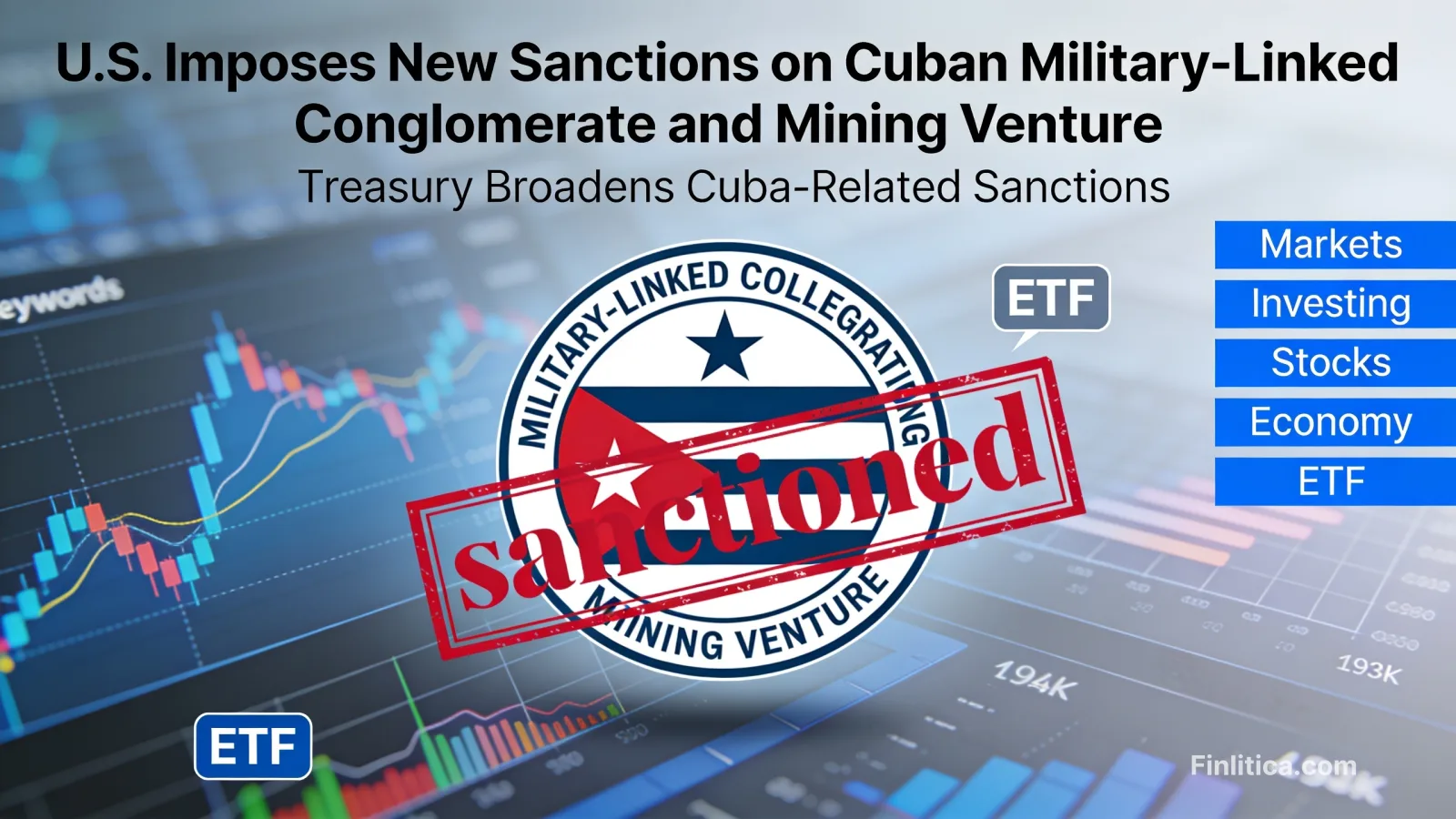
U.S. targets Cuban military-linked conglomerate and mining venture with new sanctions
The U.S. Treasury broadened Cuba-related sanctions, designating a military-controlled holding company and a mining joint venture. The move raises compliance stakes for commodities supply chains and firms with Caribbean exposure.
The United States tightened Cuba-related sanctions, adding a Cuban military-controlled conglomerate and a mining joint venture to its list of restricted parties. The action, published by the U.S. Treasury’s sanctions office, underscores Washington’s continued use of financial pressure against entities tied to Cuba’s security apparatus. For markets and investing audiences, the designations increase compliance complexity across commodities, shipping, and trade finance at a time when global risk appetite remains sensitive to geopolitical headlines.
The measures fall under the Cuba sanctions framework administered by the Office of Foreign Assets Control (OFAC), which prohibits U.S. persons from dealing with listed parties and can expose non-U.S. firms to secondary sanctions risks through facilitation or significant transactions. The move also interacts with existing rules under the Cuban Assets Control Regulations in 31 CFR part 515, adding fresh screening requirements for banks, brokers, and logistics providers.
What changed vs prior baseline
- Two new designations extend U.S. restrictions to a large, military-linked holding company and a mining joint venture, broadening exposure beyond previously targeted individuals and smaller affiliates.
- The additions reinforce OFAC’s 50 Percent Rule, meaning any entity owned 50% or more-directly or indirectly-by a designated party is also considered blocked, requiring expanded counterparty mapping and vendor diligence.
- Compliance expectations rise for metals and shipping supply chains that may intersect with Cuban-origin goods or services, tightening trade documentation and payment screening compared with prior practice.
- The actions come while Cuba remains on the U.S. State Sponsors of Terrorism list since 2021, signaling continuity rather than a loosening of the policy baseline.
Key details and numbers that matter
- 2 designations: A military-controlled conglomerate and a mining joint venture were added, increasing the number of entities that U.S. persons must block and report, and that global firms must screen out of transactions.
- 50% ownership threshold: Under OFAC’s 50 Percent Rule, any firm majority-owned by a designated party is automatically treated as sanctioned, amplifying the reach of the new listings into corporate networks and subsidiaries.
- 31 CFR part 515: The Cuba program is codified under these regulations, which set out prohibitions, licensing pathways, and penalties-providing the legal basis that banks and corporates must implement in control frameworks.
- 2021 terrorism designation: Cuba’s continued placement on the State Sponsors of Terrorism list since 2021 elevates sanctions risk, affects correspondent banking appetite, and complicates insurance and trade finance decisions.
Why it matters
The designations tighten financial isolation around entities central to Cuba’s state-linked commercial activity and signal sustained U.S. enforcement. For investors, lenders, and traders, the sanctions raise operational risk in due diligence, particularly where commodity flows, logistics, or financing may inadvertently touch Cuban-linked parties. Even without direct revenue exposure, firms face potential disruptions via compliance holds, delayed payments, or insurance constraints.
Market implications
Equities and sector allocation
- Commodities value chain: If the targeted mining joint venture touches nickel, cobalt, or related inputs, listed miners, traders, and battery-materials processors may see incremental compliance costs and contract vetting, though direct revenue exposure to Cuba is typically small for large-cap peers.
- Transportation and logistics: Shipping operators and port service providers could face longer documentation cycles and heightened sanctions checks for Caribbean routes, a modest headwind to utilization and working capital cycles.
Credit and trade finance
- Banks and insurers: Enhanced screening against the updated SDN list may lift operational costs and extend transaction settlement times. Trade credit insurers and marine insurers may recalibrate risk on routes with any Cuban touchpoints.
- EM debt and frontier exposure: Cuba is not a mainstream benchmark constituent, but de-risking by global banks can have spillovers across the region, potentially nudging funding costs wider for counterparties perceived as higher compliance risk.
ETFs and passive vehicles
- Minimal direct weight: Broad EM or commodity ETFs have negligible direct Cuban exposure, but metals-linked funds could experience volatility if supply chain concerns affect benchmark constituents elsewhere.
How companies and investors can respond
- Refresh counterparty screening: Immediately update SDN and ownership screening tools to capture the two new designations and any majority-owned affiliates under the 50 Percent Rule.
- Map supply chains: Identify any Cuban-origin materials or services and ensure contractual representations, warranties, and audit rights are sufficient to manage sanctions risk.
- Review payment flows: Check correspondent banking paths and trade finance arrangements to prevent processing through blocked entities or sanctioned jurisdictions.
- Document decisions: Maintain robust records for audits and potential regulator inquiries, including escalation and license assessment where applicable.
Risks and alternative scenario
- Enforcement escalation: Additional entities or sectors could be targeted, expanding the compliance perimeter and increasing the chance of false positives and processing delays.
- Supply chain friction: If the designated mining venture intersects with critical battery metals, tighter compliance could disrupt deliveries or re-route flows, adding cost and lead-time risk.
- Secondary sanctions exposure: Non-U.S. firms facilitating significant transactions with designated parties risk penalties or loss of U.S. market access, which could deter counterparties and reduce liquidity.
- Policy shifts: A change in U.S. administration priorities could either intensify sanctions or open selective licensing channels; either path would shift compliance planning and market expectations.
Compliance checkpoints
- U.S. persons are generally prohibited from dealings with designated entities and must block property or interests in property of listed parties.
- Non-U.S. persons should avoid facilitation, evasion, or significant transactions with designated parties to mitigate secondary sanctions risk.
- Licensing may be available in narrow cases; firms should consult counsel before relying on exemptions or general licenses.
FAQ
What did the U.S. announce?
OFAC designated a Cuban military-controlled conglomerate and a mining joint venture, adding them to the list of parties U.S. persons cannot transact with and whose property under U.S. jurisdiction must be blocked.
Who is affected?
U.S. persons, U.S.-owned or controlled entities, and non-U.S. firms that facilitate or conduct significant transactions with the designated parties. Financial institutions, shippers, and commodity traders face the most immediate operational changes.
Does the 50 Percent Rule apply?
Yes. Any entity owned 50% or more, directly or indirectly, by a designated party is also considered blocked, even if not individually listed.
Is this different from the broader Cuba embargo?
The embargo and Cuba program continue under 31 CFR part 515. The new designations specifically add named entities and their majority-owned affiliates to the SDN list, triggering blocking and transaction prohibitions.
What should companies do now?
Update screening systems, reassess supply chains for Cuban touchpoints, review trade finance and insurance exposures, and obtain legal advice on licensing or wind-down options if applicable.
Sources & Verification
-
View sourceInvesting.comwww.investing.com