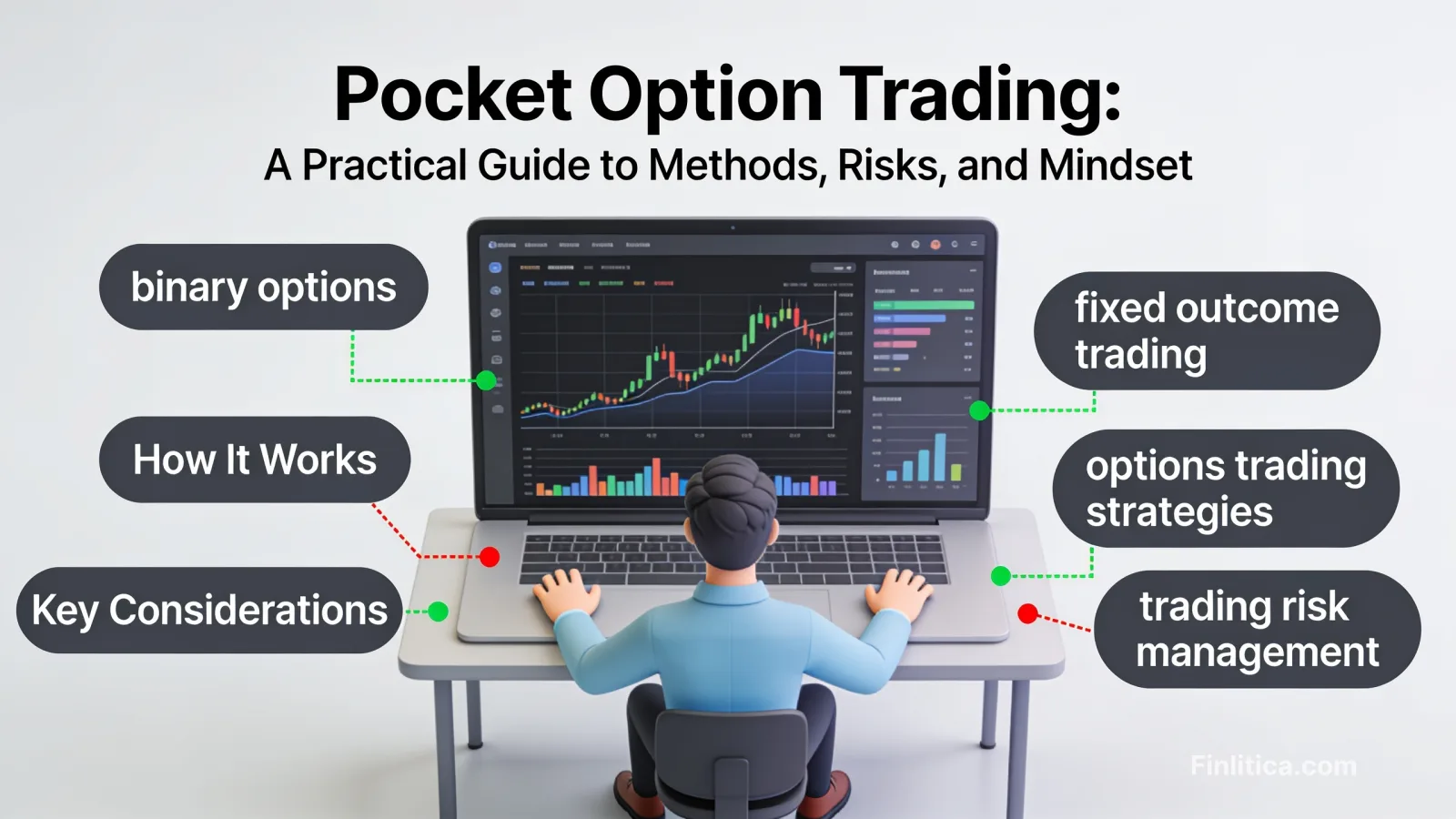
Pocket Option Trading: A Practical Guide to Methods, Risks, and Mindset
Learn how Pocket Option trading works, what to consider before you start, and practical ways to build a rules-based plan. Explore common strategies, risk controls, platform features, and FAQs-all explained clearly without hype.
Pocket Option trading can look simple at first glance: choose a market direction, select an expiration, and commit a stake. In practice, consistent decision-making requires structure, risk discipline, and a clear understanding of how fixed-outcome options behave across different market conditions. This guide walks through the mechanics, planning considerations, strategy frameworks, risk controls, and mindset that experienced traders rely on-so you can evaluate whether this approach fits your objectives and tolerance for loss.
What Pocket Option Trading Involves
At its core, this style of trading uses fixed-outcome contracts tied to an underlying market such as a currency pair, commodity, index, or crypto asset. You select an expiration time and forecast whether price will be above or below a reference level when the contract settles. Outcomes are predefined: a correct forecast results in a fixed return; an incorrect one typically results in losing your stake. Because the payoff is fixed, entry price, timing, and risk sizing matter significantly.
Key Mechanics to Understand
- Expiration selection: Shorter expirations magnify noise and require fast execution; longer ones place more weight on broader trend context.
- Reference level: Your forecast is evaluated against a strike or reference price at expiration, not during interim fluctuations.
- Stake sizing: The amount you commit per contract is the capital at risk for that position.
- Market conditions: Volatility, liquidity, and event risk can affect price behavior into expiration.
Building a Rules-Based Plan
A plan helps you act consistently under uncertainty. Before you place real stakes, write down practical rules you can follow without exception. Keep your plan simple at first, then refine it with data.
Core Elements of a Trading Plan
- Market selection: Focus on a small set of instruments you can observe regularly. Each market has distinct volatility and session patterns.
- Timeframe alignment: Choose expirations that suit your analysis horizon. For example, if you analyze on 5–15 minute charts, your expirations might be slightly longer than your signal candle to allow confirmation.
- Entry criteria: Define exactly what constitutes a valid setup (trend condition, support/resistance, indicator confluence, or price action trigger).
- Risk per trade: Use a fixed fraction of your account for each position to avoid disproportionate losses. Many traders cap risk tightly to stay in the game through losing streaks.
- Daily limits: Predetermine a maximum daily loss and a maximum number of trades. Stop when either limit is reached.
- Review process: Log each trade with screenshots and notes. Evaluate whether the setup followed your rules and how market context evolved into expiration.
Common Strategy Frameworks (Educational Only)
No strategy eliminates risk. The most useful approaches are simple, testable, and matched to specific conditions. Consider these frameworks as starting points for practice and evaluation-not as signals.
1) Trend-Following Continuation
- Idea: Participate in moves that resume after a brief pause within a clear directional trend.
- Tools: Moving averages for bias, pullback to a prior minor level, confirmation candle in the direction of trend.
- Risk note: Sideways markets can generate frequent false signals; wait for clean structure.
2) Support/Resistance Reactions
- Idea: Price often reacts at well-tested levels. Look for rejection wicks, momentum shifts, or volume surges near these zones.
- Tools: Horizontal zones drawn from multiple touches; candle confirmation like engulfing or pin bars.
- Risk note: Levels can break abruptly during news or thin liquidity; avoid trading directly into major announcements.
3) Breakout and Retest
- Idea: When price breaks a consolidation, it may retest the breakout area before continuing.
- Tools: Range boundaries, volatility contraction, retest confirmation via higher low/lower high.
- Risk note: False breakouts are common; require clear retest acceptance before entry.
4) Mean-Reversion Windows
- Idea: In low-trend, range-bound markets, price may revert toward the middle after reaching extremes.
- Tools: Range identification, oscillators for overbought/oversold, evidence of waning momentum.
- Risk note: Trending phases can invalidate mean-reversion assumptions quickly; define conditions precisely.
Risk Management and Capital Protection
Because outcomes are binary, risk is concentrated in each stake. Without guardrails, a short string of losses can materially impact your account. Set boundaries that keep you solvent and clear-headed.
- Position size consistency: Keep your stake as a small, steady percentage of total capital so results are not dominated by any single trade.
- Loss limits: A daily or session stop helps you avoid chasing and decision fatigue.
- Diversification by time: Spreading trades over different sessions or days can reduce correlation in outcomes.
- Avoid compounding losses: Progressive staking to “win it back” increases the probability of large drawdowns.
- Event awareness: Scheduled announcements can expand spreads and volatility; consider standing aside during major releases if your edge depends on stable conditions.
Analyzing Market Context
Context informs whether a strategy is appropriate. Rather than trading every signal, match your approach to the backdrop.
- Trend vs. range: Identify higher highs/lows for trends; multiple touches within horizontal boundaries suggest ranges.
- Volatility regimes: Use simple measures like average true range or candle ranges to gauge whether conditions favor momentum or mean reversion.
- Session tendencies: Currency pairs often move differently across Asia, Europe, and North America sessions; crypto markets can behave distinctly around risk events.
- Confluence: Multiple independent signals aligning (level, structure, momentum) may improve selectivity.
Using Platform Features Wisely
Platforms commonly provide charts, multiple timeframes, indicators, drawing tools, and order controls. Some include social elements or copy features. Treat every feature as optional. Your plan should define what you use and why.
- Charts and indicators: Keep your workspace uncluttered. A few well-understood tools typically outperform indicator stacks.
- Watchlists: Track a limited number of instruments to recognize normal behavior versus anomalies.
- Notes and screenshots: Document your rationale to improve post-trade reviews.
- Practice mode: Test rule changes in a risk-free environment before applying them to real stakes.
Psychology and Process Discipline
Most errors stem from behavior, not analysis. A small set of habits can materially improve consistency.
- Pre-session checklist: Market bias, key levels, scheduled events, maximum risk, and your first planned setup.
- One decision at a time: Enter, then step back. Avoid micromanaging or reacting to mid-trade noise.
- Breaks and resets: After a loss or two, pause. Clarify whether the market changed or you deviated from rules.
- Post-session review: Categorize trades (A/B/C quality). Keep only what works in current conditions.
Backtesting and Forward Testing
Before committing real money, validate your ideas.
- Manual backtesting: Scroll historical charts bar-by-bar, marking where your rules would trigger and recording outcomes.
- Sample size: Evaluate performance over varied conditions (trending, ranging, high/low volatility) to see where your edge holds or fails.
- Forward testing: Apply your plan in a practice environment to confirm execution and psychological fit.
- Iteration: Adjust one variable at a time (entry filter, expiration alignment, time of day) to isolate effects.
Risk, Regulation, and Availability
Availability and legal considerations for this type of trading can vary by region and may change over time. Ensure you understand local rules and any restrictions that may apply to your situation. Only trade with capital you can afford to lose, and recognize that fixed-outcome products can carry a high level of risk.
Putting It All Together
A practical approach to Pocket Option trading blends clear rules, selective setups, cautious risk sizing, and relentless review. The goal is not to trade often, but to trade well-only when your edge, the market context, and your risk controls align. Start small, keep meticulous records, and expect a learning curve.
FAQ
Is Pocket Option trading suitable for beginners?
It can be accessible in terms of interface, but the decision-making is challenging. Beginners should study the mechanics, practice in a risk-free environment, and use small stakes if they decide to proceed.
How much should I risk per trade?
There is no universal number. Many traders keep risk as a small, consistent fraction of account size to limit drawdowns. Choose a level that allows you to withstand losing streaks without emotional pressure.
Do strategies guarantee profits?
No. Markets are uncertain, and even robust strategies experience losses. The goal is to maintain positive expectancy over many trades through selectivity and discipline.
What timeframes work best?
Timeframes should match your analysis style. Short expirations require rapid decisions and tolerance for noise; longer expirations emphasize broader structure. Test across regimes and choose what fits your temperament.
How important is news?
Scheduled events can significantly affect volatility and price behavior into expiration. If your approach relies on stable conditions, consider stepping aside during major announcements.
Can I learn from other traders?
Observing others can spark ideas, but always validate approaches with your own testing. Copying trades without understanding the context can lead to inconsistent results.
What if I hit my daily loss limit?
Stop for the day by rule. Review your trades, note deviations, and return with a clear plan. Protecting capital and confidence is part of the edge.
Conclusion
Pocket Option trading rewards preparation and punishes impulsiveness. Define a narrow, testable playbook, size risk conservatively, align setups with context, and maintain a structured review loop. With realistic expectations and steady process discipline, you can make informed decisions about whether this product suits your goals and how to approach it responsibly.