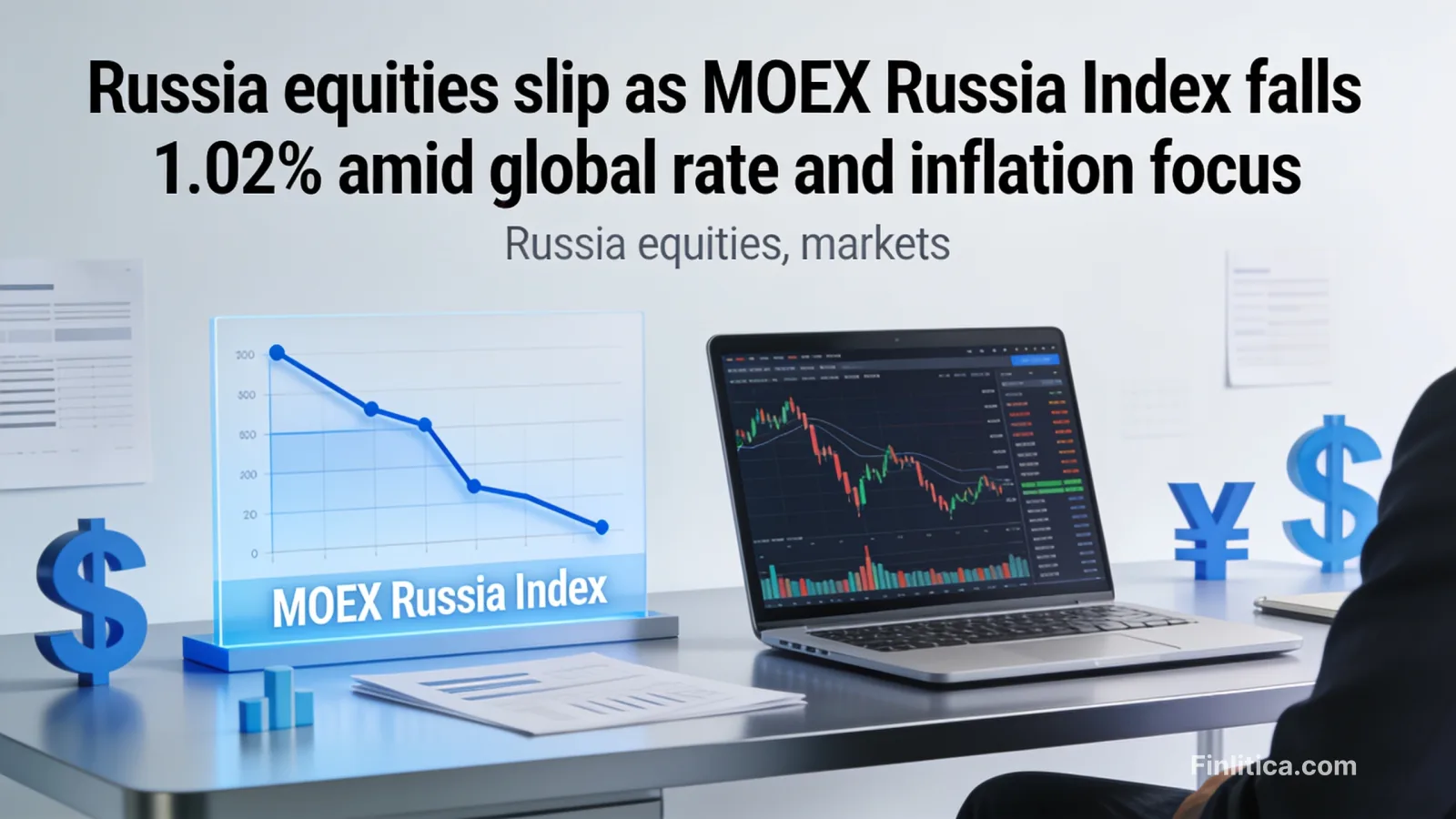
Russia equities slip as MOEX Russia Index falls 1.02% amid global rate and inflation focus
Russian stocks declined at the close, with the MOEX Russia Index down 1.02%, as investors weighed domestic inflation dynamics and global rate expectations.
Russian stocks finished lower, with the MOEX Russia Index declining 1.02% at the close as investors reassessed risk alongside shifting inflation and interest-rate expectations. The move comes as global markets parse central bank signals and corporate earnings guidance, keeping risk appetite sensitive to rate paths and commodity-linked revenue outlooks.
The session’s pullback adds to a cautious tone across risk assets, with traders watching how policy and prices intersect for Russia’s energy-heavy market. While local factors such as domestic demand and currency moves play a role, international rate developments and inflation trends continue to set the backdrop for valuations and funding costs.
What changed vs prior baseline
- Sharper sensitivity to interest-rate rhetoric: With central banks focused on inflation, a 1.02% single-session drop underscores how equity pricing reacts to perceived shifts in the path of rates.
- Re-emphasis on inflation targets: The U.S. Federal Reserve’s 2% inflation goal and the Bank of Russia’s 4% objective have re-entered investor calculations, highlighting the policy bias that shapes discount rates and earnings multiples.
- Renewed attention to liquidity conditions: Market depth and bid-ask spreads matter more during macro-driven moves, elevating execution risk for both institutional and retail flows.
- Heightened cross-asset monitoring: Currency and commodity moves are receiving greater weight in models, influencing equity risk budgeting and hedging decisions.
Why it matters
Equity valuations are highly sensitive to real rates and inflation expectations. A 1.02% decline in the MOEX Russia Index can alter asset-allocation decisions, particularly for investors with commodity or emerging-market exposure. Clearer rate and inflation signals tend to reduce risk premia; uncertainty does the opposite.
Session context and key numbers
- MOEX Russia Index: down 1.02% at the close, signaling a risk-off tone and tighter discount-rate assumptions applied to cash flows.
- Federal Reserve inflation target: 2%. This anchor shapes global rate expectations, affecting equity multiples even outside the U.S. via funding costs and cross-border capital flows.
- Bank of Russia inflation target: 4%. This benchmark guides domestic policy stance and influences local borrowing costs, which feed into corporate margins and valuation models.
Market implications
Equities and sector allocation
- Equity investors: A 1.02% pullback may prompt rebalancing from higher-beta to defensive exposures, especially where earnings sensitivity to rates and inflation is pronounced.
- Sector tilt: Energy-linked names often move with commodity expectations, while domestically oriented sectors can hinge more on local rates and real incomes. Tighter financial conditions generally compress multiples across cyclicals first.
Credit and funding
- Corporate credit: Higher perceived real rates can widen credit spreads, lifting refinancing costs and potentially pressuring leverage metrics, particularly for issuers with floating-rate obligations.
- Sovereign risk channel: Shifts in inflation expectations can reverberate through government bond yields, influencing banks’ funding bases and loan pricing.
ETFs and portfolio construction
- ETF investors: Many Russia-focused ETFs have faced prolonged trading or redemption constraints since 2022, limiting direct rebalancing. Investors may instead adjust EM or commodity allocations to manage indirect exposure.
- Hedging: Cross-asset hedges-such as currency overlays or commodity hedges-can help manage tracking error when direct equity instruments are less accessible.
Risks and alternative scenario
- Policy path uncertainty: If inflation proves stickier than expected, central banks may keep rates restrictive longer, compressing equity valuations further.
- Commodity price swings: Large moves in energy prices can quickly alter earnings outlooks for heavyweights in the index, amplifying equity volatility.
- Liquidity and access constraints: Limited trading access to certain Russian assets and instruments can elevate tracking error and execution risk, complicating portfolio adjustments.
- Currency volatility: Exchange-rate moves can affect import costs, profit translation, and foreign investor returns, potentially exaggerating equity swings.
- Headline and geopolitical risk: Sudden news flow can widen bid-ask spreads and increase gap risk around market opens and closes.
What investors can watch next
- Inflation data: Progress toward the 2% and 4% inflation targets globally and domestically will shape discount rates and earnings multiples.
- Central bank communications: Signals on balance-sheet policy and terminal rates can reset cross-asset pricing swiftly.
- Earnings commentary: Guidance on margins, capex, and cost of capital will indicate how companies are navigating rate and price pressures.
- Market microstructure: Shifts in volumes and spreads can reveal whether de-risking is momentum-driven or valuation-led.
FAQ
What is the MOEX Russia Index?
It is a capitalisation-weighted index tracking a basket of major Russian equities across sectors, widely used as a barometer of local market performance.
Why does a 1.02% move matter?
Even single-percent swings can change portfolio risk metrics, prompt rebalancing, and influence funding costs via equity-to-credit spillovers.
How do inflation and rates affect Russian stocks?
Inflation and rate expectations shape discount rates, borrowing costs, and consumer purchasing power-key drivers of valuations and earnings.
Can international investors easily adjust Russia exposure?
Access remains constrained for many listed products. Investors often manage exposure indirectly via broader emerging-market or commodity allocations.
What could stabilize sentiment?
Clearer inflation progress toward policy targets, predictable rate guidance, and steady earnings outlooks typically reduce risk premia and support valuations.
Sources & Verification
-
View sourceInvesting.comwww.investing.com