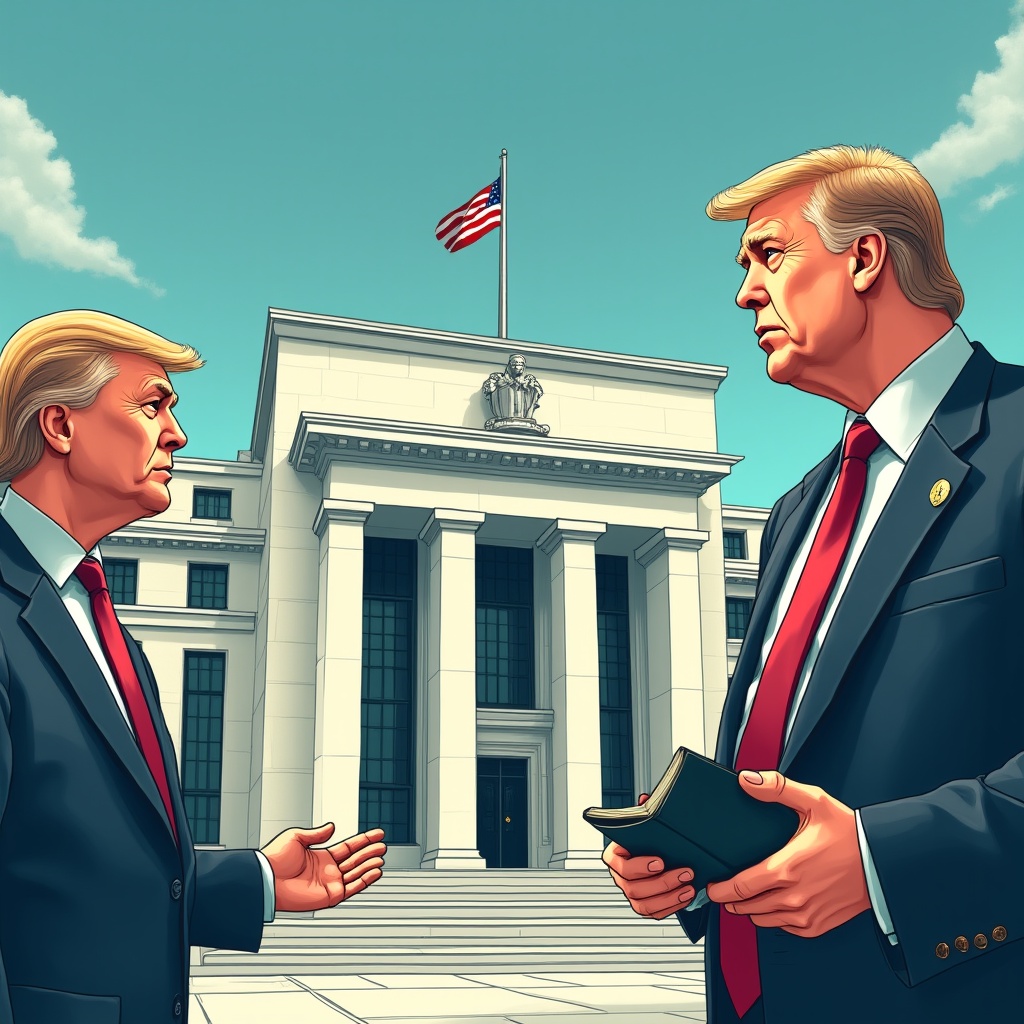
Fed asks court to block effort to reinstate subpoenas in Powell probe as Trump renews criticism
The Federal Reserve asked a judge to reject a push to revive subpoenas tied to an investigation involving Chair Jerome Powell, a legal move that lands as former President Donald Trump escalates attacks on Powell over interest-rate policy.
The Federal Reserve urged a federal judge to deny a bid to reinstate subpoenas connected to an investigation involving Chair Jerome Powell, seeking to keep the central bank’s internal communications out of a renewed legal fight. The request arrives just as former President Donald Trump amplified criticism of Powell, calling him a "moron" and faulting the Fed for keeping the policy rate too high—comments that ricocheted through markets sensitive to interest-rate expectations and inflation dynamics.
The case turns on whether outside parties can compel testimony or documents from the Fed and Powell after earlier efforts were halted. While the legal questions are narrow, the stakes are significant: any perception of political interference in monetary policy can alter how investors price risk in stocks, credit, and rate-sensitive assets.
Why it matters
Central bank independence is a cornerstone of U.S. economic management. The Fed targets 2% inflation, and markets calibrate valuations around how quickly policymakers think they can get there without derailing growth. Elevated political pressure or intrusive legal discovery could complicate communications and, by extension, rate signaling that anchors everything from corporate borrowing to mortgage costs.
What changed vs prior baseline
- The Fed moved to block an attempt to revive subpoenas, shifting the dispute back into court after earlier efforts to compel testimony or documents had been put on hold.
- Trump’s latest broadside against Powell raised the political temperature around interest-rate policy at a time when investors are parsing each policy signal for timing and magnitude of future moves.
- The combination of a legal push and high-profile criticism increases headline risk around upcoming policy communications, compared with a prior baseline of lower legal and political noise.
Context and verifiable facts
The Federal Reserve System comprises 12 regional Reserve Banks and a Board of Governors with up to 7 members. That structure is designed to diffuse political influence and bring regional economic insight into national policy. The Federal Open Market Committee (FOMC), which sets the federal funds rate, typically meets 8 times per year, creating a predictable cadence for markets to reassess valuations and earnings assumptions. The Fed’s stated inflation goal is 2%, a numeric anchor that informs how quickly rates might rise or fall and how risk assets discount future cash flows.
These numbers matter because they define the policy machinery investors track: 12 Reserve Banks and 7 governors highlight the institutional checks on any single figure; 8 scheduled FOMC meetings set the tempo for repricing in rates and equities; and the 2% target frames forward guidance, helping firms plan capital spending and investors calibrate portfolio duration.
Market implications
Equities and sector allocation
- Heightened legal and political scrutiny around the Fed may increase short-term equity volatility, particularly in rate-sensitive sectors like financials, housing, and utilities. Communication frictions can widen the range of earnings multiples investors are willing to pay when discount rates are in flux.
- Companies with heavier refinancing needs could see greater multiple compression if uncertainty lifts equity risk premia even modestly. For example, a 25-basis-point shift in rate expectations can alter discounted cash-flow models enough to move valuations in capital-intensive industries.
Rates, credit, and ETFs
- Rates markets may respond by pricing a fatter distribution of outcomes around upcoming FOMC meetings, affecting Treasury duration bets and investment-grade credit spreads. Credit ETFs tracking intermediate maturities could see heavier flows as investors hedge policy-path uncertainty.
- High-yield issuers are especially sensitive: an incremental 50 basis points in funding costs can materially change debt-service ratios for lower-rated borrowers, impacting both primary issuance windows and secondary spreads.
Risks and alternative scenario
- Legal overhang: If subpoenas are revived and lead to broader discovery, internal deliberations could face exposure, increasing the risk of misinterpretation and market overreactions.
- Political interference risk: Escalating public attacks on the Fed could erode perceived independence, lifting term premia and pushing up borrowing costs even without an immediate policy move.
- Communication noise: Headlines competing with official statements may dilute forward guidance, increasing volatility around FOMC announcements and economic data prints.
- Alternative scenario: If the court decisively rejects the subpoenas and political rhetoric cools, market focus could revert to macro data and the 2% inflation objective, compressing volatility and narrowing spreads.
What to watch next
- Court rulings or procedural updates that clarify whether the subpoenas remain quashed or are revived.
- FOMC communications and Summary of Economic Projections for any change in rate-path signaling and inflation assessments.
- Market-based gauges such as interest-rate futures and breakeven inflation for shifts in policy expectations after major headlines.
FAQ
What is this legal dispute about?
Parties sought to compel testimony or documents involving Fed Chair Jerome Powell. The Fed has asked a judge to deny a move to revive those subpoenas, arguing to keep internal communications out of legal proceedings.
Could this affect interest-rate decisions?
Policy is set by the FOMC to achieve maximum employment and 2% inflation. While legal or political noise does not dictate decisions, it can affect how guidance is communicated and how markets interpret it, influencing financial conditions.
Why do investors care about the Fed’s structure?
The system’s 12 Reserve Banks and up to 7 governors distribute decision-making and input, supporting independence. Consistent, insulated policymaking helps stabilize markets and reduce uncertainty premia.
How often does the FOMC meet?
Typically 8 times per year. That schedule shapes when markets reassess rate expectations, which feed into pricing for stocks, credit, and rates-linked ETFs.
Sources & Verification
-
View sourceCNBC Top Newswww.cnbc.com