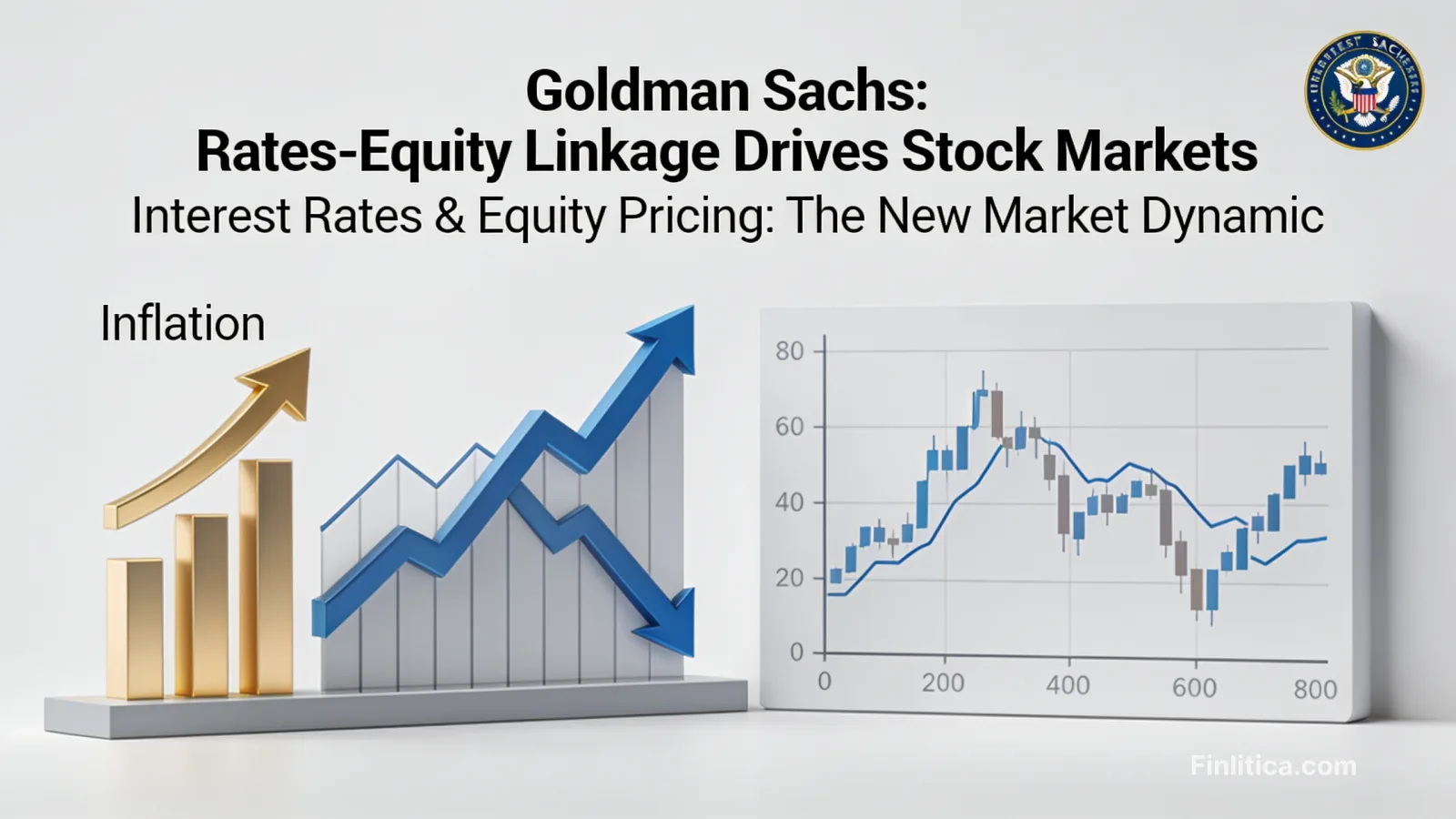
Goldman Sachs flags rates-equity linkage as the key force steering stocks
Goldman Sachs highlights that the relationship between interest rates and equity pricing is once again setting the tone for markets, with valuations, sector leadership, and factor performance moving in tandem with rate expectations.
Stocks are taking their cues from interest rates again, according to Goldman Sachs, which says the underlying relationship between equities and yields is shaping how investors price risk across markets. With the Fed’s policy stance and inflation trajectory under close watch, shifts in discount rates are filtering directly into valuations, factor returns, and sector leadership. For investors navigating earnings season and macro headlines, understanding how rates transmit into equity pricing is now a central task, not a side note.
The equity-rates linkage matters because it influences both the multiple investors are willing to pay and the cash flow outlook those multiples discount. When yields climb, long-duration assets-growth companies with profits further in the future-tend to see faster multiple compression, while cash-generating, rate-sensitive groups can outperform. In reverse, easing rate expectations typically boost higher-duration equities and support broader market risk appetite.
What changed vs prior baseline
- Correlation regime shift: Over recent cycles, the sign and strength of the equity-rates correlation have flipped as inflation dynamics evolved. In disinflationary expansions, falling rates often coincided with stronger risk appetite; in inflationary episodes, higher yields sometimes tracked better growth and stronger earnings. Investors now face a more data-dependent, regime-sensitive linkage.
- Valuation sensitivity: With price-to-earnings ratios elevated relative to long-run medians in several large-cap benchmarks, the valuation impact of rate changes is amplified. For example, a P/E of 20 implies a 5% earnings yield; a 100-basis-point change in the discount rate can meaningfully affect present values for cash flows with long duration.
- Factor rotation: Rate repricing has driven visible swings among style factors. Quality and profitability profiles have gained favor when financing costs rise, while high-duration growth has tended to re-rate when forward rate paths flatten.
- Policy focal point: The path of policy rates-set at eight scheduled Federal Reserve meetings each year-has become the anchor for cross-asset positioning, pushing investors to reassess duration risk across equities, credit, and multi-asset portfolios.
Why it matters
When interest rates are the dominant driver, market leadership can change quickly and portfolio hedges may behave differently than in a growth-led rally. Earnings seasons can be overshadowed by shifts in the forward rate path, and dispersion between sectors and styles tends to widen-creating risks for passive exposures and opportunities for active selection.
How rates transmit into equity pricing
The pathway runs through both the numerator and the denominator of valuation math. Discount rates move via Treasury yields, credit spreads, and equity risk premiums, while earnings expectations adjust with the economy. Historically, investors have required a long-run equity risk premium in the neighborhood of 3-5% over risk-free rates, a spread that compresses in risk-on phases and widens when growth is uncertain. A simple illustration: a company trading at a 20x multiple (5% earnings yield) faces greater sensitivity to rate changes than one at 12x (8.3% earnings yield), because a larger share of its value resides in future cash flows.
Inflation is the fulcrum. The Federal Reserve targets 2% inflation over time, and progress-or lack thereof-tends to steer policy expectations. If inflation momentum cools, term premiums and policy path assumptions can fall, supporting higher equity multiples. Conversely, sticky inflation can lift real yields, tighten financial conditions, and weigh on valuation-rich corners of the market.
Market implications
Equity investors
- Duration balance: Growth-heavy allocations benefit when rate expectations ease; value, quality, and cash-generative sectors tend to hold up better when yields rise. Rebalancing exposures across duration profiles can temper volatility.
- Earnings vs multiples: In a rates-led tape, a 1-2 multiple-point change on a major index can offset mid-single-digit earnings growth. That dynamic underscores the need to watch both earnings revisions and rate moves together.
Credit and fixed income
- Spread resilience: Higher policy rates can pressure refinancing costs, especially for lower-rated issuers. Investment-grade balance sheets typically absorb higher coupons better than high yield, shifting relative value toward quality when real yields rise.
- Cross-asset hedging: Treasury duration can resume its role as a partial equity hedge when growth risks dominate, but in inflationary shocks the correlation can turn positive. Portfolio hedges should be sized with that regime risk in mind.
ETF allocators and multi-asset
- Factor ETFs: Style tilts (quality, low volatility, dividend) may provide ballast during rate upswings, while growth and thematic exposures tend to benefit from declining rate paths.
- Rebalance cadence: With four corporate earnings seasons and eight Fed meetings annually, aligning rebalance windows around these catalysts can capture shifts in leadership without excessive turnover.
Risks and alternative scenario
- Sticky inflation: If inflation proves persistent above the 2% target, real rates may remain elevated, compressing valuation multiples and raising downside risk for long-duration equities.
- Growth downside: A sharper-than-expected slowdown could widen credit spreads and undermine earnings, offsetting any valuation support from lower policy rates.
- Policy error: Miscommunication or delayed policy response could tighten financial conditions abruptly, sparking cross-asset volatility and correlation breakdowns.
- Liquidity shocks: Market depth can thin around macro catalysts, increasing gap risk for ETFs and derivatives, and heightening tracking error for factor exposures.
Sector and asset-class dynamics
Rate-sensitive sectors such as financials and utilities react differently depending on curve shape and deposit dynamics, while technology and communication services-often carrying longer duration-are more exposed to shifts in discount rates. Dividend strategies can provide income support when yields stabilize, but face competition from cash-like instruments when front-end rates are high. In alternatives, crypto assets have at times traded as high-beta risk proxies, responding to liquidity conditions and real yield moves rather than traditional cash flow discounting.
What to watch next
- Inflation trend: Progress toward 2% is the main catalyst for repricing the policy path and term premiums.
- Earnings revisions: Estimate momentum can cushion multiple compression or amplify it if growth decelerates.
- Real yields: Moves in inflation-adjusted rates tend to have outsized effects on valuation-rich segments.
FAQ
How do rate changes affect equity valuations?
Higher rates increase discount rates, which lowers the present value of future cash flows. The effect is larger for long-duration equities-companies whose expected profits are further out in time.
Why does the equity-rates correlation change over time?
When inflation is contained, falling rates often support risk appetite. In inflationary periods, rising rates can coincide with stronger nominal growth and earnings, altering the correlation’s sign and magnitude.
What is a practical way to gauge sensitivity?
Use simple anchors: a P/E of 20 equates to a 5% earnings yield; a P/E of 15 equals about 6.7%. The lower the earnings yield, the more sensitive the valuation tends to be to rate changes.
How often does the Fed set policy?
The Federal Open Market Committee holds eight scheduled meetings per year, with policy rates and guidance that influence front-end yields and, indirectly, equity discount rates.
Sources & Verification
-
View sourceInvesting.comwww.investing.com