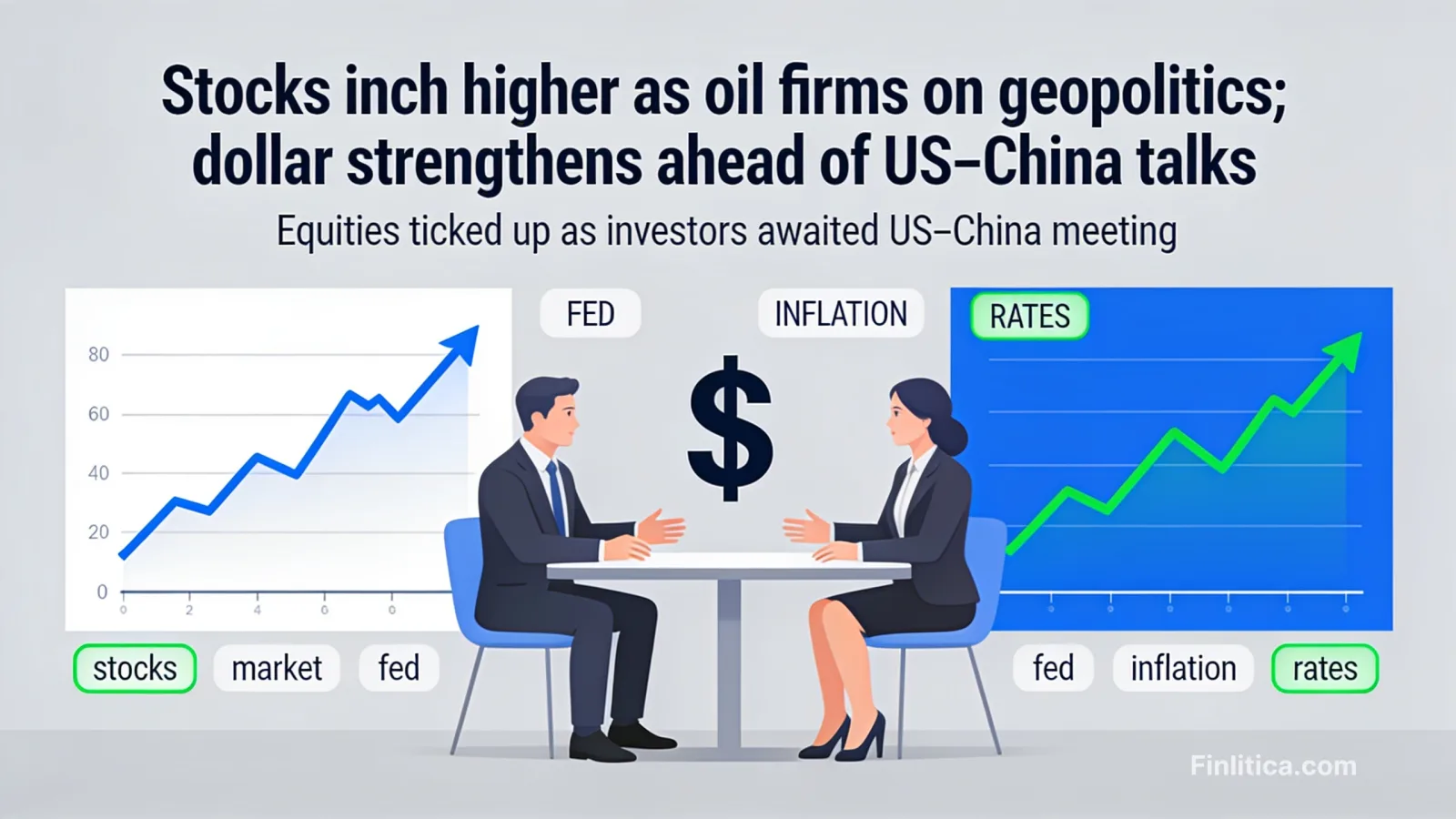
Stocks inch higher as oil firms on geopolitics; dollar strengthens ahead of US–China talks
Equities ticked up and oil prices firmed as investors awaited a high-level US–China meeting and watched a stalemate in US–Iran discussions. A stronger dollar and steady Fed policy outlook kept rates in focus.
Global stocks edged higher while oil prices advanced as investors weighed a high-stakes US–China meeting and an apparent stalemate in US–Iran talks that could constrain energy supply. A firmer US dollar and steady rate expectations kept the Federal Reserve’s inflation fight in view, setting the tone for markets and earnings-sensitive sectors.
The market narrative this week centers on policy and geopolitics: whether dialogue between Washington and Beijing can stabilize trade and technology frictions, and whether the lack of progress with Tehran prolongs tightness in crude markets. With the Fed holding borrowing costs at a restrictive level and inflation still above target, asset allocators are calibrating risk across equities, credit, and ETFs.
Why it matters
Stocks and oil often pull in opposite directions when growth and inflation tensions rise. A stronger dollar tightens global financial conditions, while higher crude can complicate the Fed’s path to its 2% inflation target. Together, these cross-currents inform positioning in cyclicals, defensives, and rate-sensitive assets.
What changed vs prior baseline
- US–China engagement is back on the agenda, raising the prospect of near-term clarity on trade, supply chains, and tech controls compared with a status quo of limited dialogue.
- Energy risk premium ticked higher as US–Iran talks showed little movement, reducing hopes for additional barrels and keeping focus on an oil market already tight by historical standards.
- The US dollar firmed, a shift from recent softness, tightening global financial conditions and pressuring non‑US earnings translations.
- Rate-cut timing remains uncertain as the Fed maintains a restrictive stance, extending the window during which financing costs stay elevated.
The policy and macro backdrop
The Fed’s target range remains at 5.25%–5.50%, a 22‑year high that continues to filter through lending, housing, and corporate financing costs. That level is restrictive by design, intended to steer inflation back toward the 2% goal without derailing the labor market.
Balance sheet policy is another lever for liquidity. In 2024, the Fed slowed its quantitative tightening pace, reducing the monthly cap on Treasury runoff to roughly $25 billion while keeping the mortgage‑backed securities cap near $35 billion. Slower runoff tempers the drain on bank reserves, a consideration for funding markets and risk appetite.
In commodities, a prolonged diplomatic impasse with Iran leaves the supply outlook uncertain. Iran’s output has hovered around the low‑3 million barrels per day mark, and any shift in sanctions or enforcement can swing exports meaningfully. Against global oil demand that remains above 100 million barrels per day, even incremental changes matter for balances and headline inflation.
Market implications
Equities
- Rate‑sensitive sectors: Higher-for-longer policy rates tend to pressure small caps and high‑growth names with longer cash‑flow durations, while quality large caps with strong balance sheets remain relatively resilient.
- Energy and industrials: Persistent crude firmness supports energy earnings and cash returns, and can aid select industrials leveraged to capex and logistics. However, higher input costs may weigh on margins in transportation and chemicals.
Credit
- Investment grade: Elevated policy rates keep all‑in yields attractive, but spread compression leaves less cushion against growth shocks. Duration risk remains a key allocation choice.
- High yield: Refinancing needs meet tighter financial conditions, increasing dispersion. Energy‑linked issuers may benefit from stronger cash flows if crude stays supported.
ETFs and multi‑asset
- Broad market ETFs: Dollar strength can dampen foreign equity returns for unhedged US investors; currency‑hedged products may see renewed interest.
- Commodity ETFs: Oil‑linked funds and energy equity ETFs can act as partial hedges against upside inflation surprises, but come with volatility tied to headlines.
Earnings lens
For multinationals, a stronger dollar can trim overseas revenue translation, affecting reported earnings growth even if local‑currency sales hold up. Conversely, US‑focused firms may see less FX drag but face higher domestic wage and financing costs. Guidance updates will be critical for assessing how management teams balance pricing, volumes, and cost control.
Risks and alternative scenario
- De‑escalation surprise: A breakthrough in US–Iran talks could add supply to the oil market faster than expected, easing crude prices and reducing near‑term inflation pressure.
- Growth disappointment: A sharper slowdown in US or Chinese activity would pressure cyclicals and high yield, potentially widening credit spreads from tight levels.
- Sticky inflation: If services inflation remains firm, the Fed could keep rates elevated for longer, lifting real yields and weighing on long‑duration equities.
- FX volatility: An extended dollar rally could tighten global liquidity, pressure emerging‑market assets, and dampen US multinationals’ earnings.
What to watch next
- US–China readouts: Any indications on trade, technology export controls, or supply‑chain cooperation that could affect semiconductors, autos, and industrial equipment.
- Energy diplomacy: Signals on sanctions enforcement and tanker flows that could shift near‑term crude balances.
- Fed communications: Speeches and minutes for clues on the balance between inflation progress and growth risks, and the pace of balance sheet runoff.
FAQ
How does a stronger dollar affect markets?
A firmer dollar tightens global financial conditions, typically weighs on commodities priced in USD, and reduces overseas earnings when translated back into dollars. It often benefits US importers and can pressure emerging‑market borrowers with dollar debt.
Why do oil moves matter for inflation and rates?
Oil feeds into transportation and goods costs. Sustained increases can lift headline inflation, complicating the Fed’s path to 2% and potentially delaying rate cuts, which influences equity valuations and credit spreads.
What should ETF investors consider now?
Investors may evaluate currency‑hedged international equity ETFs amid dollar strength, energy or commodity‑linked ETFs as partial inflation hedges, and quality‑tilted factor funds to navigate higher‑for‑longer rates.
How could a US–China meeting affect specific sectors?
Any easing of tensions could support semiconductors, industrial machinery, and autos via clearer trade and supply‑chain outlooks. Stricter tech controls would have the opposite effect, particularly for companies reliant on cross‑border chip equipment and design tools.
Sources & Verification
-
View sourceInvesting.comwww.investing.com