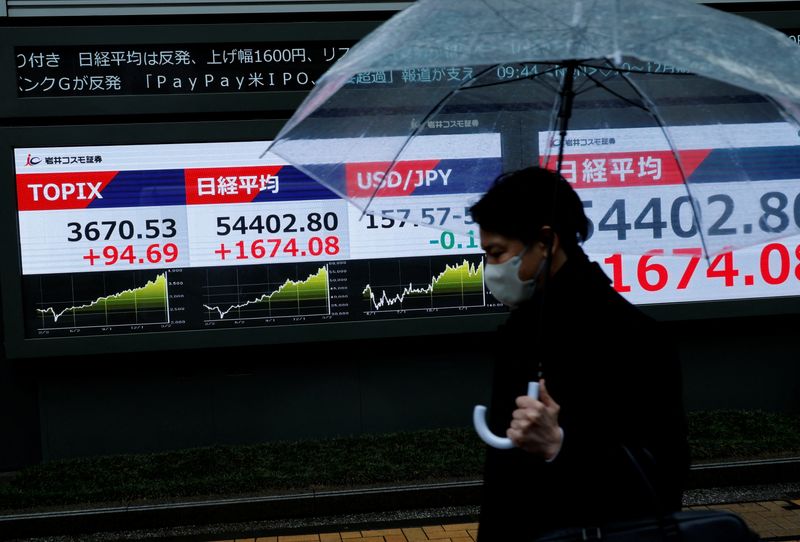
Asian stocks retreat as Brent crude aims for record monthly gain; rate path in focus
Equities across Asia slipped as Brent crude headed toward a record monthly rise, reviving inflation concerns and putting central bank rate expectations back at the center of global markets.
Asian stocks fell as the month drew to a close, with traders reacting to a sharp run-up in Brent crude that is on track for a record monthly increase. The move has renewed focus on inflation, interest rates and the Federal Reserve’s path, with ripple effects across risk assets from equities to crypto, as investors reassess earnings resilience and portfolio positioning.
The combination of higher oil prices and a firmer dollar tightened financial conditions, pressuring growth-sensitive sectors and pushing investors toward defensives. For markets, the question now is whether the energy spike proves transitory or forces central banks to keep rates elevated for longer, reshaping strategies across cash, bonds, ETFs and equities.
Why it matters
- Energy costs feed directly into headline inflation, which anchors policy decisions at major central banks, including the Fed.
- Higher oil can compress profit margins in energy-intensive industries, complicating earnings guidance and equity valuations.
- Rate-sensitive segments—from high-growth tech to small caps and crypto—tend to underperform when real yields rise alongside inflation risks.
What changed vs prior baseline
- Energy shock returns to the narrative: Brent’s outsized monthly advance contrasts with earlier assumptions of stable or easing fuel costs, challenging the disinflation trend.
- Policy-rate glide path in doubt: Markets had priced a smoother rate-cut cycle; stickier headline inflation risks could delay or reduce the number of cuts.
- Sector leadership rotation: Cyclical and rate-sensitive stocks lost ground while defensive groups and select energy names saw relative support.
- Cross-asset correlations tightened: Equities, credit spreads and currencies are reacting more uniformly to oil-driven inflation surprises, increasing macro beta.
Key numbers to watch
- 2%: The inflation target used by the Federal Reserve and many peers. A sustained energy-driven overshoot above this level can extend higher-for-longer policy rates, affecting discount rates and equity multiples.
- ~7%: Approximate weight of energy components in the U.S. CPI basket. Moves in gasoline, electricity and utility gas have an outsized impact on headline CPI and market rate expectations.
- 1,000 barrels: Standard Brent futures contract size. Each $1 move in Brent changes the contract’s value by roughly $1,000, highlighting the speed at which P&L and hedging costs can shift for investors and corporates.
Market implications
Equities and sector allocation
- Equity investors may see multiple compression in growth segments if rate-cut expectations fade. Industrials, airlines and chemicals could face margin headwinds from higher input costs, while energy producers and services may benefit from stronger cash flows.
- Defensives (health care, staples) tend to retain relative strength when inflation uncertainty rises, though absolute performance still hinges on overall risk appetite and earnings visibility.
Credit and income investors
- Credit spreads can widen as earnings cushions shrink and refinancing costs remain elevated. High yield is more exposed to input-cost shocks and slower top-line growth than investment grade.
- Short-duration and floating-rate instruments help manage duration risk if the path to rate cuts lengthens, but credit selection remains critical as dispersion rises.
ETF flows and portfolio construction
- Broad equity ETFs may experience outflows in favor of energy or quality-factor funds as investors tilt toward cash-flow resilience and commodity exposure.
- Commodity and energy ETFs can serve as partial hedges against inflation surprises, while multi-asset funds may reweight toward value and dividend strategies to balance rate sensitivity.
Crypto and alternative assets
- Crypto performance often correlates with broader risk sentiment. Tighter financial conditions and higher real yields can weigh on flows, even as some investors view digital assets as diversification tools.
Policy and macro backdrop
With oil’s surge lifting headline inflation risk, markets are reassessing the probability and timing of rate cuts across major central banks. While core inflation dynamics and labor trends remain central to decisions, fuel prices can shape near-term prints and messaging. For corporate earnings, guidance sensitivity to energy inputs and freight costs will be in focus through the next reporting cycle.
Asia’s market reaction underscores the region’s leverage to energy imports and global demand. Export-heavy economies face a pincer of higher input costs and uncertain end-demand, while commodity exporters could see terms-of-trade support offset weaker global risk appetite.
Risks and alternative scenario
- Energy shock persists: A prolonged oil rally tightens financial conditions further, lifts headline inflation and delays rate relief, pressuring valuations and credit quality.
- Growth slowdown: If higher fuel costs collide with weakening demand, margins compress and earnings downgrades broaden, raising recession concerns.
- Policy miscalculation: Central banks overtighten or stay restrictive for too long, amplifying volatility across rates, FX and equities.
- Supply-side surprise: Rapid restoration of supply or demand destruction could reverse oil gains abruptly, creating whipsaw risk for energy equities and related ETFs.
What to watch next
- Incoming CPI and PPI releases for signs that energy is spilling over into broader price pressures.
- Central bank communications on the balance between headline inflation and core trends in setting rates.
- Corporate earnings guidance on fuel surcharges, freight costs and hedging strategies.
- ETF flow data for shifts toward energy, quality and dividend strategies.
FAQ
How do higher oil prices affect inflation and rates?
Rising oil lifts headline inflation via gasoline and transportation costs. If the increase persists, central banks may keep policy rates higher for longer to prevent inflation expectations from drifting up.
Which sectors are most exposed to sustained oil gains?
Industrials, airlines, trucking, chemicals and consumer discretionary with high logistics intensity face margin pressure. Energy producers and oilfield services often benefit from stronger prices and activity.
What can investors do to manage portfolio risk?
Consider balancing rate sensitivity with quality and cash-flow resilience, evaluate selective energy exposure or commodity-linked hedges, and manage duration in fixed income while focusing on credit fundamentals.
Sources & Verification
-
View sourceInvesting.comwww.investing.com