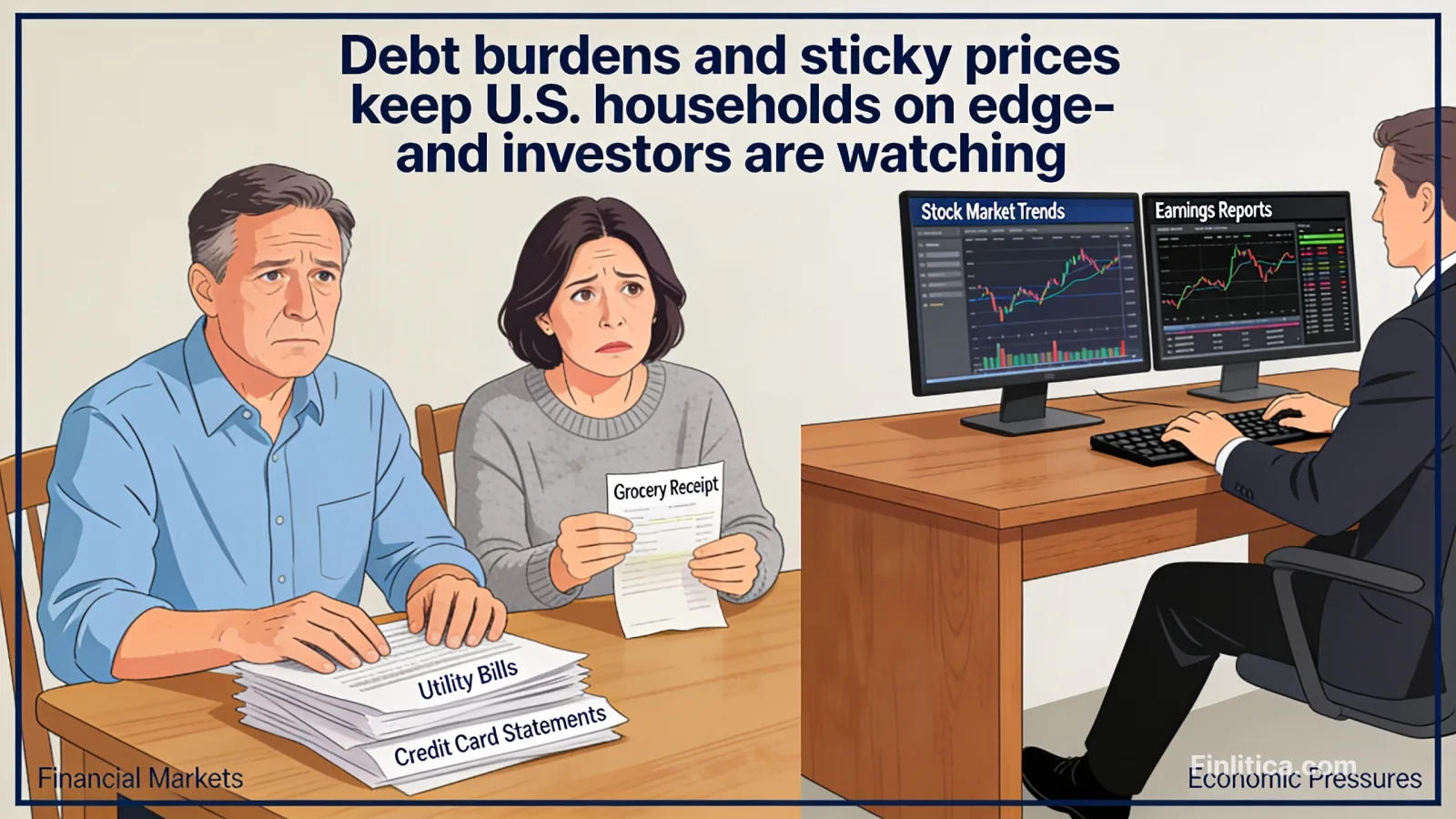
Debt burdens and sticky prices keep U.S. households on edge - and investors are watching
With inflation still pressuring budgets and borrowing costs high, more Americans report financial stress. The ripple effects span consumer spending, credit quality, and sector positioning across markets.
American households are contending with persistent price pressures and elevated borrowing costs, reinforcing a period of financial stress that has implications for the broader economy and markets. Inflation remains a key headwind for day-to-day budgets, while higher interest rates have increased the cost of carrying debt, reshaping how consumers spend and save. Nonprofit credit counselors say demand for help is steady as families look to stabilize finances.
The backdrop matters for investors because consumer spending drives a large share of U.S. economic activity. When more income goes to servicing debt, discretionary purchases can slow, affecting revenue trajectories for retailers, travel, and services companies. At the same time, rising balances and late payments are increasingly relevant for banks, card issuers, and credit-sensitive sectors.
What changed vs prior baseline
- Higher revolving balances: U.S. credit card debt surpassed $1 trillion in 2023, according to Federal Reserve data. That threshold matters because revolving balances amplify sensitivity to interest rates and can quickly translate into higher monthly payments.
- Cost of credit reset: Average credit card APRs climbed into the low- to mid‑20% range by 2024. At 22-24%, every $1,000 carried month to month adds meaningful interest charges, compressing household cash flow and limiting discretionary outlays.
- Household leverage higher in aggregate: Total household debt exceeded $17 trillion by 2024, reflecting mortgages, auto loans, credit cards, and student loans. This scale increases the macro importance of small changes in delinquency rates for banks and fixed income investors.
- Student loan repayment’s drag: Student debt outstanding hovered around $1.6 trillion after repayment resumed in late 2023. Even modest monthly installments can crowd out spending among younger cohorts, affecting categories like entry-level housing, travel, and dining.
Why it matters
Financial stress can shift spending from discretionary to essential items, dampening revenue growth for cyclically exposed companies. Elevated borrowing costs also raise the risk of rising charge‑offs for lenders. For policymakers, the balance between containing inflation and avoiding an unnecessary slowdown becomes more delicate as households retrench.
Market implications
Equities
- Consumer discretionary: Slower ticket sizes and traffic could weigh on earnings guidance for retailers, leisure, and apparel. Companies with value positioning and private‑label strength may hold share better than premium brands.
- Financials: Card issuers and regional banks may face higher provisioning if delinquencies rise from low bases. Conversely, firms with robust underwriting and diversified fee income could show relative resilience.
- Staples and utilities: Defensive sectors often benefit when consumers prioritize essentials. Margin stability and dividend visibility can support multiples during periods of household stress.
Credit and ETFs
- Corporate credit: Wider spreads are possible for lower‑quality consumer‑exposed issuers if cash flows weaken. Investment‑grade names with pricing power may remain more insulated.
- High yield and loan funds: ETFs and mutual funds focused on sub‑investment‑grade credit could see greater dispersion. Duration‑short floating‑rate products may benefit from carry but face credit‑cycle risk if charge‑offs climb.
- Securitized products: Auto ABS and credit card ABS performance will hinge on payment trends; structures with stronger credit enhancement are positioned to weather higher loss assumptions.
Current drivers of household stress
- Sticky essentials: Food, housing, and services costs have risen over multiple years, keeping monthly budgets tight even as goods inflation cooled. Persistent services inflation limits how quickly relief reaches consumers.
- Rate sensitivity: Higher policy rates filter through to variable or repriced borrowing, notably credit cards. The cumulative impact reduces buffer savings and heightens sensitivity to income shocks.
- Income and savings mix: Excess savings accumulated during the pandemic have largely normalized, leaving less cushion for unexpected expenses, particularly among lower‑ and middle‑income households.
How consumers are responding
- Trading down and delaying: Households are prioritizing essentials, shifting to discount channels, and postponing big‑ticket purchases like appliances and electronics.
- Refinancing where possible: Some borrowers have consolidated higher‑rate debt into lower‑rate personal loans, though access depends on credit profile.
- Seeking guidance: Nonprofit credit counseling agencies report steady demand for budgeting help and, when appropriate, debt management plans that can streamline payments and negotiate concessions with creditors.
Risks and alternative scenario
- Labor market softening: A faster‑than‑expected rise in unemployment would pressure delinquency trends and discretionary spending, intensifying earnings risk for cyclical sectors.
- Inflation persistence: If services inflation proves sticky, real wage gains could erode, extending the squeeze on household budgets and delaying a consumption rebound.
- Policy path uncertainty: An uneven interest‑rate trajectory-either cuts that come later than markets expect or a re‑acceleration in inflation-could unsettle rate‑sensitive assets and consumer confidence.
- Credit tightening: Tighter underwriting in response to rising losses could limit refinancing options for stretched borrowers, increasing default risk in subprime segments.
Practical steps consumers can consider
- Prioritize high‑APR balances: Target revolving debt first, given compounding at 22-24% APR materially raises total costs over time.
- Build a basic buffer: Even a modest emergency fund can reduce reliance on high‑cost credit when expenses surprise.
- Use accredited help: 501(c)(3) nonprofit credit counseling organizations can review budgets, negotiate with creditors, and help structure repayment plans tailored to income and goals.
FAQ
Why are higher credit card rates such a problem?
At APRs in the low‑ to mid‑20% range, interest can quickly outpace principal payments if balances are only minimally serviced. This diverts income from consumption and saving, increasing financial strain.
How does household debt affect markets?
High aggregate debt-over $17 trillion by 2024-means even small changes in delinquency rates can ripple through banks, securitized credit, and consumer‑facing equities. Investors watch these metrics for signals on earnings and default cycles.
Can nonprofit counseling really lower costs?
Accredited nonprofits provide budgeting guidance and, when suitable, arrange debt management plans that can consolidate payments and may secure concessions from creditors. Results vary by profile, but structured plans can improve repayment outcomes.
What would improve the outlook?
Sustained disinflation in services, steady job growth, and gradual rate relief would ease budget pressure, support real incomes, and lower borrowing costs-conditions that typically favor a reacceleration in discretionary spending.
Sources & Verification
-
View sourceCNBC Top Newswww.cnbc.com