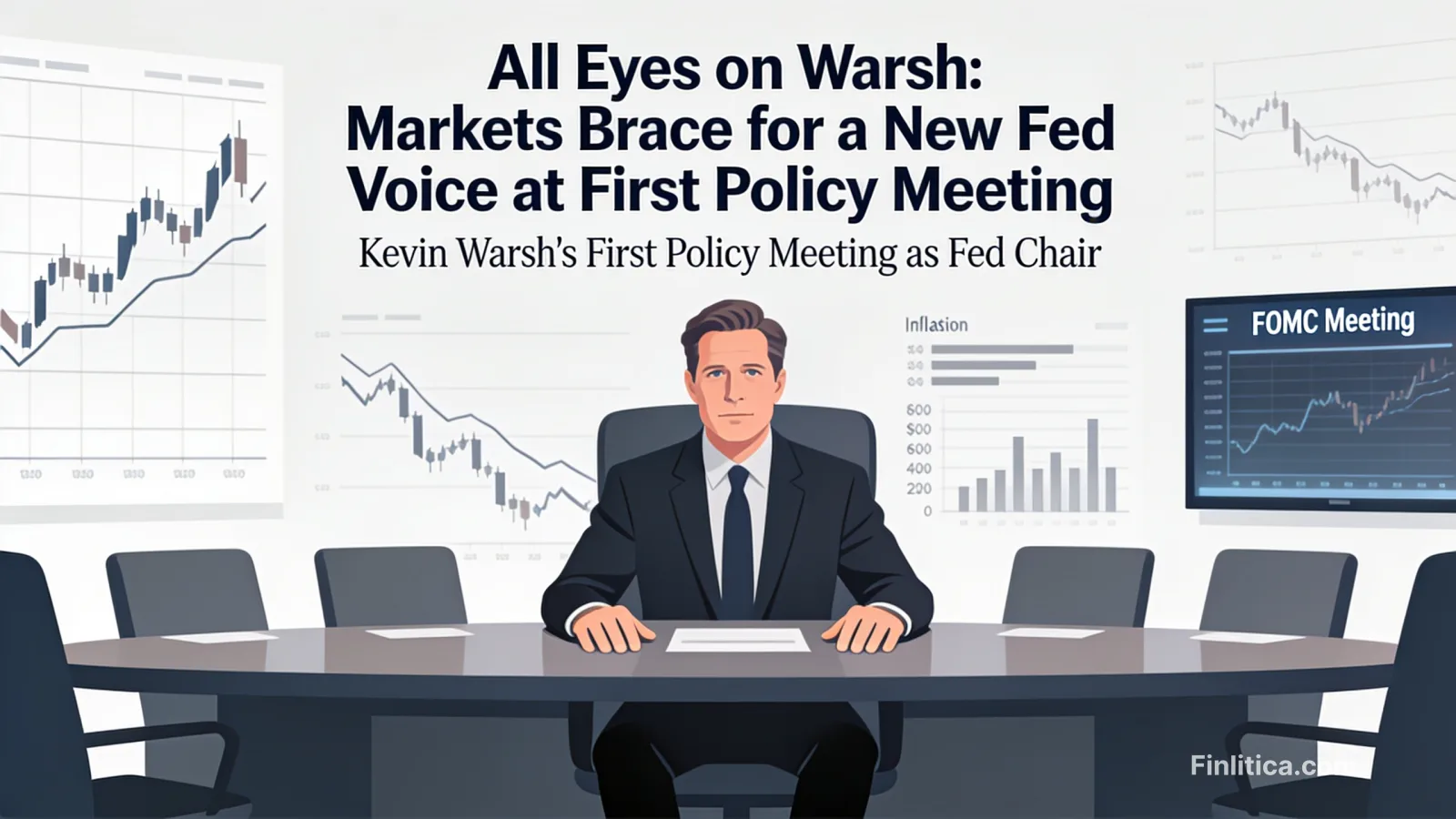
All Eyes on Warsh: Markets Brace for a New Fed Voice at First Policy Meeting
Kevin Warsh chairs his first FOMC meeting, giving investors an early read on how the Federal Reserve will communicate on rates, inflation and the economy under new leadership.
Kevin Warsh will preside over his first Federal Open Market Committee gathering this week, offering markets a crucial first look at how the new Federal Reserve chair intends to communicate on interest-rate policy, inflation and the broader economy. For investors in stocks, bonds and ETFs, the initial tone and structure of Warsh’s messaging could reshape expectations around the policy path and market volatility near term.
While policy substance may not shift immediately, the style of guidance-how much the Fed says, and when-often sets the tempo for markets. Warsh’s debut comes as traders parse every word for clues on the future of rates and the durability of disinflation, with positioning across equities and credit unusually sensitive to language as well as numbers.
What changed vs prior baseline
- Leadership reset: Warsh’s elevation introduces a new communication cadence at the Fed’s eight scheduled meetings each year. A different balance between detail and restraint can alter how markets interpret the same data.
- Press dynamics: Since 2019, the Fed has held a press conference after every meeting; investors will scrutinize Warsh’s first Q&A for signals on tolerance for inflation and growth trade-offs, and whether he leans into or away from forward guidance.
- Guidance texture: The quarterly Summary of Economic Projections and its dot plot-released four times a year-may get tighter framing. Even small changes in how the range of policy-rate paths is explained can widen or narrow market-implied rate distributions.
- Decision increments: Markets will watch whether 25-basis-point steps remain the default unit of adjustment and how Warsh communicates any conditions for deviating from that norm, a detail that can meaningfully affect rate-volatility pricing.
Setting the stage
Warsh previously served as a Federal Reserve governor from 2006 to 2011, a five-year stretch that spanned the global financial crisis. That experience informs his approach to policy trade-offs and real-time market functioning-factors that often matter as much as macro models when conditions tighten or liquidity thins.
The FOMC’s communication structure is well-defined: eight policy statements per year, press conferences after each decision, and four projection updates (March, June, September, December). Those touchpoints-especially the quarterly materials-anchor how traders calibrate terminal-rate odds, duration exposure and equity risk premia.
What investors will watch
- Inflation framing: Does the chair emphasize the trajectory toward target or the risks of persistence? The weight he assigns to recent inflation prints versus trend measures will guide rate-path probabilities.
- Labor-market lens: Signals on how much labor slack is needed to ensure inflation control can sway earnings multiples and credit spreads.
- Balance-sheet stance: Even without numerical targets, color on the speed and composition of balance-sheet policy influences term premiums and sector leadership.
Market implications
Equities
For stocks, clearer boundaries around the reaction function can compress equity volatility, while opaque signals could do the opposite. A communication tilt that prioritizes realized inflation over forecasts would likely favor quality and cash-generative names, shifting leadership away from longer-duration growth exposures when rate uncertainty rises.
Rates and credit
Treasury markets will focus on how Warsh describes the balance of risks. A tighter emphasis on data dependency tends to lift rate volatility and steepen curves when growth surprises; more prescriptive guidance generally flattens curves. In credit, even a 25-basis-point change in implied path can widen high-yield spreads if recession risk is framed more explicitly, while investment-grade often remains cushioned by duration demand.
ETFs and allocation
Rate-sensitive ETFs in Treasurys and mortgage-backed securities could see larger flows around the statement and press conference window, particularly if the chair reduces forward guidance. Multi-asset allocators may tactically tilt toward short-duration instruments when the communication regime elevates uncertainty around the policy rate.
Why it matters
Communication is policy. Markets translate language into prices, and those prices influence financial conditions that feed back into the real economy. A small change in how the Fed articulates reaction functions can shift rate expectations, equity valuations and credit availability within a single session.
Key numbers to know
- 8 scheduled FOMC meetings per year: These events set the rhythm for portfolio risk, liquidity and hedging plans, concentrating information and volatility.
- 4 projection cycles annually: The March, June, September and December releases of the Summary of Economic Projections and dot plot anchor rate-path scenarios used in bond pricing and equity discount rates.
- 5 years of prior Fed service (2006-2011): Warsh’s crisis-era tenure provides experience with market stress and policy transmission, shaping how he may prioritize stability versus transparency when trade-offs emerge.
Risks and alternative scenario
- Communication ambiguity: If the inaugural message reduces clarity without offering a consistent framework, rate volatility could jump and risk assets underperform as investors demand wider risk premia.
- Data surprise risk: A hotter-than-expected inflation or jobs print proximate to the meeting could force rapid repricing, challenging any attempt to set a steady tone and destabilizing both stocks and credit.
- Projection misread: Markets may over-interpret the dot plot’s central tendency as a promise. If subsequent data diverge, disappointment can trigger sharp moves in yields and equities.
- Liquidity air pockets: Thinner depth around announcement times may amplify price swings, especially in longer-duration Treasurys and high-beta equity segments.
What to watch on meeting day
- Statement wording on inflation progress and labor-market balance.
- Any discussion of balance-sheet runoff tempo and composition.
- Press conference cues on thresholds for changing the policy rate and tolerance for overshooting or undershooting inflation objectives.
FAQ
What is different about a new Fed chair’s first meeting?
Investors assess the chair’s communication style-how directly they tie policy to data and risks. This influences how markets translate statements into rate expectations and asset prices.
Will policy likely change immediately under new leadership?
Substantive policy shifts at a first meeting are uncommon. The larger immediate effect typically comes from how guidance is framed and the degree of specificity provided.
How does the dot plot affect markets?
Released four times a year, the dot plot shows individual policymakers’ rate projections. Markets use it as a map for the likely path of rates, though it is not a promise and can shift with incoming data.
Why do 25-basis-point steps matter?
Because many derivatives and risk models are built around quarter-point increments, signaling a readiness to deviate can reprice volatility and alter hedging costs.
Sources & Verification
-
View sourceCNBC Top Newswww.cnbc.com