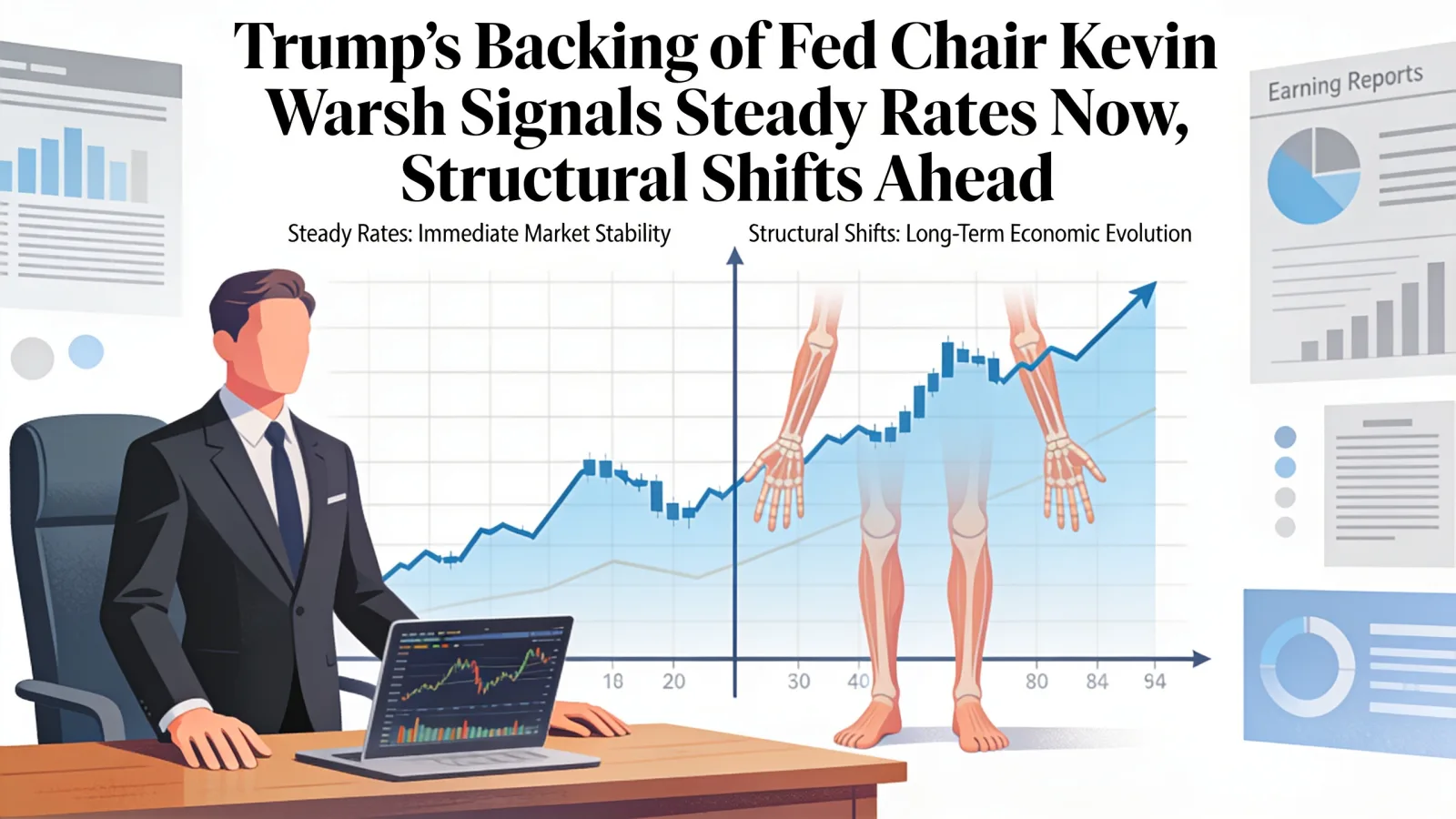
Trump’s Backing of Fed Chair Kevin Warsh Signals Steady Rates Now, Structural Shifts Ahead
With President Trump expressing confidence in new Fed Chair Kevin Warsh, investors expect no rate move this week while watching for longer-term changes to policy strategy, balance sheet management, and regulation.
President Donald Trump’s public confidence in new Federal Reserve Chair Kevin Warsh is shaping expectations for the central bank’s near-term and long-term agenda. While markets broadly anticipate the Fed to hold its policy rate steady this week, the political backing could give Warsh latitude to pursue structural adjustments that matter for the economy, stocks, earnings, and fixed income over time. For investors tracking the market, inflation, and crypto-adjacent policy debates, the focus now shifts from a single rate decision to how the Fed may recalibrate its framework and communications in the months ahead.
The near-term setup appears straightforward: a steady rate path amid mixed economic signals. The longer-term question is whether Warsh uses the early window of credibility to refine the Fed’s policy toolkit, clarify its guidance, and adjust supervision-moves that can reshape how markets price risk and how ETFs and other vehicles transmit monetary policy across asset classes.
What changed vs prior baseline
- Leadership credibility: Clear support from the White House reduces early-tenure uncertainty and may allow Warsh to prioritize policy design over day-to-day signaling. Historically, new chairs face a credibility gap; explicit political backing can narrow that gap, at least initially.
- Near-term stance: Consensus expectations center on holding the policy rate unchanged this week, pivoting attention from the immediate move to the statement, projections, and press conference language that guide markets over coming meetings.
- Longer-horizon agenda: With political room to maneuver, the Fed can advance non-rate initiatives-such as communication updates, balance sheet runoff pacing, and review of liquidity facilities-that affect markets even when the headline rate is steady.
- Supervision and market structure: Warsh could revisit elements of bank capital, liquidity backstops, and payment-system modernization, which influence credit availability, funding costs, and risk appetite beyond traditional rate channels.
Key numbers that frame the debate
- 2% inflation goal: The Fed’s long-run inflation objective remains 2%, anchoring how it interprets incoming data and communicates the path for rates. This target is central to valuing stocks and bonds because it guides real rate assumptions and corporate earnings discount rates.
- 8 scheduled FOMC meetings each year: With policy set at eight regularly scheduled gatherings, guidance between meetings and the Summary of Economic Projections take on outsized importance. Markets often reprice around these milestones, shaping ETF flows and sector rotation.
- 12 regional Reserve Banks and up to 7 Board governors: The institution’s decentralized design helps incorporate diverse regional conditions into national policy. For investors, this breadth can influence how quickly the Fed reacts to sector-specific slowdowns in housing, manufacturing, or services.
- 1913 founding year: More than a century of precedents informs how the Fed balances growth, employment, and price stability through cycles. That institutional history affects market confidence when leadership signals continuity versus redesign.
What to watch in this week’s decision
- Statement language: Any refinement around the balance of risks between inflation and employment will steer rate path expectations and Treasury curve shape.
- Press conference tone: Warsh’s emphasis on data dependence, financial stability, or labor dynamics can tilt equity factor performance-favoring quality and cash-flow resilience if uncertainty is highlighted.
- Balance sheet guidance: Even without a rate move, comments on the pace of runoff or reinvestment policy can shift term premiums and credit spreads.
Why it matters
Markets often react more to the Fed’s framework than to a single rate decision. Clear backing from the administration amplifies the chair’s ability to shape that framework, affecting discount rates, earnings multiples, funding costs, and portfolio construction across equities, credit, and ETFs.
Market implications
Equities and sector allocation
- Steady rates paired with emphasis on price stability tend to support quality and large-cap profitability screens, while rate-sensitive segments-like housing and leveraged growth-take cues from forward guidance rather than today’s decision.
- Stronger communication discipline could lower equity volatility by tightening the range of plausible outcomes for earnings multiples, particularly in defensives and dividend payers.
Credit and rates
- A hold this week likely stabilizes front-end yields, leaving credit spreads more sensitive to remarks on balance sheet runoff. Slower runoff would generally compress term premiums and aid investment-grade supply digestion.
- Clarity on liquidity facilities can reduce tail risks in funding markets, a positive for short-duration credit ETFs and money market strategies that bridge cash and policy rates.
ETF flows and multi-asset
- Unchanged rates plus steadier messaging often channel flows into core bond and broad-market equity ETFs, with factor tilts adjusting as guidance evolves.
- If the Fed underscores data dependence, tactical allocation may favor barbell exposures-pairing high-quality duration with cyclicals leveraged to a resilient economy.
Policy areas to monitor beyond rates
- Communication framework: Potential tweaks to forward guidance and use of projections could reduce ambiguity around the Fed’s reaction function.
- Balance sheet strategy: Signals on reinvestment and runoff shape term structure dynamics and mortgage market liquidity.
- Supervision and regulation: Calibration of capital and liquidity buffers influences bank lending capacity and, by extension, real-economy credit and earnings trajectories.
- Payments and digital finance: Oversight of faster payments and crypto-adjacent risks affects market plumbing, collateral flows, and settlement stability.
Risks and alternative scenario
- Political overhang: Visible alignment with the White House could raise concerns about perceived independence, potentially lifting term premiums if investors demand a higher policy uncertainty buffer.
- Data surprises: A sharp upside or downside surprise in inflation or employment could force a faster policy adjustment than signaled, unsettling rate-sensitive assets.
- Communication misstep: Any inconsistency between the statement and press remarks can widen market ranges, elevating equity and rates volatility.
- Financial stability shock: Stress in funding, housing, or commercial real estate could refocus the Fed on backstop measures, altering the expected path of balance sheet and supervision policy.
FAQs
Is the Fed expected to change rates this week?
Market consensus points to holding the policy rate steady. Investors are focused on the statement and press conference for clues about the path ahead.
Why does White House support for the Fed Chair matter?
Early-term political backing can strengthen the chair’s ability to drive longer-term policy and communication changes, which influence markets even if the headline rate is unchanged.
What should investors watch most closely?
Guidance on inflation-risk balance, balance sheet runoff pacing, and any hints of changes to communication tools. These shape discount rates, credit spreads, and equity factor performance.
How does this affect crypto and digital finance?
While not a rate decision, the Fed’s stance on payments, custody, and financial plumbing can influence liquidity conditions and risk appetite in digital assets and related equities.
What is the Fed’s long-run inflation goal?
The target is 2%, a benchmark that anchors expectations for policy and informs valuations across stocks, bonds, and ETFs.
Sources & Verification
-
View sourceCNBC Top Newswww.cnbc.com