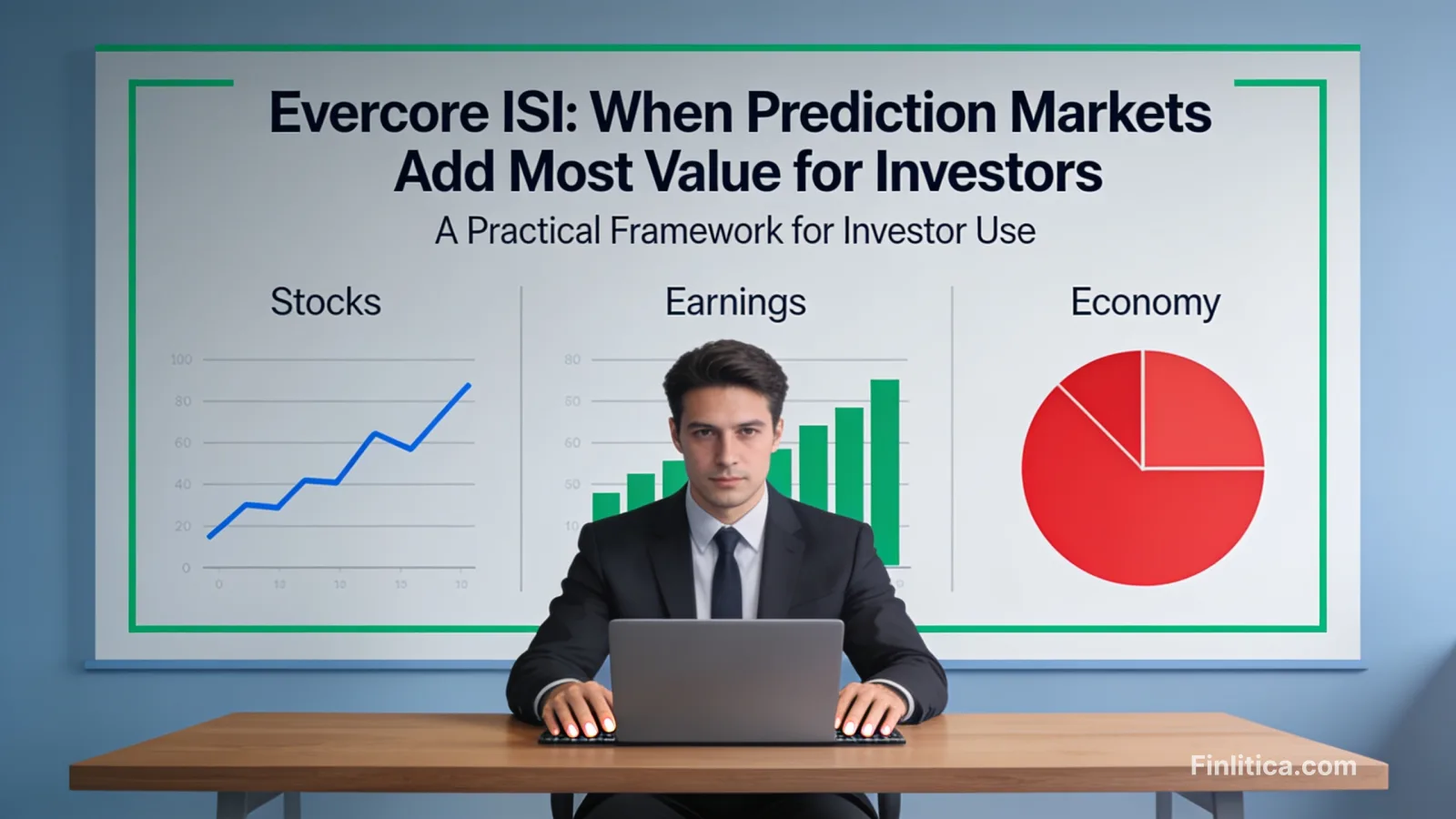
Evercore ISI outlines when prediction markets add the most value for investors
Evercore ISI strategists map out a practical framework for using prediction markets, helping investors judge when crowd pricing is decision‑useful for stocks, rates, and macro calls-and when to rely on traditional analysis instead.
Evercore ISI strategists have set out a practical framework for when prediction markets are most helpful to investors right now, distilling where crowd pricing can sharpen calls on stocks, earnings, policy, and the economy-and where it can mislead. With markets processing headline risk across inflation, rate policy, and crypto regulation, the note aims to help portfolio managers decide when to lean on market‑implied probabilities versus fundamental or policy analysis.
The research focuses on event types that prediction markets tend to price best: clearly defined, time‑bounded outcomes with broad information access. That orientation matters for investors navigating quarterly earnings, regulatory decisions, and election timelines, where probability, not narrative, drives position sizing, hedging, and ETF exposures.
Key takeaways from Evercore ISI’s framework
- Clarity over precision: Markets tend to do better with binary (0/1) questions-such as whether a policy is approved-than with continuous outcomes like growth rates. The 0/1 structure reduces modeling noise and makes the payoff easier to hedge.
- Time‑bounded horizons: Contracts tied to outcomes within a defined window, such as a ruling due by a fixed date, generally generate cleaner signals than open‑ended questions that drift with new information.
- Broad information sets: Events where information is widely available (e.g., scheduled earnings or macro releases) better support crowd aggregation than specialized, non‑public developments.
- Liquidity matters: Thicker order books translate to narrower spreads and faster incorporation of news, improving signal reliability around catalysts.
What changed vs prior baseline
- Sharper event focus: The framework emphasizes shorter, well‑specified horizons instead of multi‑year themes, pushing investors to use markets for discrete catalysts rather than structural narratives.
- Use as a weighting tool: Rather than serving as a standalone forecast, prediction prices are positioned as inputs that adjust conviction and sizing alongside traditional research.
- Cross‑asset relevance: The guidance explicitly spans equities, rates, and crypto events, reflecting the broader set of listed contracts now trading around policy and macro outcomes.
How to apply it to portfolios
Screen events
- Define the question precisely (who/what/when). Favor events with a scheduled decision date and clear pass/fail criteria.
- Check liquidity and fees. Thin markets can distort signals via wide spreads or one‑sided flow.
- Map payoff to portfolio exposure. Ensure the contract’s settlement aligns with the risk you are hedging or expressing.
Blend with fundamentals
- Use market‑implied probabilities as a cross‑check for analyst models, policy tracking, and channel checks.
- Translate probabilities into position sizes and stop‑losses, not into absolute certainty. Prices shift as new information arrives.
Market implications
Equity and sector allocators
- Earnings are quarterly-four windows each year-creating repeatable chances to compare prediction market odds with implied moves in options and with sell‑side estimates. The frequency (four) matters because it enables consistent, out‑of‑sample testing of how well crowd pricing anticipates beats or misses.
- For sector rotation, contracts tied to policy milestones (e.g., approvals or funding deadlines) can guide tactical tilts where outcomes translate directly to revenue timing.
Rates and macro investors
- Binary policy outcomes can complement rate‑path views anchored in data like inflation prints. When an event is scheduled within a defined window, the pricing offers a cross‑check on near‑term volatility and term premium assumptions.
- Liquidity in short‑dated, policy‑linked contracts can help frame hedges around key announcements without overcommitting balance sheet.
ETF strategists
- Prediction prices around catalysts can inform pre‑positioning in thematic and sector ETFs, especially where index weights concentrate exposure to a single event risk.
- For broad beta vehicles, market odds can flag when to increase or reduce hedges ahead of week‑specific catalysts that might drive flows.
Concrete numbers that help size decisions
- 0/1 outcomes: Structuring a catalyst as a binary event improves signal translation into portfolio actions because payoffs map directly to yes/no scenarios.
- 24/7 trading: Many prediction venues operate continuously, a 24‑hour cycle that matters for global investors who must manage risk across time zones and after‑hours headlines.
- 252 trading days: Public markets typically have about 252 sessions per year, which is relevant when aligning event settlement dates with rebalancing calendars and measuring opportunity cost.
Why it matters
Prediction markets convert dispersed information into tradable probabilities. Used well, they can add discipline to investing decisions on earnings, policy, and macro risks by clarifying the odds, the time horizon, and potential payoff. The Evercore ISI framework encourages investors to treat these prices as structured inputs-useful where events are clear and imminent-rather than as substitutes for analysis.
Risks and alternative scenario
- Liquidity gaps: Thin order books or sudden flow imbalances can skew prices, reducing reliability at the exact moment investors need clarity.
- Ambiguous questions: Poorly defined contracts or moving goalposts can undermine settlement confidence and distort pre‑event pricing.
- Information asymmetry: If material, non‑public information drives trading, the “wisdom of crowds” premise breaks down, and prices may mislead.
- Regulatory shifts: Rule changes affecting what can be listed or who can trade may curb access, volume, or the range of available contracts.
FAQ
Are prediction markets a substitute for fundamental research?
No. Evercore ISI frames them as complementary tools that help calibrate conviction and sizing, especially for near‑term, well‑defined events.
When are they most useful for equities?
Around quarterly earnings, product approvals, or binary legal/regulatory outcomes with scheduled dates and clear settlement criteria.
How should investors interpret fast price moves?
As changing probabilities, not certainties. Treat swings as signals to reassess thesis, hedge, or resize risk rather than as definitive forecasts.
Do these markets help with longer‑term themes?
They are generally less effective for multi‑year narratives where outcomes are continuous and information is uneven. Traditional analysis tends to carry more weight in those cases.
Sources & Verification
-
View sourceCNBC Top Newswww.cnbc.com