U.S. Still a Prize for Chinese Companies as Policies Shift and Trust Deficit Lingers
Despite policy adjustments on trade, Chinese firms continue to target the U.S. consumer market, tailoring operations to regulatory and political scrutiny while investors gauge sector winners and risks.

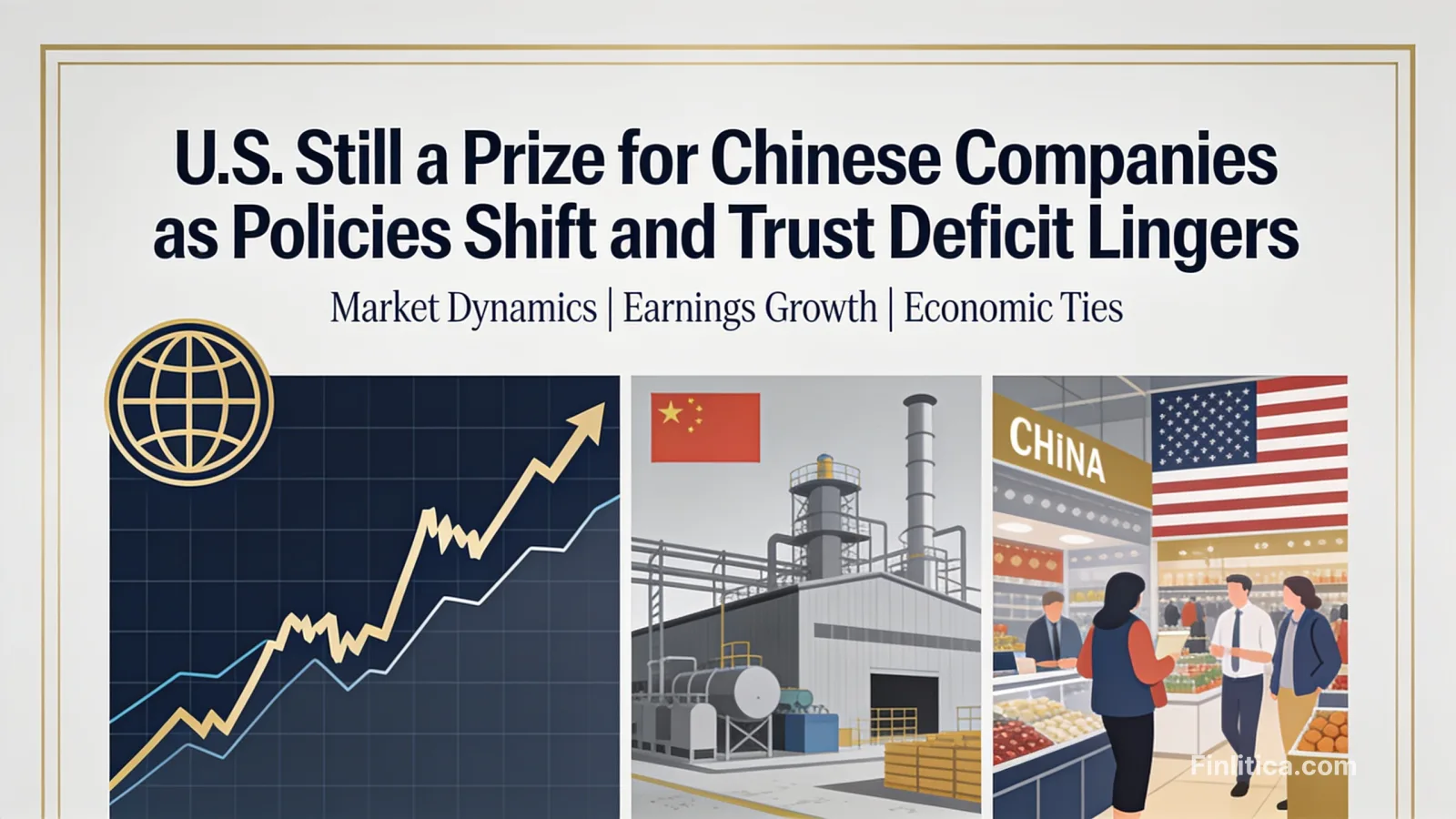
Chinese companies are pressing ahead in the U.S. despite shifting trade rules and a persistent trust deficit, adapting operations and compliance to reach the world’s largest consumer market. For investors tracking markets, stocks, and the broader economy, the key question is how this steady localization and regulatory navigation will filter into earnings, sector leadership, and portfolio construction now.
The U.S. remains highly attractive on scale alone: personal consumption expenditures run at roughly $19 trillion a year, a figure that underscores why companies recalibrate strategies even as policy winds change. While headline tariffs and security reviews have evolved, the pursuit of resilient access to U.S. demand-via local hiring, data safeguards, and supply chain adjustments-has become central to corporate planning and to investing decisions across equities, credit, and ETFs.
Why it matters
- U.S. demand depth: With consumption representing about 68% of U.S. GDP, steady access to American buyers can materially shape revenue trajectories and valuation multiples for global sellers.
- Policy bifurcation: Some tariff lines have eased or been refined, while strategic categories-such as electric vehicles-face sharply higher rates, creating uneven competitive dynamics by sector.
- Portfolio ripple effects: Tighter scrutiny on data and critical tech can alter index composition, sector weightings, and factor exposures that drive ETF and active strategies.
What changed vs prior baseline
- Targeted policy shifts: Since the initial Section 301 actions that covered roughly $370 billion of Chinese imports, the policy mix has become more granular-some inputs and intermediate goods see adjusted treatment while strategic items face higher barriers.
- Sector-specific escalation: Tariffs on certain categories such as EVs have climbed to as high as 100%, signaling that national security and supply-chain resilience now trump broad tariff relief in sensitive sectors.
- Operational localization: More Chinese firms are creating U.S.-based entities, hiring locally, and committing to onshore or nearshore assembly to address political concerns and procurement rules.
- Data governance: Enhanced data storage, audit trails, and compliance protocols are becoming standard as companies seek to meet federal and state-level requirements and rebuild trust.
Current landscape
Trade policy is no longer a single headline rate; it is a patchwork that varies by product class and perceived strategic importance. This mosaic approach makes planning more complex but also opens paths for firms willing to localize operations. For example, tariff lines for certain consumer and capital goods have been recalibrated, while sensitive technologies face higher walls alongside national security reviews.
Three numbers frame the opportunity and constraints. First, the U.S. economy’s nominal size-about $28 trillion-illustrates the scale that continues to pull in overseas entrants. Second, personal consumption near $19 trillion highlights why retail, consumer electronics, and services platforms still prioritize U.S. exposure. Third, the long-standing ~$370 billion in tariff-covered imports underscores that market access is available but conditional, encouraging re-engineered supply chains rather than pure export reliance.
Market implications
Equity investors
- Stock selection: Companies with diversified supply chains, localized compliance, and clear data-governance playbooks may command higher multiples due to reduced policy volatility in earnings.
- Sector tilts: Consumer-facing names and industrials supplying non-sensitive components may see steadier revenue conversion, while strategic tech and EV adjacencies face multiple compression from persistent policy risk.
Credit markets
- Spread differentiation: Issuers demonstrating U.S. localization-such as domestic warehousing, final assembly, or joint ventures-could benefit from tighter spreads relative to peers with pure export models.
- Refinancing windows: Policy clarity, even if restrictive, can support refinancing if business models adapt; conversely, abrupt rule changes raise downgrade and refinancing risk.
ETF and asset allocation
- Exposure hygiene: Broad emerging markets ETFs can mask divergent policy sensitivities; some allocators may favor thematic or factor ETFs to isolate quality balance sheets and lower policy beta.
- Rebalancing cadence: Faster policy cycles argue for more frequent rebalances in quantitative and multi-asset mandates to manage factor drifts tied to trade and rate expectations.
Company playbook: what firms are doing
- Localization and hiring: Building U.S. teams for compliance, government relations, and customer support to shorten response time to regulatory changes.
- Supply-chain redesign: Shifting final assembly or key steps to the U.S. or treaty partners to meet content rules and reduce effective tariff burdens.
- Data and security upgrades: Onshoring data storage, adding third-party audits, and ring-fencing U.S. user information to satisfy security reviews.
- Brand positioning: Emphasizing product reliability, warranties, and transparent pricing to address consumer hesitancy while focusing on value segments.
Risks and alternative scenario
- Policy reversals: A renewed escalation-additional tariff lines or broader restrictions-could pressure margins and reroute supply chains yet again.
- Regulatory fragmentation: Divergent state-level privacy and security rules increase compliance costs and legal risk, complicating national go-to-market plans.
- Demand sensitivity: A slowdown in growth, stickier inflation, or a higher-for-longer rate environment could compress discretionary spending and weigh on earnings.
- Technology export controls: Expanded controls on chips, software, or data flows could limit product roadmaps and reduce cross-border collaboration.
- Reputational setbacks: High-profile enforcement actions or data incidents would widen the trust gap and dampen sales conversion.
Earnings watch: what to monitor
- Gross margin stability: Signals whether localization is offsetting tariff and logistics costs.
- SG&A trends: Rising compliance and legal costs should be tracked against revenue growth to gauge scalability.
- Inventory and lead times: Faster turns suggest supply-chain resilience and better cash conversion.
- U.S. segment disclosures: More granular reporting on U.S. revenue can reveal traction and policy exposure.
FAQ
Are tariffs broadly lower today?
No. While some lines have been adjusted, many strategic categories still carry elevated tariffs, and certain sectors-such as EVs-face rates as high as 100%.
Why do Chinese firms still target the U.S.?
Scale and depth. With consumption near $19 trillion annually and the economy around $28 trillion, the U.S. market can materially influence growth trajectories, even with added compliance requirements.
How should investors position?
Focus on companies with diversified supply chains, transparent compliance, and pricing power. Consider ETFs or factor tilts that reduce exposure to policy-sensitive segments while maintaining access to U.S. demand.
What could change the outlook?
A shift in trade negotiations, new data-security mandates, or a turn in the inflation and interest-rate cycle could quickly alter margins, valuations, and capital access.
Bottom line
Trade policy may ebb and flow, but demand scale and the drive to de-risk supply chains are pushing Chinese firms to adapt rather than retreat. For markets and investing, the edge goes to businesses-and portfolios-that convert policy complexity into operational resilience and steadier earnings.
Sources & Verification
-
View sourceCNBC Top Newswww.cnbc.com