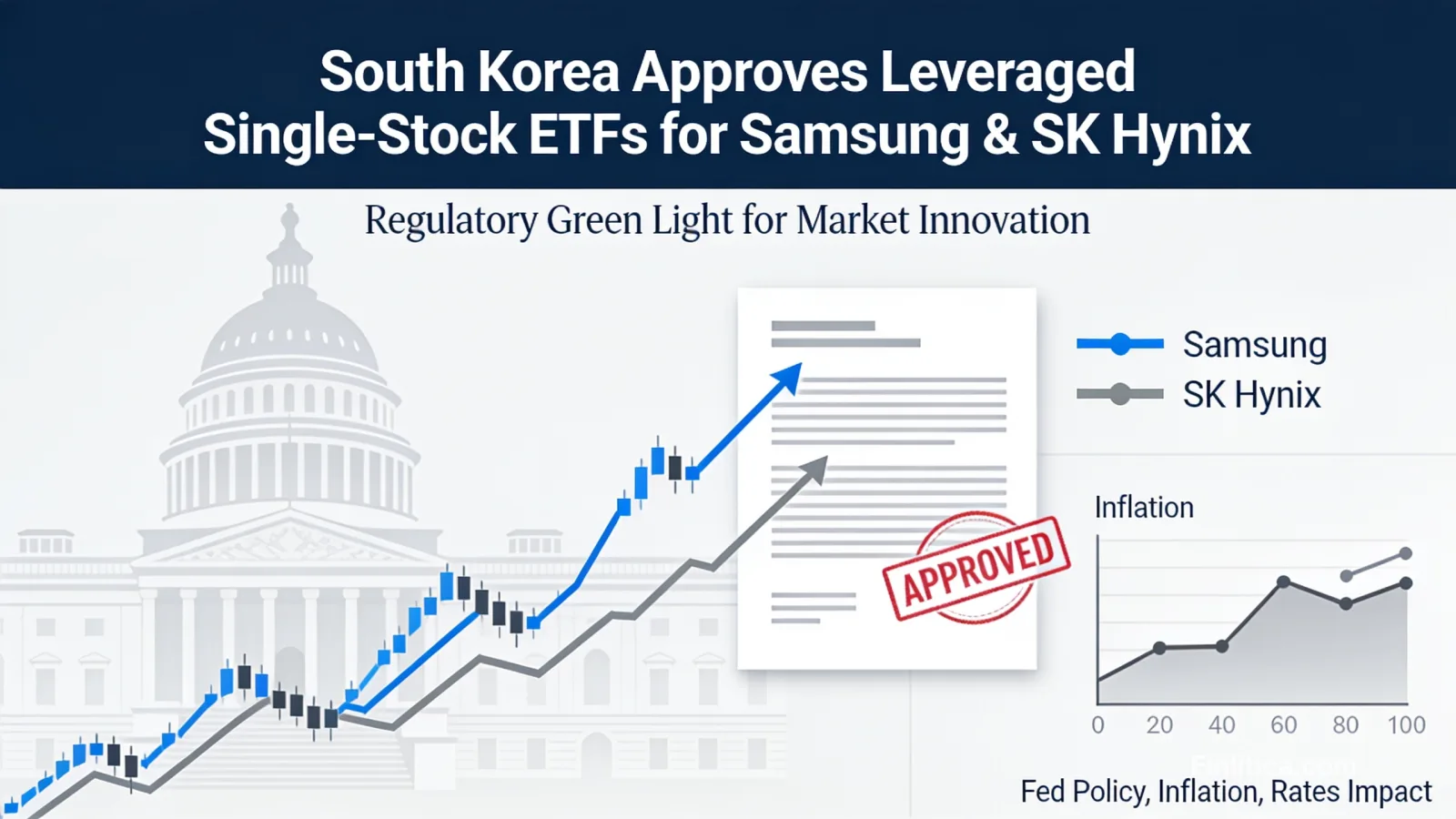
South Korea clears leveraged single‑stock ETFs tied to Samsung and SK Hynix
Regulators in South Korea have approved leveraged ETFs linked to Samsung Electronics and SK Hynix, expanding tools for traders to express targeted views on two marquee chip stocks while heightening focus on daily-reset leverage and risk controls.
South Korea is set to introduce leveraged exchange-traded funds that track Samsung Electronics and SK Hynix, broadening the country’s ETF toolkit and giving investors a new way to trade two of the equity market’s most influential stocks. The move, reported by Bloomberg, adds daily-reset leverage to single‑stock exposure and may reshape short-term positioning across the market as investors weigh amplified returns against higher risk. For investors focused on stocks and ETF strategies, the development comes as markets adjust to rate expectations, earnings momentum, and a shifting economy.
The planned products would provide magnified, stock-specific exposure to Korea’s leading semiconductor names, both of which are central to index performance and sector sentiment. Leveraged ETFs typically seek to deliver a multiple of the underlying stock’s daily move, enabling tactical participation in market swings without using margin, but also introducing path-dependency and volatility drag.
What changed vs prior baseline
- Introduction of leverage on single‑stock ETFs: Korea previously focused on index-tracking leveraged funds; adding leveraged exposure to individual names like Samsung and SK Hynix marks a new layer of precision for equity traders.
- Alternative to margin and derivatives: The products offer a listed, collateralized structure as an alternative to margin accounts or single‑stock futures for short-term positioning.
- Potential for higher intraday activity: Single‑stock leveraged ETFs can concentrate flows around catalysts such as earnings and guidance, raising turnover around headline events.
- Expansion of issuer product shelves: ETF providers can diversify lineups beyond sector and index factors, aligning with demand for semiconductor-focused instruments.
Why it matters
Samsung and SK Hynix are pivotal to Korea’s equity market and global chip supply chains, so new instruments that amplify daily returns can influence market microstructure, liquidity, and investor behavior. The launch also reflects global demand for tools that target specific stocks, complementing broader strategies tied to inflation, rates, and the Fed’s policy path.
Key mechanics and numbers to know
- Daily leverage targeting: A 2x leveraged ETF aims to deliver roughly twice the underlying stock’s daily percentage move. For example, if the stock gains 3% in a session, a 2x product targets about +6% before fees and frictions; if the stock falls 3%, it targets about −6%. This matters because the objective resets each day rather than compounding over longer horizons.
- Compounding effect: Consider two sessions of +5% then −5% for the stock. The stock would go from 100 to 105 to 99.75 (−0.25%). A 2x ETF targeting +10% then −10% would move from 100 to 110 to 99 (−1%). The gap highlights “volatility drag,” an important consideration for holding periods longer than a day.
- Local trading context: Korea’s main equity session runs for 6.5 hours (09:00-15:30 local time). Since leveraged ETFs rebalance on a daily schedule within these hours, intraday swings and closing auctions can significantly shape tracking and costs.
- Price limit environment: Korea’s stock price limit is typically ±30% per day. While limits may temper extremes in the underlier, leverage magnifies targeted exposure, underscoring how quickly P&L can change near daily extremes.
Market implications
Equity and active traders
- Sharper tools for event risk: Earnings, guidance revisions, or macro headlines can now be expressed with stock-specific leverage rather than broader index bets, potentially increasing intraday volatility around catalysts.
- Positioning without margin: Traders can express 2x directional views through ETFs instead of borrowing in a margin account, simplifying execution and collateral management for short-term strategies.
ETF issuers and market makers
- Liquidity provisioning: Authorized participants and market makers will need to manage hedges dynamically across cash equities and derivatives, particularly near the close when daily leverage targets are squared.
- Fee and spread dynamics: Competition among issuers could compress expense ratios over time, but spreads may widen during volatile periods as hedging costs rise.
Sector allocation and global investors
- Semiconductor beta management: Global investors seeking chip exposure can fine-tune Korea allocations using single‑stock leverage, complementing broader semiconductor indices.
- Cross-asset signaling: Flows into these ETFs may act as a real-time gauge of sentiment toward memory pricing cycles and AI-related demand, informing positioning across equities and credit tied to the chip supply chain.
Risks and alternative scenario
- Volatility drag and tracking variance: Because leverage resets daily, multi-day returns can diverge from simple multiples of the stock’s move, particularly in choppy markets.
- Concentration risk: Single‑stock leveraged exposure heightens idiosyncratic risk driven by company news, regulatory actions, or supply‑chain disruptions.
- Liquidity and gap risk: Sudden gaps at the open or into the close can impair tracking and widen spreads, especially around earnings or macro surprises.
- Regulatory adjustments: Authorities could tighten rules, alter product parameters, or limit marketing if retail risk metrics deteriorate, changing availability or costs.
- Alternative outcome: If demand is muted or hedging proves expensive, issuance may be gradual and assets may concentrate in a few tickers, limiting broader market impact.
What to watch next
- Product specifications: Final leverage factors (e.g., 2x long or inverse) and expense ratios will shape competitiveness and holding-cost math.
- Launch timing and lineup: The number of issuers and listing dates will indicate how quickly the market scales and how concentrated assets become.
- Earnings season: Initial trading around quarterly results for Samsung and SK Hynix will test liquidity, spreads, and hedging depth.
FAQ
How do leveraged single‑stock ETFs work?
They aim to deliver a set multiple of a stock’s daily move-commonly 2x for long exposure or an inverse multiple for bearish exposure-by using derivatives and daily rebalancing. They are designed for short holding periods.
Are these suitable for long-term investors?
Generally not. Daily reset, compounding effects, and volatility drag mean returns over multiple days can deviate from expectations. They’re typically used for tactical trading or hedging.
How do they differ from margin trading?
Leveraged ETFs package leverage in a listed fund without requiring a margin account or margin calls. However, investors still bear amplified gains and losses, as well as fund fees and potential tracking error.
What risks should investors consider first?
Understand daily reset mechanics, potential for large percentage swings, liquidity at the open and close, and the impact of company-specific news on single‑stock products.
Sources & Verification
-
View sourceInvesting.comwww.investing.com