Trump’s Beijing Trip Blends Pageantry and Deal Talk as Markets Gauge Policy Signals
A high-profile visit to Beijing featured state-level ceremony, business overtures, and tech celebrity moments. Investors are parsing what the friendlier tone could mean for tariffs, supply chains, and sector positioning across equities, credit, and ETFs.
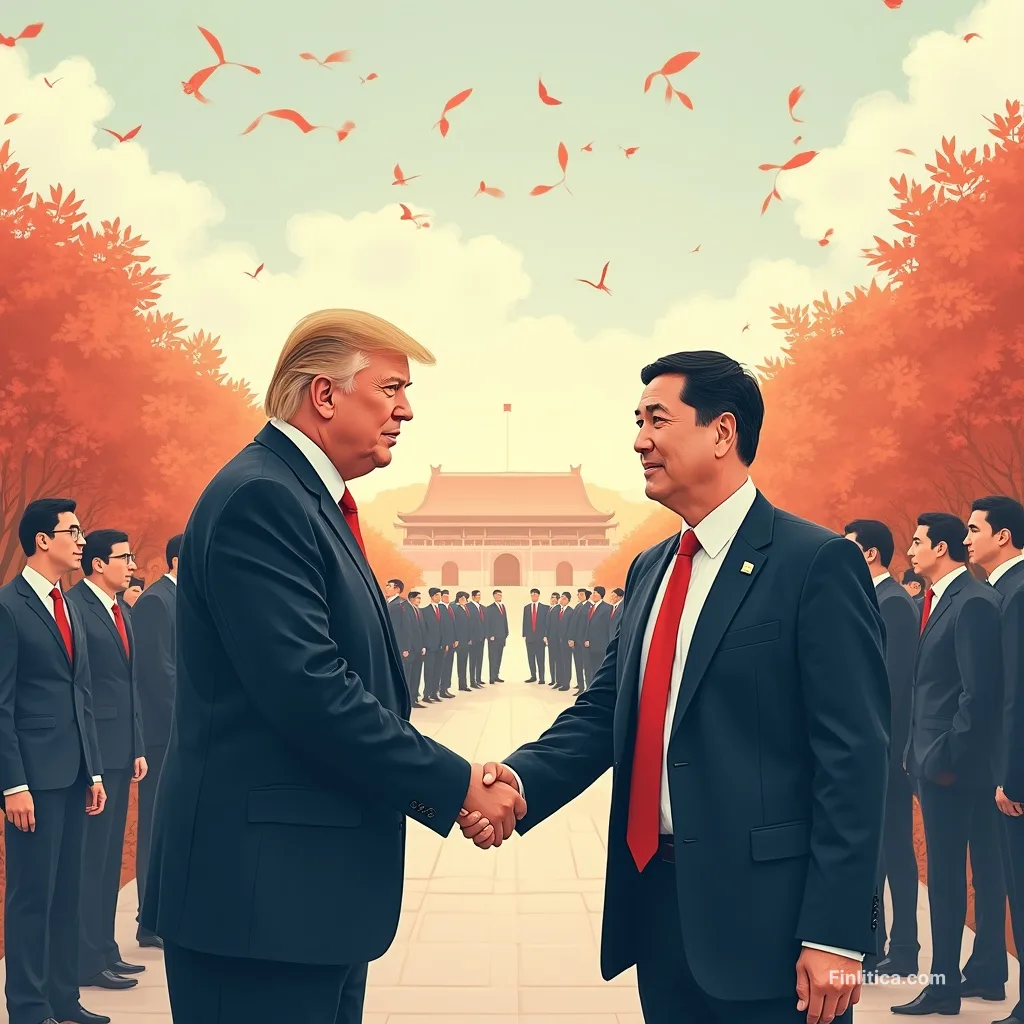
Donald Trump’s visit to Beijing combined state-level ceremony with visible outreach to business, as appearances alongside prominent technology leaders punctuated a schedule heavy on symbolism. For markets, the question is whether the warmer optics translate into tangible policy movement on tariffs, access, and tech supply chains that could influence stocks, credit spreads, and ETF flows in the weeks ahead.
The trip arrives at a time when investors are sensitive to any signals on U.S.-China economic engagement. Together, the two economies represent roughly 40% of global GDP, and China’s 1.4 billion consumers remain central to long-run demand assumptions across autos, semiconductors, and luxury goods. Pageantry alone won’t reset trade policy, but the choreography matters for expectations on earnings, inflation dynamics, and the rate path.
Key takeaways for investors
- Optics improved: state banquet and business-focused events suggested a deliberate effort to lower the temperature and foreground commercial interests.
- Tech front and center: public moments with Elon Musk and Jensen Huang underscored investor focus on EVs, AI hardware, and supply resilience.
- No immediate policy changes: existing tariffs, including measures that run up to 25% on select goods, remain in force pending formal announcements.
- Watch second-order effects: any easing of tension could ripple through input prices, capex plans, and EPS guidance in upcoming earnings seasons.
What changed vs prior baseline
- Tone and access: The staging signaled an incremental shift from confrontation to engagement, replacing prior cycles of headline friction with visible, high-level dialogue.
- Business visibility: High-profile tech participation placed AI infrastructure, semiconductors, and EV supply chains at the center of the agenda, elevating sector-specific expectations versus a broad-brush trade narrative.
- Process over proclamations: Rather than immediate policy reversals, the visit emphasized relationship-building and potential working channels, resetting the timeline investors use to handicap tariff or licensing adjustments.
- Domestic signaling: The imagery targeted both domestic audiences, indicating room for pragmatic dealmaking without sacrificing core strategic positions.
Market implications
Equities
- Semiconductors: Appearances with leading chip and AI executives may support sentiment for firms tied to AI accelerators, memory, and packaging. Any perception of steadier cross-border component flows could reduce risk premia embedded in valuations.
- EVs and autos: Public focus on EV founders keeps attention on battery supply chains, charging ecosystems, and export policies. An improvement in dialogue could benefit automakers with China joint ventures and suppliers exposed to cathode/anode materials.
- Consumer and luxury: A friendlier backdrop can aid brands reliant on China demand; however, revenue sensitivity remains contingent on travel, licensing, and digital-platform dynamics.
Credit
- Cross-border issuers: Calmer rhetoric may compress spreads for corporates with material China revenue or procurement exposure, though durable tightening likely requires concrete policy steps.
- High yield vs. IG: Investment-grade names with diversified supply chains stand to benefit first; high yield remains more exposed to execution and refinancing risk if input costs stay elevated.
ETFs and asset allocation
- Country and sector ETFs: Flows could rotate toward China-sensitive sectors (semis, industrials, autos) if investors price a lower tail risk of disruption. Conversely, broad market ETFs may see neutral impact absent policy specifics.
- Factor tilts: Reduced geopolitical risk premia can favor quality-growth and momentum factors tied to AI capex cycles, while value benefits if input-cost volatility ebbs.
Why it matters
Supply-chain stability influences inflation and, by extension, the interest-rate outlook. If dialogue curbs uncertainty, it could ease cost pressures embedded in corporate guidance and, in turn, affect discount rates applied to long-duration assets. With the U.S. and China comprising about 40% of global output, even marginal de-escalation can shift baseline scenarios for earnings and cross-asset correlations.
What to watch next
- Policy communiqués: Look for any joint statements, working groups, or timelines on trade, export controls, and data governance.
- Licensing and export rules: Changes to semiconductor equipment access, AI chip restrictions, or EV-related components would have immediate sector impact.
- Corporate guidance: Management commentary on China demand, lead times, and pricing-especially from semis, autos, and luxury-will test whether sentiment shifts translate to fundamentals.
Risks and alternative scenario
- Policy inertia: Ceremonial warmth may not yield concrete changes; tariffs that reach up to 25% on select categories could persist, keeping input costs elevated.
- Regulatory whiplash: Surprise moves on export controls, data localization, or investment restrictions could reintroduce volatility and disrupt supply planning.
- Growth disappointments: Weaker-than-expected demand in either economy would blunt equity optimism and widen credit spreads, especially for cyclical names.
- Inflation stickiness: If supply gains don’t materialize, price pressures may remain, complicating central-bank rate trajectories and pressuring duration-sensitive assets.
- Headline risk: Isolated incidents or diplomatic setbacks can quickly reverse risk-on positioning, particularly in sectors with concentrated China exposure.
Context and numbers to anchor expectations
- 1.4 billion: China’s approximate population underscores why consumer, auto, and luxury revenues hinge on access and sentiment.
- ~40%: Combined U.S.-China share of global GDP illustrates why even modest policy shifts can move cross-asset risk premia.
- Up to 25%: Tariff rates on select goods remain a headwind for margins and capex plans until formally revised.
- 2 high-profile CEOs: Public moments featuring Elon Musk and Jensen Huang placed EVs and AI infrastructure at the center of investor attention, reinforcing sector leadership narratives.
FAQ
Did the visit produce binding trade or tariff changes?
No binding changes were announced during the visit. Existing measures, including tariffs that in some cases run up to 25%, remain in place pending formal policy actions.
Which sectors are most sensitive to any follow-through?
Semiconductors, EVs and autos, industrial equipment, luxury goods, and select internet platforms are most exposed to shifts in access, licensing, or demand signals tied to China.
How might this affect inflation and interest rates?
If dialogue reduces supply frictions, input costs could ease, supporting disinflation and potentially a less restrictive rate path. Absent policy movement, the inflation and rate outlook is unlikely to change meaningfully.
What should ETF investors consider?
Monitor sector and country ETF flows for early positioning shifts. Semis and autos may see interest on improved sentiment, while broad market ETFs likely await concrete policy details.
Is crypto affected?
Crypto markets tend to react to macro risk appetite. A de-escalation narrative can support risk-on sentiment, but there is no direct policy linkage from this visit to crypto regulations.
Sources & Verification
-
View sourceCNBC Top Newswww.cnbc.com