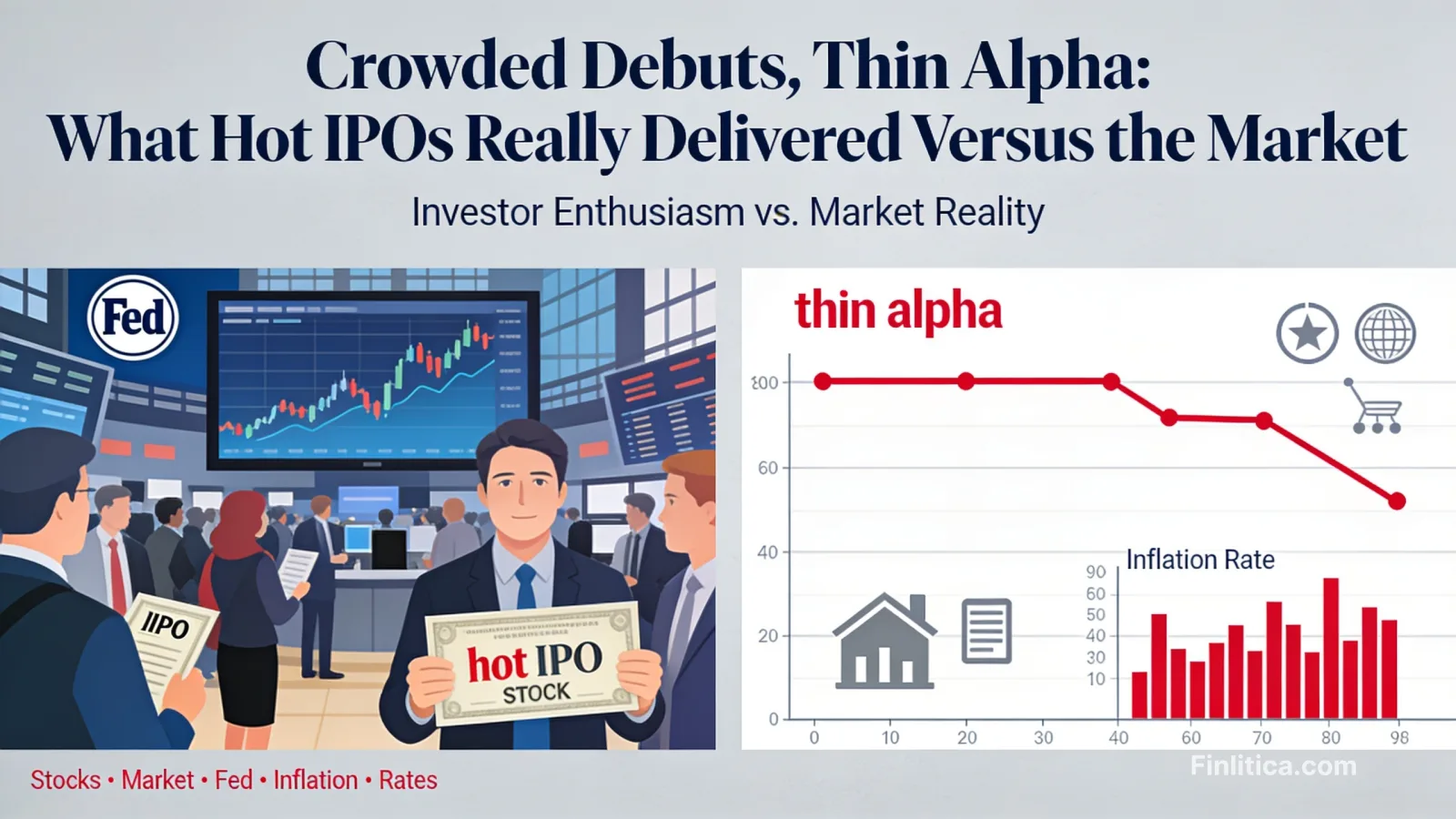
Crowded Debuts, Thin Alpha: What Hot IPOs Really Delivered Versus the Market
Investor enthusiasm around high-profile debuts has returned, but recent IPO cohorts have struggled to outperform broad equity benchmarks beyond the initial pop. Here’s what changed, why it matters for markets, and how to position across equity, credit, and ETFs.
Investor interest in high-profile listings has surged again, with attention gravitating to marquee private companies and buzzy first-day rallies. Yet a clear pattern has re-emerged in stocks: while opening-day gains can be eye-catching, relatively few recent hot IPOs have outpaced broad market indices over the following months. For investors navigating the current market shaped by rates, inflation, and earnings visibility, the lesson is familiar-most post-IPO performance has been more about fundamentals and valuation discipline than fanfare.
That disconnect matters for portfolio construction. In an economy where policy rates remain a central driver of risk appetite, the gap between first-day “pop” and long-run returns continues to test momentum strategies. With macro dispersion across sectors and cash still yielding competitively, investors are scrutinizing price-to-growth trade-offs more than at any point since the last tightening cycle.
Key takeaways
- First-day gains remain common, but sustained outperformance versus large-cap benchmarks is rare without durable growth and improving margins.
- Higher funding costs and tighter liquidity have lifted the bar for valuations and increased dispersion across new listings.
- Selective, fundamentals-first screening has outperformed blanket IPO chasing in most recent cohorts.
What changed vs prior baseline
- Cost of capital reset: Following a cumulative increase of roughly 500-525 basis points in the policy rate during the last tightening cycle, the hurdle rate for equity risk has shifted higher. This reduces tolerance for cash burn and inflates the penalty for execution misses.
- Structure and supply: Standard IPO mechanics-such as the 15% overallotment “greenshoe” and 180-day lockups-have regained importance as liquidity buffers and supply gates. The greenshoe size matters because it can stabilize day-one trading, while the lockup often triggers a secondary wave of supply six months post-listing.
- Volatility gating: Issuance has clustered in calmer windows when equity volatility is subdued (historically, the VIX below the low-20s). Higher volatility stretches price discovery and tends to widen discounts.
- Quality premium: Investors have shown a clear preference for companies with high gross margins and visible free cash flow paths, curbing indiscriminate appetite for revenue-only stories.
By the numbers
- 18% average first-day return: Long-run U.S. data show average IPO day-one gains near the high-teens percentage range. While headline-grabbing, that pop has not reliably translated into index-beating 6-12 month performance without improving operating metrics.
- 15% greenshoe: Underwriters commonly hold a 15% overallotment option. This tool is critical in early trading because it can help manage order imbalances and reduce volatility, shaping the initial price path.
- 180 days to the first unlock: Typical lockups last about six months, often creating a supply inflection when early investors and employees can sell. That calendar dynamic frequently coincides with the market’s first rigorous reassessment of valuation versus fundamentals.
Market implications
Equity investors
- Stock selection over headlines: Focus on unit economics, gross margin trajectory, and operating leverage over the next 4-6 quarters. Pay particular attention to cohort retention and sales efficiency where available.
- Mind the calendar: Monitor lockup expiries and secondary offerings, which can alter supply/demand and widen bid-ask spreads. Liquidity-aware position sizing can reduce slippage around these dates.
Credit and private market investors
- Balance sheet first: With higher rates, leverage and interest coverage covenants take center stage. Companies leaning on revolving credit or venture debt face tighter constraints, affecting growth pacing and capex.
- Exit optionality: The IPO window is selective, making trade sales or structured secondaries more relevant. For late-stage holders, valuation discipline and earnout structures can bridge expectation gaps.
ETF and allocator perspective
- IPO baskets vs core beta: IPO-focused ETFs can amplify factor tilts toward growth and momentum. Compare their drawdown profiles and turnover costs against core market ETFs before sizing exposures.
- Factor timing: In markets led by mega-cap profitability factors, broad IPO baskets may lag unless constituents show rapid margin expansion or unique moats.
Why it matters
The latest wave of attention around high-profile debuts underscores enduring appetite for new stories in markets. But with inflation still shaping rate expectations and earnings revisions driving sector rotations, investors cannot rely on the first-day narrative. A disciplined process-anchored in cash flow visibility, balance sheet resilience, and realistic growth-remains the edge.
How to analyze new listings
- Unit economics: Track gross margin, contribution margin, and payback periods for new cohorts or products.
- Path to cash generation: Assess operating leverage milestones and breakeven timelines under conservative rate assumptions.
- Supply dynamics: Map the 180-day lockup, insider ownership concentration, and potential secondary supply.
- Comparable valuation: Benchmark EV/sales or EV/EBITDA versus profitable peers adjusting for growth durability and cyclicality.
Risks and alternative scenario
- Macro downside risk: A growth slowdown or reacceleration in inflation could keep rates higher for longer, pressuring valuation multiples and delaying the IPO pipeline.
- Execution slippage: If newly public companies miss on product delivery or sales efficiency, multiple compression can more than offset top-line growth.
- Liquidity shocks: Elevated volatility or credit tightening can widen discounts, increase aftermarket overhang, and mute follow-on financing.
- Alternative upside: A benign inflation path and clearer Fed rate cuts could lower discount rates, improve risk appetite, and broaden participation beyond a handful of marquee names.
FAQ
Why do many IPOs lag the market after the debut?
Early trading often reflects scarcity and momentum. Over time, fundamentals-revenue quality, margins, and cash flow-dominate. If growth or profitability falls short of expectations set at pricing, multiples tend to compress toward sector averages.
How do rates and inflation influence IPO performance?
Higher policy rates raise discount rates and funding costs, making investors less forgiving of cash burn. When inflation uncertainty is elevated, earnings visibility carries a premium, and valuations reset toward firms with durable free cash flow.
What signals suggest a higher-quality debut?
Clear use of proceeds, improving gross margins, disciplined customer acquisition, and insider lockups aligned beyond the standard 180 days are positive indicators. Conservative pricing relative to growth and profitability can also support durable aftermarket performance.
How should I size IPO exposure in a diversified portfolio?
Consider IPOs as satellite positions. Use staged entries around earnings and lockup milestones, and balance exposure with core ETFs or seasoned holdings to manage volatility and liquidity risk.
Sources & Verification
-
View sourceInvesting.comwww.investing.com