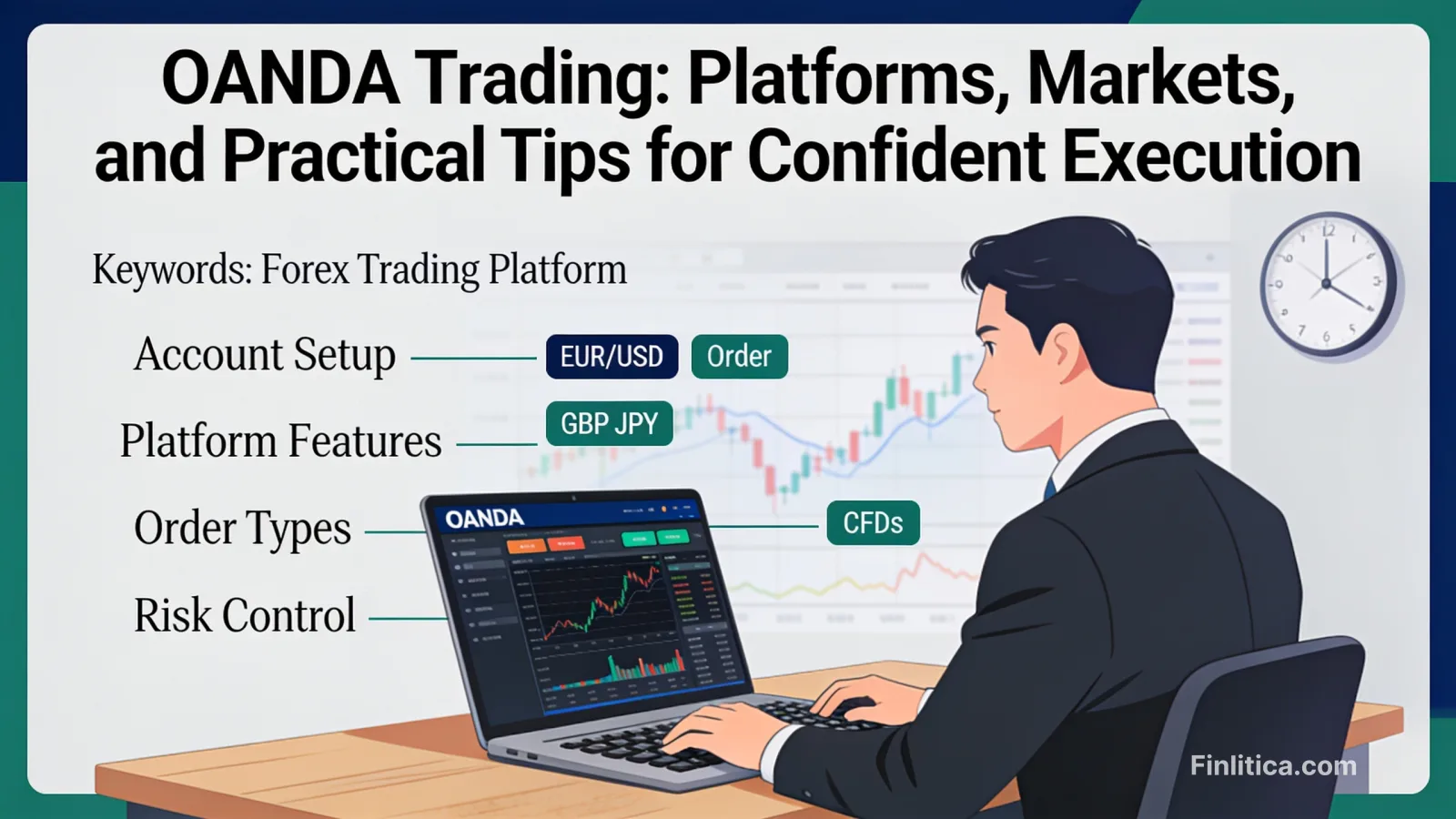
OANDA Trading: Platforms, Markets, and Practical Tips for Confident Execution
Learn how OANDA trading works, from account setup and platform features to order types, risk controls, and best practices. This guide explains instruments, analysis tools, and common pitfalls, with an FAQ to help new and experienced traders navigate the broker’s ecosystem more confidently.
Whether you are exploring your first live trade or refining an established approach, understanding the strengths and trade-offs of OANDA trading can help you operate with greater clarity. This guide explains how the broker’s platforms, order types, and analysis tools fit together, what to expect when trading common instruments, and how to apply disciplined risk controls. You will also find tips for building a workflow that matches your goals and a practical FAQ to address common questions.
What Is OANDA Trading?
At its core, OANDA trading refers to placing and managing trades through OANDA’s brokerage infrastructure and platforms. Traders use it to access major currency pairs, select indices, commodities, precious metals, and other contracts for difference (CFDs), depending on their region and account type. The experience centers on execution quality, intuitive charting, robust order controls, and a data-driven toolkit designed to support informed decision-making.
Who It’s For
- New traders seeking a straightforward platform and a demo environment to practice execution.
- Experienced traders who value flexible order types, backtesting tools, and data-rich charts.
- Systematic traders who may connect via APIs or pursue rule-based workflows.
Key Platforms and Tools
OANDA provides multiple ways to access markets, each suited to a different style and experience level. Availability may vary by region and account.
Web and Desktop Trading
- Charting and indicators: Multiple timeframes, technical overlays, oscillators, and drawing tools support both discretionary and rules-based analysis.
- One-click or confirmation-based trading: Choose faster entry or added confirmation to reduce input errors.
- Trade management panel: Modify stops and targets on-chart, monitor open positions, and view account metrics in real time.
Mobile Trading
- Portable execution: Place, modify, and close orders on the go with synchronized watchlists and chart settings.
- Notifications: Set alerts for price levels or indicator conditions to stay informed without constant screen time.
APIs and Integrations
- API access: Programmatic trading and data retrieval for testing strategies or building custom dashboards.
- Third-party tools: Many traders combine OANDA’s execution with familiar analysis platforms, depending on preference and workflow.
Tradable Instruments and Market Considerations
The instruments you can trade through OANDA vary by jurisdiction, but many traders focus on forex majors, minors, and metals, with additional exposure via indices and commodities in some regions. Each instrument type carries distinct characteristics:
Forex Pairs
- Liquidity and spreads: Major pairs often feature tighter spreads and deeper liquidity than exotics.
- Session dynamics: Volatility tends to rise during overlapping market sessions (e.g., London-New York), influencing trade timing and risk control.
Indices and Commodities (where available)
- Macro sensitivity: Economic releases, inventory reports, and geopolitical developments can drive sharp moves.
- Roll and funding: Be aware of overnight financing and contract specifications, which may differ by instrument.
Metals and Energy
- Safe-haven behavior: Metals may respond to risk sentiment, inflation expectations, and currency fluctuations.
- Event-driven volatility: Scheduled news or unexpected headlines can widen spreads and increase slippage.
Order Types and Practical Execution
Thoughtful order selection can improve consistency and reduce mistakes. OANDA trading supports order types that align with a variety of tactics, from breakout entries to mean-reversion setups.
Common Order Types
- Market orders: Immediate execution at the best available price. Useful for fast entries but subject to slippage during volatility.
- Limit orders: Specify a price to enter better than the current market. Helpful for pullback entries and defined risk-reward conditions.
- Stop orders: Trigger at a specified level to enter with momentum or exit losing positions.
- Stop-loss and take-profit: Core risk tools to cap downside and systematically realize gains.
- Trailing stops: Adjust dynamically as price moves in your favor, helping lock in gains while allowing room for trends to develop.
Execution Tips
- Pre-define risk per trade: Decide your maximum loss before entry, then set position size and stop accordingly.
- Use alerts: Price and indicator alerts can reduce screen fatigue and prompt timely decisions.
- Avoid over-leveraging: Larger position sizes amplify both gains and losses and can lead to inconsistent outcomes.
Analysis: Technical, Fundamental, and Sentiment
Successful traders often combine multiple lenses-technical structure, macro drivers, and market psychology-to form a more complete view.
Technical Analysis
- Trend and structure: Identify higher highs/lows for uptrends and lower highs/lows for downtrends to guide bias.
- Support and resistance: Use historical levels, moving averages, or Fibonacci zones as potential decision areas.
- Momentum: Oscillators can help spot divergences or overextended conditions.
Fundamental Context
- Economic indicators: Employment, inflation, and growth data can affect currency and index pricing.
- Monetary policy: Central bank statements and rate decisions often spark volatility.
- Event planning: Consider reducing size or adjusting stops around high-impact releases.
Sentiment and Positioning
- Risk appetite: Equities, credit spreads, and volatility indexes may hint at broader risk-on or risk-off dynamics.
- Crowding risk: One-sided positions can see abrupt reversals; consider scenario planning.
Risk Management Essentials
Risk controls are non-negotiable in any trading plan. The aim is to stay solvent long enough for a valid edge to play out across many trades.
Position Sizing
- Percent risk model: Allocate a consistent fraction of account equity per trade (for example, a small, pre-defined percentage) to stabilize drawdowns.
- Volatility-adjusted sizing: Wider stops for more volatile instruments, smaller stops for quieter markets, while keeping monetary risk constant.
Stop Placement
- Structure-based stops: Place beyond logical invalidation points (e.g., beyond key swing highs/lows) rather than arbitrary pip counts.
- Gap and slippage awareness: Around major events, consider additional buffer or reduced size.
Portfolio-Level Controls
- Instrument correlation: Limit concurrent exposure to highly correlated pairs or assets.
- Daily loss limits: Pause trading after a predefined loss to maintain discipline.
Building a Sustainable Workflow
A repeatable process helps you focus on high-quality setups and consistent execution. OANDA trading tools can slot into a simple, reliable routine.
Pre-Market Routine
- Calendar check: Note scheduled events and plan exposure accordingly.
- Top-down scan: Start with higher timeframes for trend context; refine entries on lower timeframes.
- Watchlist curation: Select a few clean charts that align with your criteria to avoid overtrading.
During Market Hours
- Plan the trade, trade the plan: Stick to your rules for entry, stop, and target.
- Log decisions: Record rationale, screenshots, and outcomes for future review.
- Risk-first adjustments: If conditions change, modify size or exit based on risk parameters, not emotion.
Post-Session Review
- Metrics tracking: Monitor win rate, average reward-to-risk, and expectancy over enough trades to be statistically meaningful.
- Playbook updates: Promote high-probability patterns and retire underperforming ones.
Demo Accounts and Strategy Testing
A demo environment can help you gain platform familiarity, test order types, and refine execution without risking capital. Treat practice seriously by simulating real position sizing, stop placement, and trade logging. While results may differ from live trading due to slippage and psychology, a disciplined demo process can shorten your learning curve.
Costs, Funding, and Practical Considerations
Trading involves costs that can affect net results. These include spreads, potential commissions where applicable, overnight financing for leveraged positions held past the trading day, and possible currency conversion charges. Review account documentation to understand how these charges apply to your instruments and region. It’s also helpful to verify deposit and withdrawal options, processing times, and any applicable account requirements before you begin.
Common Mistakes to Avoid
- Ignoring risk parameters: Entering without a stop or with inconsistent sizing can magnify drawdowns.
- Chasing volatility: Trading impulsively during news spikes can lead to slippage and poor fills.
- Overfitting strategies: Systems tuned too tightly to past data may underperform in live markets.
- Neglecting review: Without a journal and metrics, it’s hard to pinpoint what works.
Putting It All Together
Effective OANDA trading blends sound analysis with robust risk management and a clear routine. Your platform setup, watchlists, and order preferences should reflect your goals and schedule. Over time, consistent process plus measured iteration usually outperforms complexity. Focus on quality setups, protect your downside, and let well-defined plans guide your decisions.
FAQs
What markets can I access with OANDA?
Availability varies by region and account type. Many traders access forex majors and minors, metals, indices, and select commodities. Check your account’s instrument list to confirm what’s offered in your jurisdiction.
How does a demo account help?
Demo trading lets you practice execution, test order types, and become comfortable with platform tools. Treat it like live trading-use realistic sizing and log decisions-to build habits that transfer to real markets.
What order type should I use?
It depends on your strategy. Market orders work for immediate entries, while limit orders are helpful for pullbacks and defined pricing. Stops and trailing stops provide structure for exits and risk control.
Is there a best time of day to trade?
For forex, liquidity and volatility often increase when major sessions overlap, such as London and New York. The “best” time depends on your strategy; some approaches perform better in trending conditions, others in quieter ranges.
How do I manage risk consistently?
Define a fixed risk per trade, place stops at logical invalidation levels, and avoid overexposing yourself to correlated instruments. Consider daily loss limits to maintain discipline.
Why can slippage occur?
In fast-moving or illiquid markets, prices can move between the time you submit an order and when it executes. Using limit orders for entries and planning around major events can help reduce unwanted slippage.
How should I evaluate performance?
Track win rate, average reward-to-risk, maximum drawdown, and expectancy over a statistically meaningful number of trades. Use a journal to connect outcomes with behaviors and market conditions.
Conclusion
OANDA trading offers a practical toolkit for accessing global markets, from forex pairs to other instruments available in your region. To get the most from it, ground your process in clear rules, consistent risk controls, and objective review. Over time, a disciplined, data-informed approach can improve decision quality and help you navigate markets with greater confidence.