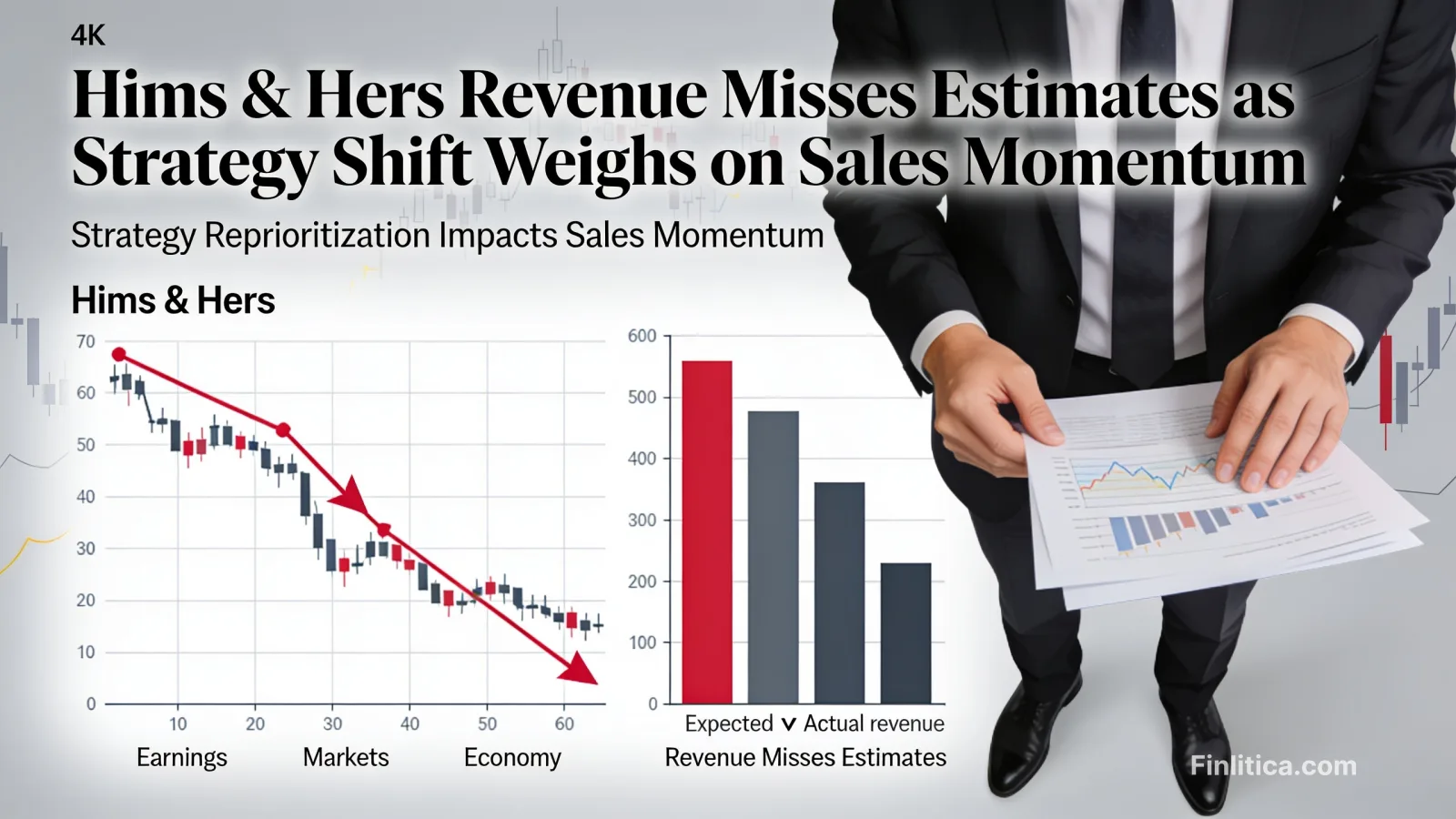
Hims & Hers revenue misses estimates as strategy shift weighs on sales momentum
Hims & Hers reported revenue below Wall Street expectations after reprioritizing growth initiatives, prompting investors to reassess the telehealth company’s near‑term trajectory and unit economics.
Hims & Hers Health reported quarterly revenue that fell short of analyst expectations, a miss the company attributed to an ongoing strategy shift meant to sharpen unit economics and reposition growth channels. The result places renewed attention on how fast the direct-to-consumer telehealth operator can convert marketing spend into recurring subscriptions without sacrificing margins, a key focus for stocks in the digital health category amid a choppy market backdrop.
The earnings update matters for investors tracking consumer-health platforms and the broader market because it tests whether demand for online care can sustain post-pandemic normalization while the Fed, inflation and rates continue to influence risk appetite. For context, Hims & Hers was founded in 2017 and went public in 2021, leaving it with a relatively short public operating history-an important consideration when evaluating variability in growth and cash generation.
What changed vs prior baseline
- Rebalanced acquisition vs. retention: Management emphasized reallocating spend from top-of-funnel growth to improving customer retention and average order value, a departure from the prior growth-at-all-costs approach.
- Product mix shift: The company leaned further into subscription services and clinically guided treatments, which typically run on 30-day refill cycles-timing that can defer recognized revenue near term while strengthening lifetime value.
- Sales channel recalibration: Paid media and partnerships were optimized for efficiency, reducing immediate conversions compared with earlier, broader campaigns but aiming for lower cost per acquisition.
- Operational discipline: A tighter focus on contribution margins suggests near-term revenue trade-offs to protect profitability metrics, including shipping, fulfillment, and clinician-network utilization.
Performance snapshot
Hims & Hers operates nationwide through an affiliated provider network that offers virtual consultations and prescription fulfillment across all 50 U.S. states. This footprint is central to scaling, as it supports uniform product launches and consistent member experience. The company’s public listing in 2021 means investors have roughly 3–4 years of comparable disclosure to gauge seasonality and marketing returns, which helps contextualize this revenue shortfall against earlier hyper-growth phases.
Founded in 2017, the business has evolved from a narrow direct-to-consumer offering to a broader health platform spanning men’s and women’s care, dermatology and mental health. The 30-day subscription cadence, while helpful for engagement and forecasting, can make revenue more sensitive to short-term changes in acquisition pace and renewal behavior-factors that often surface immediately after strategy pivots.
Market implications
- Equity investors: Revenue below estimates typically pressures valuation multiples for growth stocks, especially where expectations embed sustained top-line acceleration. A greater emphasis on retention and margin could support earnings quality, but near-term multiples may compress until the growth-optimization trade-off proves out in subsequent quarters.
- Credit and converts: For lenders and convertible noteholders, slower growth may be acceptable if accompanied by improving cash burn and contribution margins. Evidence of disciplined working capital-particularly inventory and fulfillment timing tied to 30-day cycles-would be supportive for credit quality.
- ETF and sector allocation: Healthcare and thematic ETFs exposed to digital health may see modest rebalancing if revenue volatility persists. Managers focused on profitability screens could rotate toward names with clearer near-term cash flow visibility.
Why it matters
Telehealth adoption remains structurally higher than pre-pandemic levels, but investors are scrutinizing unit economics more closely as markets adjust to sustained rate uncertainty. How Hims & Hers executes through this strategy shift will inform sentiment toward direct-to-consumer healthcare models that rely on subscription retention and efficient digital marketing.
Risks and alternative scenario
- Execution risk: Changes to acquisition channels and product mix may depress conversions longer than expected, extending the revenue shortfall.
- Churn sensitivity: If renewals soften, the 30-day subscription structure can amplify revenue variability, pressuring marketing efficiency and lifetime value.
- Regulatory landscape: Adjustments in telehealth prescribing rules or pharmacy fulfillment standards could raise compliance costs and slow onboarding.
- Competitive response: Aggressive pricing or promotions from rivals could force higher acquisition spend to defend share, delaying margin improvements.
- Macro drag: Weaker consumer demand or tighter financing conditions could dampen discretionary health spending and elevate required returns for growth equities.
What to watch next
- Conversion and retention metrics across core categories to validate the shift toward higher-quality growth.
- Contribution margin and marketing efficiency trends as indicators of sustainable unit economics.
- Guidance updates on revenue and operating leverage as the company cycles past the initial impact of the strategy reset.
FAQ
What is Hims & Hers changing in its strategy?
The company is prioritizing customer retention, contribution margins and product mix quality over maximum near-term acquisition. That includes optimizing paid media, emphasizing recurring treatments, and tightening operational costs.
Why did revenue miss estimates?
Management pointed to the near-term impact of reallocating growth spend and shifting the mix toward subscription services. These changes can defer revenue recognition and reduce immediate conversions while aiming to improve lifetime value.
How broad is Hims & Hers’ U.S. coverage?
Hims & Hers operates through an affiliated provider network that services all 50 states, enabling consistent nationwide access and supporting scale for new product launches.
What timeline should investors consider?
Given its 2017 founding and 2021 public listing, the company has a relatively short public history. Investors will likely watch the next two to three quarters for evidence that retention, margins and growth can improve in tandem.
Sources & Verification
-
View sourceInvesting.comwww.investing.com