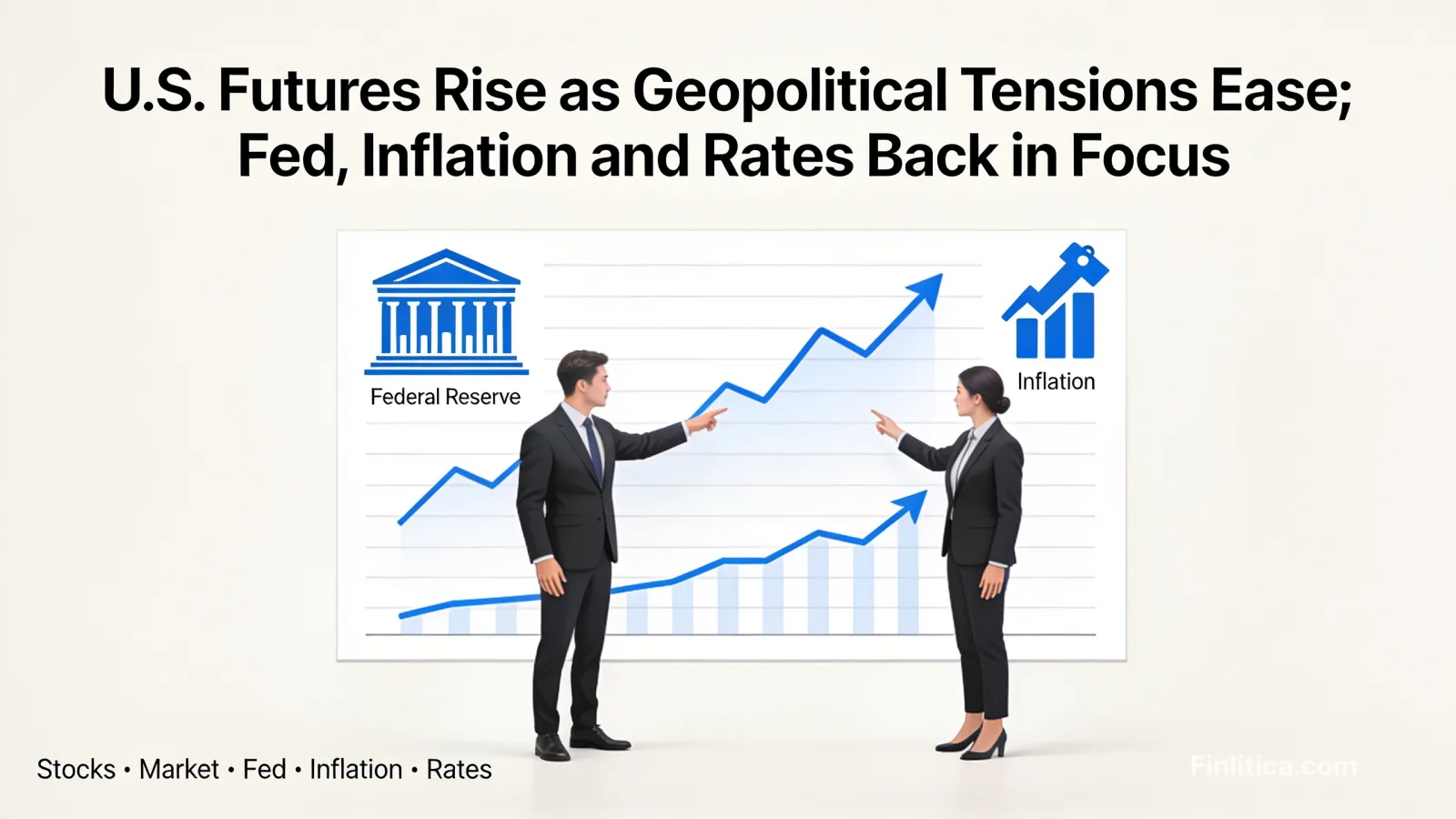
U.S. Futures Rise as Geopolitical Tensions Ease; Fed, Inflation and Rates Back in Focus
U.S. equity futures advanced as signs of cooling U.S.-Iran tensions tempered risk aversion and turned attention back to the Fed’s policy path, inflation data, and upcoming earnings.
U.S. stock futures advanced in early trade as easing tensions between the United States and Iran lowered the immediate geopolitical risk premium, shifting investor attention back to the Federal Reserve, inflation trends, and interest rates. The move comes at the start of a data-heavy stretch that could reset expectations for how long policy stays restrictive and how markets price growth versus safety.
With the broader market recalibrating, traders are watching how any de-escalation overseas affects oil and energy supply assumptions, while repricing risk across equities, credit, and crypto. The focus now pivots to whether the Fed’s next steps and incoming inflation readings can support a firmer backdrop for stocks without reigniting price pressures.
What changed vs prior baseline
- Reduced near-term geopolitical risk: Signs of a U.S.-Iran thaw have eased immediate tail risks that previously supported a higher risk premium across energy and defense-sensitive assets.
- Refocus on policy and data: Attention shifts to the Fed’s reaction function ahead of upcoming inflation prints and labor indicators, after weeks where geopolitics dominated price action.
- Positioning reset: Investor positioning appears to be rotating from defensive to cyclical exposures, with sensitivity to commodities and rates volatility likely to moderate if tensions remain contained.
- Cross-asset breadth: Improved futures tone is broadening to rate-sensitive tech, cyclicals, and some credit segments, signaling a tentative risk-on tilt pending confirmation from data.
Market snapshot and key numbers
Three structural figures help frame today’s moves and why they matter for markets:
- 2% inflation goal: The Fed’s long-run inflation target is 2%. Whether realized inflation is converging toward that level will heavily influence the path of policy rates, equity valuations, and the cost of credit.
- 8 scheduled FOMC meetings per year: With eight regular policy meetings annually, guidance and projections are updated frequently enough to reset market pricing, but not so often as to remove interim data risks. Each meeting can reprice rates, equity multiples, and ETF flows.
- 11 S&P 500 sectors: Cross-sector leadership matters as breadth improves or narrows. A shift from defensives to cyclicals across the 11 sectors can signal improving growth sentiment and drive factor rotation in quant and ETF strategies.
Market implications
Equity and ETF investors
- Lower geopolitical risk could support multiples for cyclicals and growth, particularly if oil volatility eases. ETF flows may tilt back toward broad beta and sector funds tied to consumer, industrials, and technology.
- Earnings sensitivity rises as policy uncertainty recedes. With roughly 252 trading days in a typical year, the cadence of preannouncements and quarterly results remains a primary driver of day-to-day dispersion and factor performance.
Rates and credit investors
- De-escalation reduces demand for havens, potentially steepening curves if growth expectations firm while front-end rates remain data-dependent. For investment-grade and high-yield credit, tighter spreads are possible if energy input risk diminishes.
- Term premium and inflation expectations bear watching; even modest changes around inflation’s glide path toward 2% can move longer maturities and total-return outcomes for duration-heavy portfolios.
Commodities and crypto
- Oil’s geopolitical premium may compress if supply risks abate, easing headline inflation pressure. That, in turn, can influence rate expectations and risk appetite.
- Crypto often trades as a high-beta risk proxy. A calmer macro backdrop with clearer policy signaling can support liquidity and reduce cross-asset volatility spikes.
Why it matters
Markets have been toggling between geopolitical headlines and macro fundamentals. A reduction in immediate conflict risk allows investors to reweight traditional drivers-growth, inflation, and rates-into models and allocations. That shift improves visibility for corporate planning, supports tighter credit spreads, and can reduce volatility across equity and ETF exposures if confirmed by data.
What to watch next
- Inflation prints versus the 2% goal: Progress toward target could re-open the path for rate cuts; sticky readings would keep policy restrictive.
- Fed communications across its 8-meeting calendar: Summary of Economic Projections, released 4 times per year, will be central to rate-path expectations and earnings multiples.
- Energy price trajectory: A sustained pullback lowers input costs for transportation and manufacturing, while renewed spikes would quickly reprice rates and equities.
Risks and alternative scenario
- Geopolitical reversal: Any breakdown in U.S.-Iran progress could quickly restore risk premia in oil, pressure cyclicals, and push investors back into cash and Treasuries.
- Sticky inflation: If inflation stalls above 2%, the Fed may keep policy tighter for longer, weighing on rate-sensitive tech and small caps while widening credit spreads.
- Growth disappointment: Weaker earnings or softer labor data could undercut the risk-on tone, boosting volatility and favoring defensives and quality factors.
- Policy miscommunication: Unexpected shifts in guidance between FOMC meetings could jolt rates and whipsaw cross-asset positioning.
FAQ
How do easing geopolitical tensions affect stocks?
Lower perceived conflict risk can reduce the discount rate investors apply to future earnings, supporting higher equity valuations, especially in cyclical and growth sectors.
What does the Fed watch most closely right now?
Progress toward its 2% inflation objective and labor-market balance. These inputs shape the policy rate path and influence financing conditions across the economy.
Why do oil prices matter for the broader market?
Energy costs feed into headline inflation and corporate margins. A stable or lower oil price can relieve pressure on rates and support consumer and industrial demand.
How might ETFs respond to a risk-on shift?
Flows often rotate toward broad market and cyclical sector ETFs, while minimum-volatility and defensive funds may see outflows if volatility subsides.
What should credit investors monitor?
Inflation expectations and growth momentum. They drive spread direction and total returns, particularly for longer-duration and lower-quality bonds.
Sources & Verification
-
View sourceInvesting.comwww.investing.com