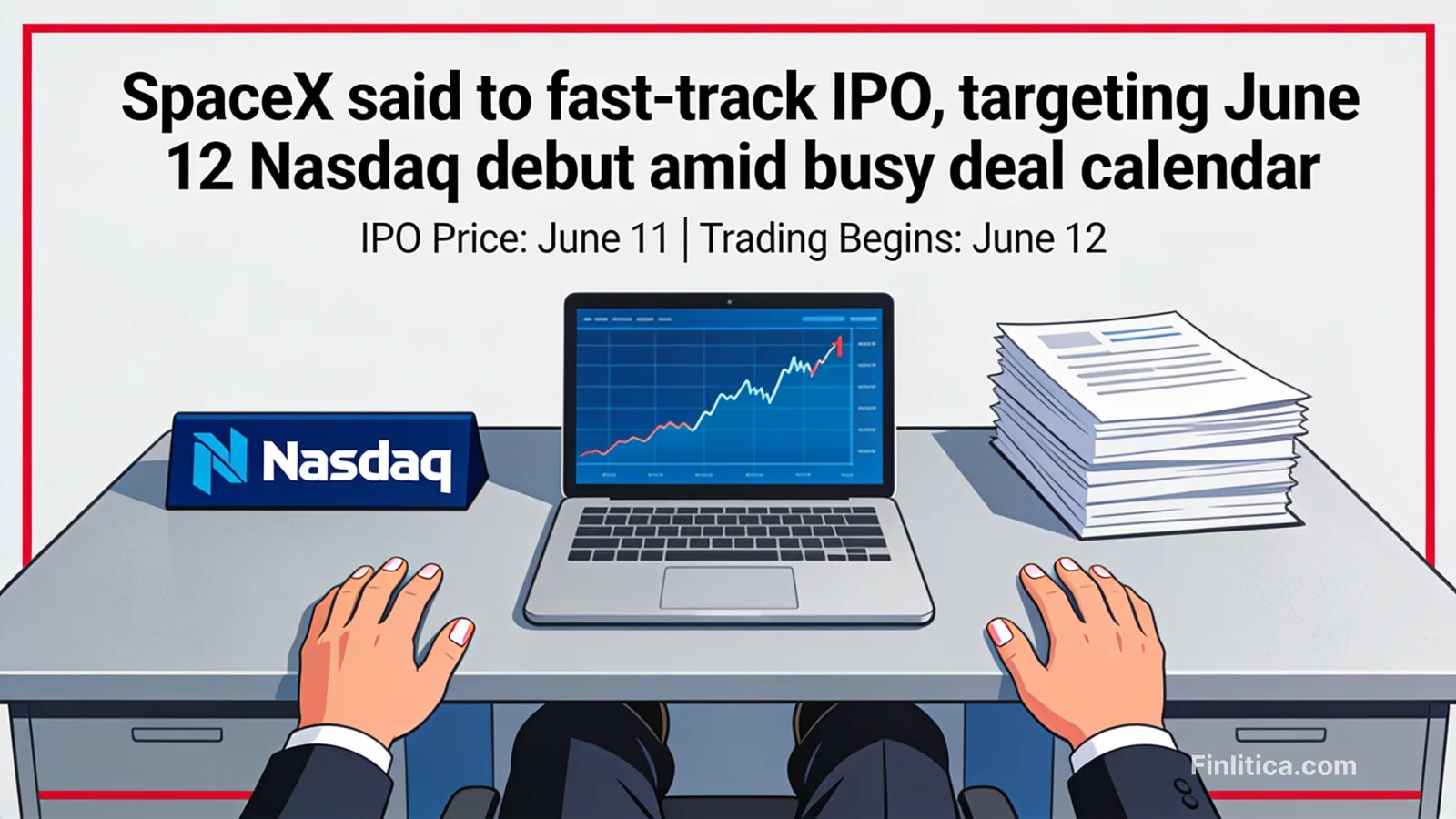
SpaceX said to fast‑track IPO, targeting June 12 Nasdaq debut amid busy deal calendar
People familiar with the matter say SpaceX is aiming to price an IPO on June 11 and begin trading on Nasdaq June 12, accelerating its timeline. The high-profile listing would test investor appetite for large tech and space names in today’s rates- and inflation-sensitive markets.
SpaceX is accelerating preparations for an initial public offering, with people familiar with the matter indicating the company is targeting June 11 for pricing and a June 12 debut on the Nasdaq. If the timeline holds, the offering would land during a period when stocks have been sensitive to interest rates and inflation data, providing a fresh read on how public markets are valuing fast-growing, capital-intensive businesses.
The closely held rocket and satellite operator has been one of the most valuable private companies in the world. Recent secondary transactions have reportedly implied a valuation near $210 billion, a figure that would place any IPO among the most closely watched equity events of 2024. While deal terms were not finalized at the time of reporting, the move to an earlier listing window suggests bookbuilding and regulatory preparations are well advanced.
Key details now in focus
- Target dates: June 11 (pricing) and June 12 (first day of trading) are the near-term markers cited by people familiar with the process. These dates matter because they position the deal just ahead of a cluster of June macro events that often move markets.
- Venue: Nasdaq is the intended listing exchange, aligning SpaceX with a peer group of high-growth technology and communications companies. Exchange selection can influence index eligibility and ETF inclusion.
- Implied scale: Private-market dealings around $210 billion provide a reference point for potential valuation conversations. That benchmark will shape allocation decisions for both active managers and index-linked vehicles.
SpaceX’s business spans launch services and its Starlink satellite broadband network. The company executed a rapid operational cadence in recent years, including dozens of orbital missions in 2023, a metric investors often watch as a proxy for revenue visibility and cost efficiency. Starlink’s global footprint has expanded quickly, broadening the mix of recurring revenue versus project-based launch income.
What changed vs prior baseline
- Pulled-forward timeline: The targeted June 12 listing date represents an acceleration versus earlier expectations that the IPO could arrive later in the summer, tightening execution windows for buy-side diligence.
- Clearer deal staging: A June 11 pricing target signals that underwriters are confident they can build a book within days, rather than weeks, reflecting strong early indications of interest.
- Exchange confirmation: The choice of Nasdaq, versus alternatives, narrows index and ETF pathways, affecting post-IPO demand dynamics.
- More defined valuation anchor: Reports of roughly $210 billion in recent private trades give investors a concrete starting point for scenario analysis on revenue multiples and free cash flow timelines.
Why it matters
A successful SpaceX IPO could reset risk appetite for large-cap growth listings, influence sector allocations across aerospace and communications, and provide a fresh benchmark for late-stage private valuations. It would also test how public investors weigh long-duration cash flows against a backdrop of elevated policy rates.
Market implications
Equity investors
- Active managers: A high-profile debut may prompt portfolio rebalancing within technology, communications services, and industrials, especially for funds underweight space-economy exposure.
- Index and ETF investors: Nasdaq listing raises the potential for inclusion in IPO-focused and growth-factor ETFs after standard seasoning periods, impacting secondary liquidity and volatility.
Credit and private markets
- Credit investors: An equity raise can strengthen the balance sheet and lower leverage metrics, which, if realized, could compress financing costs for future capex cycles.
- Private-market holders: An IPO provides a price discovery event and potential liquidity pathway for long-standing shareholders, affecting secondary market discounts and fundraising terms for space-sector peers.
How the numbers frame the debate
- June 11 pricing and June 12 trading: A 24-hour gap between pricing and debut is standard in U.S. markets and underscores the tight execution window underwriters are working to meet.
- ~$210 billion private valuation: This benchmark will guide discussions on revenue multiples for launch and broadband segments; a 10% swing at this scale implies roughly $21 billion in market cap change, material for both single-name and thematic allocations.
- 180-day lock-up norm: While deal-specific terms were not disclosed, IPOs typically carry around a 180-day lock-up for insiders. That timeline matters for supply overhang analysis and post-listing technicals.
Risks and alternative scenario
- Regulatory timing: The offering requires effective SEC registration; any feedback cycle could delay the schedule beyond mid-June.
- Market volatility: Macro prints on inflation, employment, or Fed policy could widen risk premia, forcing pricing concessions or a postponement.
- Valuation sensitivity: Higher discount rates and shifting growth assumptions may pressure multiples relative to recent private transactions.
- Structural alternatives: The company could opt for a partial listing, a unit spin-off, or additional private financing if market conditions deteriorate.
- Execution risk: Large-scale retail and institutional demand coordination, stabilization capacity, and early trading dynamics could drive elevated first-week volatility.
What to watch next
- Filing cadence: Any updates to offering documents, including financials and segment disclosures, will refine valuation ranges and peer comps.
- Order book color: Indications of interest, coverage levels, and price talk will signal how much of the private valuation is transferable to public markets.
- Index and ETF timelines: Post-IPO eligibility windows can influence secondary flows and realized volatility.
FAQ
When would SpaceX go public?
People familiar with the matter indicate a June 11 pricing and June 12 Nasdaq listing are the current targets, subject to market and regulatory conditions.
What valuation is being discussed?
Recent private-market transactions reportedly imply around $210 billion. The IPO price range will ultimately reflect updated financials, demand, and market conditions.
Which exchange is expected?
Nasdaq is the planned venue, aligning the company with growth- and technology-oriented peers and index frameworks.
Will all of SpaceX list or just a part?
Deal structure was not finalized at the time of reporting. Large tech listings often float a minority stake initially, with standard lock-up periods for existing holders.
What could delay the IPO?
Volatile markets, regulatory feedback, or shifts in the interest-rate outlook could push the timeline, alter sizing, or change pricing.
Sources & Verification
-
View sourceInvesting.comwww.investing.com