Fed issues enforcement action involving former Commerce Bank employee
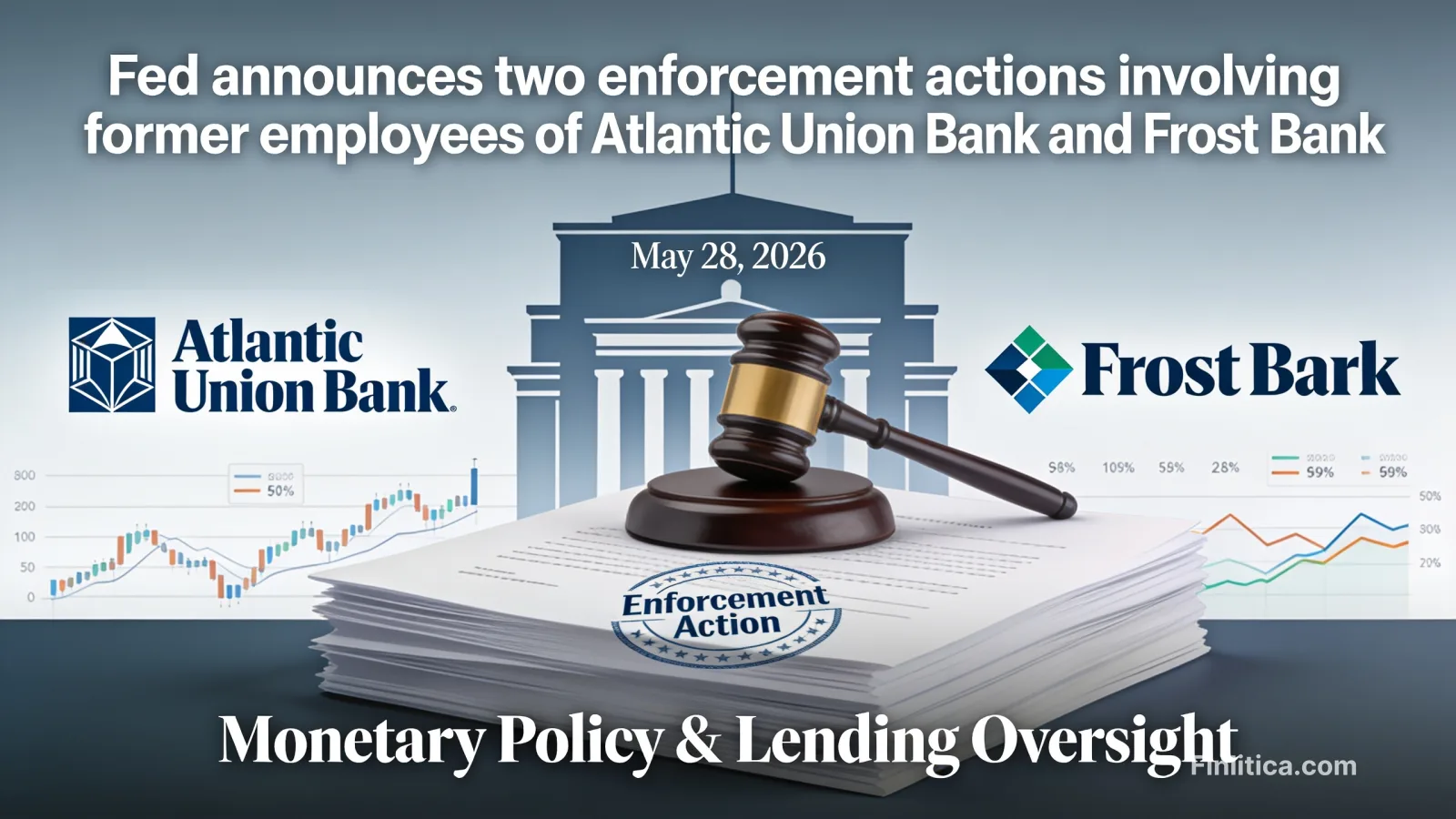
The Federal Reserve announced an enforcement action concerning a former Commerce Bank employee, underscoring the central bank’s supervisory stance on individual accountability. The order, dated May 21, 2026, highlights legal authorities used in such cases and signals continued scrutiny of conduct risk across U.S. banks.
The Federal Reserve announced an enforcement action involving a former employee of Commerce Bank, reinforcing the central bank’s focus on individual accountability in the banking system. The action, made public on May 21, 2026, is part of the Fed’s broader mandate to safeguard the safety and soundness of supervised institutions and uphold market integrity as monetary policy and bank lending conditions continue to evolve.
The case centers on alleged misconduct tied to the individual’s prior role at the bank. While enforcement details vary case by case, such actions typically rely on the Federal Reserve’s authority under banking law to restrict or prohibit future participation in the industry when warranted. For investors tracking the Fed, banks, and financial markets, the development offers another data point on supervisory priorities at a time when rates, credit quality, and compliance costs are closely watched.
What changed vs prior baseline
- Formal action against an individual: The Fed’s step elevates conduct oversight from institution-level remediation to person-specific accountability, a shift that can sharpen internal controls and deterrence within banks.
- Legal basis emphasized: Actions of this type commonly draw on 12 U.S.C. 1818, the enforcement framework that enables prohibition orders and other remedies. Citing this authority clarifies the scope of potential restrictions on future banking employment.
- Timing amid tighter credit conditions: Announced in 2026, the action lands when lending standards are tighter than in prior cycles, linking conduct oversight to broader risk management as banks balance credit growth with capital and compliance demands.
- Signal to control functions: The move underscores the necessity of robust first- and second-line controls, encouraging banks to strengthen surveillance, case management, and documentation practices relative to earlier baselines.
Key facts and context
- Date of action: May 21, 2026. Why it matters: The timing provides context for ongoing supervisory themes as banks manage through a late-cycle credit environment and heightened regulatory attention to operational risk.
- Statutory framework: The Fed’s enforcement toolkit is rooted in 12 U.S.C. 1818, which allows for prohibition orders and civil remedies. Why it matters: The statute outlines when and how individuals can be restricted from participating in banking without prior regulatory approval.
- System-wide remit: The Federal Reserve System, created in 1913 and comprising 12 Reserve Banks, supervises bank holding companies and certain state-chartered banks. Why it matters: The nationwide supervisory footprint supports consistent application of conduct standards across institutions and geographies.
Why it matters
Individual-focused enforcement actions can reduce misconduct risk and strengthen customer protection, which ultimately benefits bank safety, earnings quality, and market confidence. For equity and credit investors, clarity on supervisory priorities helps gauge compliance spend, litigation exposure, and potential constraints on growth strategies.
Market implications
Equities and sector allocation
- Bank stocks: Enhanced conduct enforcement can lift long-run quality-of-earnings perceptions but may pressure near-term expenses as banks invest in controls and remediation. Investors may differentiate among banks with stronger risk cultures and lower operational loss histories.
- Financials vs. broader markets: If enforcement intensity rises, it could nudge cost-to-income ratios higher across parts of the sector. That may favor higher-quality franchises with diversified fee income and disciplined lending, while raising the hurdle rate for turnaround stories.
Credit and funding markets
- Credit spreads: Clear supervisory action generally supports creditor confidence by addressing conduct risk early. However, issuers with recurring control gaps could face modest spread widening or tighter covenants in subsequent debt placements.
- Structured products and ETFs: Funds with concentrated exposure to regional banks may see incremental dispersion, with flows favoring issuers demonstrating strong compliance track records and stable deposit franchises.
What to watch next
- Follow-on supervisory steps: Institutions often respond with strengthened policies, training, and monitoring. Disclosures in upcoming quarterly reports may reference compliance investments or operational risk updates.
- Peer actions: Additional person-specific orders across the industry would indicate a broader enforcement cadence, shaping how banks prioritize surveillance and disciplinary frameworks.
- Intersect with rates and lending: As rate paths influence net interest margins and credit appetite, effective conduct controls remain essential to managing underwriting standards and reputational risk.
Risks and alternative scenario
- Limited disclosure risk: If details of the action remain narrow, markets may over- or under-estimate the severity, creating headline-driven volatility without fundamental change.
- Compliance cost creep: Banks might face rising operating expenses from enhanced monitoring and remediation, compressing margins if revenue growth softens.
- Legal and reputational overhang: Prolonged investigations or parallel actions by other agencies could extend uncertainty, affecting funding costs or customer acquisition.
- Benign resolution scenario: If subsequent reviews find limited systemic issues, the impact could be contained to the individual case, with minimal implications for bank earnings or sector multiples.
How this fits into the Fed’s supervisory role
The Federal Reserve’s enforcement work complements its monetary policy mandate by bolstering confidence in the financial system. By holding individuals to account, the Fed aims to deter misconduct that can impair asset quality, distort lending practices, or undermine public trust-factors that ultimately influence banks’ capacity to support the economy.
FAQ
What is an enforcement action?
An enforcement action is a formal supervisory response to suspected violations of law, unsafe or unsound practices, or breaches of fiduciary duty. Remedies can include prohibition orders that restrict future participation in banking without regulatory approval, and, in some cases, civil money penalties.
Does this action affect Commerce Bank’s daily operations?
The action is directed at a former employee. Unless specified otherwise by regulators or the bank, customer services and core operations typically continue uninterrupted.
How does this relate to interest rates and markets?
While separate from rate-setting, credible supervision supports confidence in banks that transmit monetary policy through lending. Stable governance and controls help sustain credit availability, which matters for markets, stocks, and the broader economy.
What should investors monitor?
Watch for banks’ disclosures on compliance investments, operational risk metrics, and any commentary on regulatory interactions during earnings updates. These signals can inform views on profitability, capital allocation, and sector positioning.
Sources & Verification
-
View sourceFederal Reservewww.federalreserve.gov