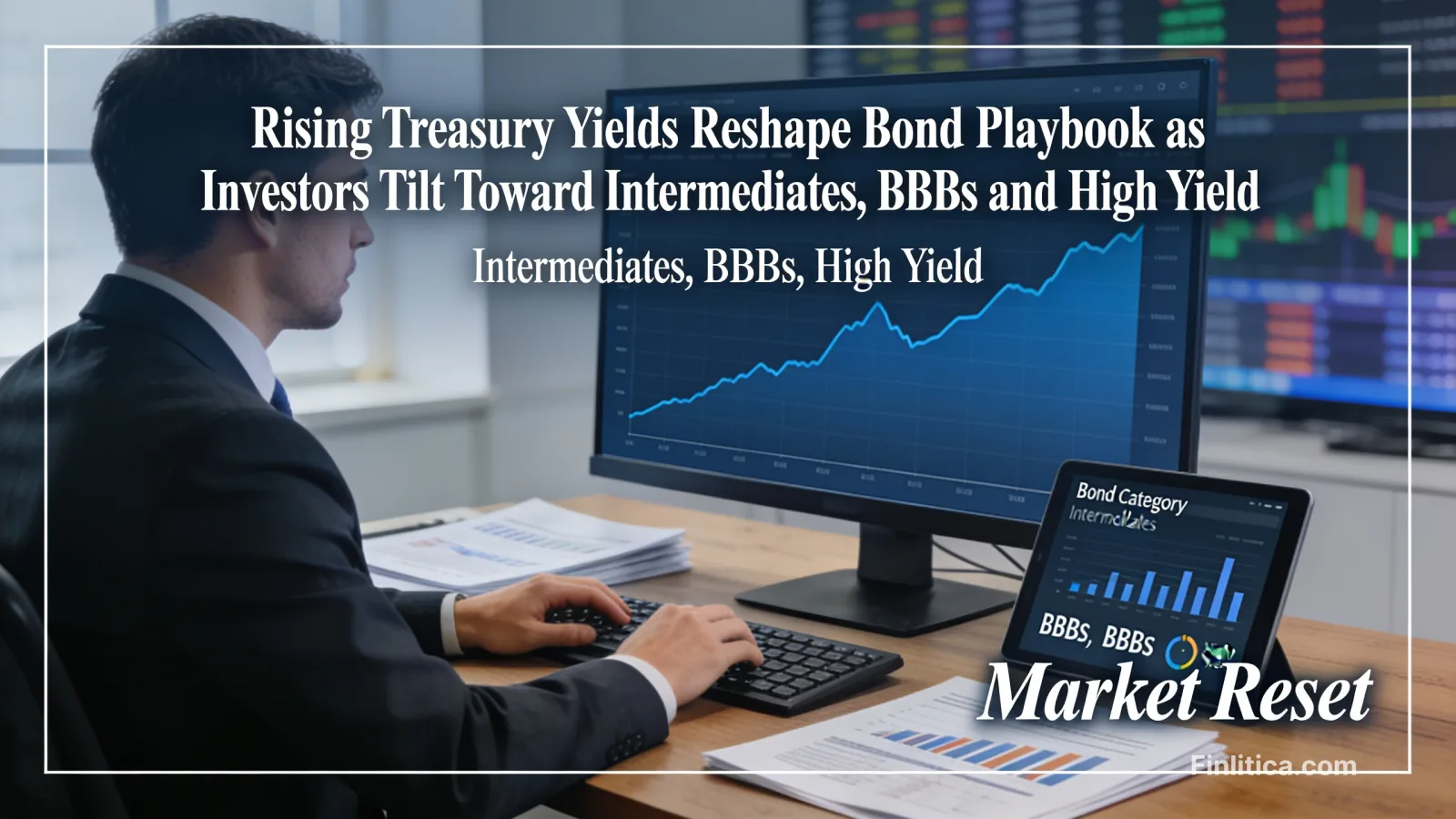
Rising Treasury Yields Reshape Bond Playbook as Investors Tilt Toward Intermediates, BBBs and High Yield
A jump in Treasury yields is forcing a reset across fixed income. Investors are rotating toward intermediate maturities, BBB-rated corporates and selective high yield to balance income, duration risk and credit exposure.
U.S. Treasury yields have climbed, challenging the notion that government debt is a "risk-free" corner of the market and prompting investors to reassess fixed-income positioning. The move is rippling through markets and portfolios as investors weigh inflation, interest-rate paths and income opportunities, with particular attention to intermediate maturities, BBB-rated corporates and segments of high yield. For market participants balancing stocks, bonds and ETFs, the latest swing in rates has revived questions about where to find durable income without taking on outsized risk.
The resurgence in yields matters for the broader economy and earnings cycle because it resets borrowing costs, raises discount rates used to value cash flows, and can crowd out risk-taking in equities and crypto at the margin. While the Treasury curve still anchors global pricing, elevated coupons and wider credit spreads have opened windows for active bond investors to improve carry and reinvest at better levels.
What changed vs prior baseline
- Higher starting yields: Coupons available on new Treasuries and corporates are materially above the lows of recent years, increasing the income component of total return and improving breakevens if rates move again.
- Repricing of duration risk: With yields shifting quickly, the interest-rate sensitivity of portfolios has come back into focus. A 1 percentage point (100 basis point) change in yields typically shifts a bond’s price by roughly its duration in percent, making intermediate maturities comparatively more resilient than long bonds.
- Credit dispersion: As Treasury yields moved up, credit spreads in BBBs and parts of high yield have offered additional compensation for risk, creating more pronounced differences across issuers and sectors.
- Reinvestment optionality: Higher coupons and maturing cash flows can now be redeployed at better rates, improving long-run return potential versus the prior low-yield baseline.
Where investors are looking now
Intermediate Treasuries and corporates
Intermediate maturities - commonly 3 to 7 years - strike a balance between yield pickup and rate sensitivity. This segment offers more income than short bills while avoiding the elevated duration risk of 20- to 30-year bonds, where price swings can be pronounced when policy expectations shift.
BBB-rated investment grade
BBB-rated corporates, the lowest tier of investment grade, provide additional spread over higher-rated peers with manageable default risk under typical economic conditions. In major U.S. indices, BBBs account for roughly half of the investment-grade market, which enhances liquidity and issuer selection. For diversified portfolios, this bucket can meaningfully increase portfolio yield without jumping fully into high yield.
Selective high yield
High-yield bonds compensate investors with larger coupons to absorb volatility. Long-run studies show speculative-grade default rates have averaged around 3% to 4% annually over full cycles, which is why issue selection and sector diversification are key. For income-focused investors prepared to weather price variability, current coupons can accelerate cash-flow recovery.
Market implications
- Equity investors: Higher risk-free rates raise discount rates on future earnings, often pressuring valuations in long-duration stocks, including unprofitable growth names. Sectors with steady cash flows and pricing power can be relative beneficiaries.
- Credit investors: Elevated base yields increase all-in carry in investment grade and high yield. BBBs may offer an attractive yield-to-risk trade-off, but monitoring leverage, interest coverage and refinancing calendars is critical.
- ETF allocators: Fixed-income ETFs provide quick exposure to targeted maturities and credit tiers. Low-cost core bond ETFs can serve as ballast, while satellite allocations in BBB or short high-yield ETFs can boost income. Expense ratios - often ranging from single-digit basis points for broad Treasuries to higher fees for niche credit - directly reduce net yield and should be weighed against liquidity and tracking.
- Asset-liability managers: Higher coupons improve the match between liability streams and portfolio cash flows, reducing the need to extend duration or assume additional credit risk to meet targets.
Why it matters
Rising Treasury yields reset the baseline for virtually every asset class, influencing corporate financing, consumer credit, and equity valuations. For multi-asset portfolios, today’s income levels provide a larger cushion against volatility, while sharper rate moves reinforce the importance of duration management and deliberate credit selection.
Key numbers to know
- 100 basis points: A 1 percentage point move in yields typically shifts a bond’s price by approximately its duration in percent. For example, a 5-year duration implies roughly a 5% price change, underscoring why intermediate bonds can mitigate rate shocks compared with long maturities.
- 3-7 years: A common definition for intermediate maturities. This range balances yield pickup over cash with more limited price sensitivity than 10-30 year bonds, aiding portfolio stability when the rate outlook is uncertain.
- 2 payments per year: Most U.S. bonds pay coupons semiannually, creating predictable cash flows for reinvestment. With higher starting coupons, those twice-yearly payments can accelerate compounding at today’s yields.
- ~3%-4%: Long-run average high-yield default rates over full cycles. This benchmark helps investors size risk budgets and evaluate whether current spreads compensate for potential credit losses.
Portfolio construction considerations
- Blend duration: Combine short and intermediate exposures to target a portfolio duration that fits risk tolerance and interest-rate views.
- Tier credit risk: Use core investment grade as a base, then incrementally add BBBs or short-duration high yield to raise carry without over-concentrating in lower-quality issuers.
- Use ladders: Stagger maturities (for example, 1-, 3-, and 5-year tenors) to spread reinvestment risk and capitalize on future rate changes.
- Mind fees and liquidity: In ETFs and mutual funds, expense ratios and trading spreads directly reduce realized yield; favor vehicles with ample liquidity for the intended holding period.
Risks and alternative scenario
- Persistent inflation: If inflation remains sticky, policy rates could stay higher for longer, pressuring longer-duration bonds and rate-sensitive equities simultaneously.
- Growth downside: A sharper-than-expected slowdown could widen credit spreads, hitting BBBs and high yield even if Treasury yields fall.
- Policy surprises: Unexpected shifts in central bank communication or balance sheet policy can jolt rate expectations and curve shape, amplifying volatility.
- Refinancing wall: Elevated base rates may challenge weaker issuers facing near-term maturities, increasing downgrade and default risk in pockets of the market.
FAQ
Why are investors favoring intermediate bonds now?
Intermediate maturities offer a mix of higher income than cash with less price sensitivity than long bonds. That balance is useful when rate direction is uncertain.
What makes BBB-rated corporates attractive?
They sit at the cusp of investment grade, providing additional spread over A/AA peers while maintaining broad market depth and liquidity. Careful issuer and sector selection remain essential.
Is high yield too risky in a higher-rate environment?
High yield carries greater default risk, but higher coupons can offset volatility if spreads adequately compensate for fundamentals. Shorter-duration high yield can reduce interest-rate sensitivity.
How do higher Treasury yields affect stocks?
They raise discount rates used in equity valuation models and can pressure multiples, particularly for long-duration growth companies. Conversely, higher income in bonds can draw some capital away from equities.
Should ETF investors change their approach?
ETFs remain effective for targeted exposure. Review duration, credit mix, and expense ratios, and consider combining core Treasuries or aggregate bonds with focused BBB or short high-yield sleeves to meet income goals.
Sources & Verification
-
View sourceCNBC Top Newswww.cnbc.com