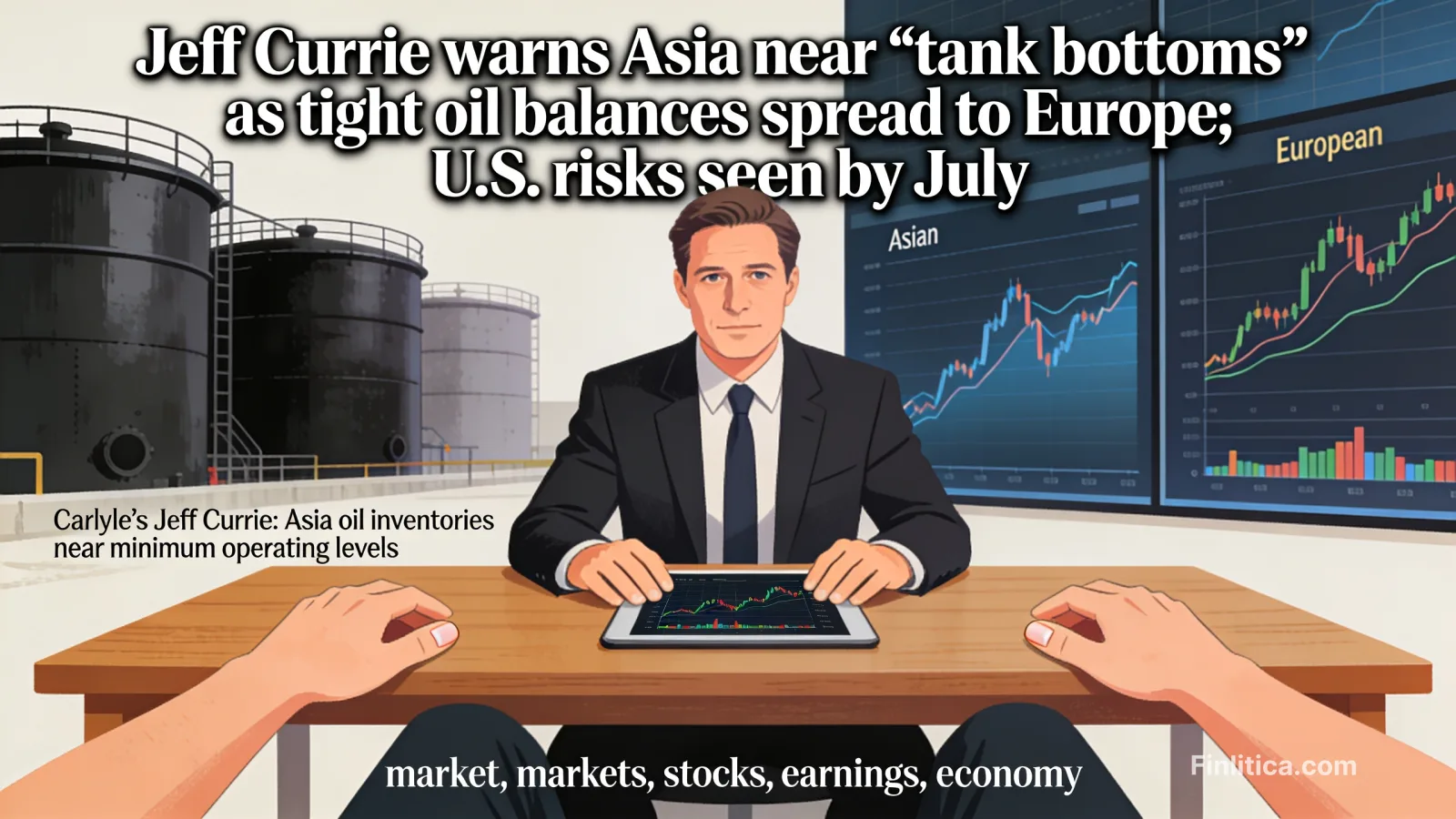
Jeff Currie warns Asia near ‘tank bottoms’ as tight oil balances spread to Europe; U.S. risks seen by July
Carlyle’s Jeff Currie says Asia’s oil inventories are approaching minimum operating levels, with Europe close behind and the U.S. potentially facing stress by July. Here’s what changed, why it matters for markets, and how investors might position.
Oil market conditions have tightened to the point that inventories in Asia are nearing minimum operating thresholds, according to commodities veteran Jeff Currie at Carlyle. He cautioned that Europe is not far behind and that the United States could encounter supply stress by July 2026 if draws persist. The warning lands as investors weigh energy’s role in portfolios amid a complex mix of macro forces including inflation, interest rate expectations, and the summer demand window across major economies.
Currie’s assessment points to a market operating with little slack. In industry practice, so-called tank bottoms refer to the fraction of storage that cannot be practically drawn without operational risk, often cited in the mid-single to low-double digit percentage range of capacity. Reaching those levels can amplify price sensitivity to incremental shocks, creating a higher-beta backdrop for stocks tied to energy, credit markets exposed to producers and refiners, and ETFs tracking commodity benchmarks.
Why it matters
Oil is a key input into transportation and manufacturing, with pass-through effects to inflation and rates. If inventories remain tight into July-roughly a matter of weeks rather than months-price volatility can feed into headline inflation prints, complicating central bank policy and broader market risk appetite. That nexus has implications for earnings guidance in energy-intensive sectors and for investors balancing exposure across equities, credit, and commodities.
What changed vs prior baseline
- Inventory drawdowns accelerated in Asia, bringing storage close to minimum operating levels instead of the more comfortable buffers seen earlier this year.
- Europe’s balances have tightened, reducing regional optionality to redirect barrels, a shift from the prior baseline where Europe held more flexible stocks.
- Timeframe pulled forward: Currie flagged potential U.S. stress by July 2026, compressing the window for restocking that many had assumed would extend into late summer.
- Operational thresholds in focus: With tank bottoms typically representing around 5-10% of tank capacity, the market’s margin for error has narrowed, elevating sensitivity to unplanned outages or logistics bottlenecks.
Market implications
Equity investors
- Energy producers and integrated majors may see improved cash flow leverage if tightness persists, but beta to headline risk rises; a single unplanned disruption can swing margins more sharply when inventories are thin.
- Refiners’ crack spreads can widen in short bursts, yet near-tank-bottom conditions can constrain run rates and elevate operational risk, making earnings outcomes more variable quarter to quarter.
Credit markets
- High-yield E&P issuers could benefit from stronger realized prices in the near term, supporting interest coverage, but refinancing risk remains if volatility spikes and liquidity tightens.
- Midstream credits with storage and logistics exposure stand to gain from elevated throughput and storage optionality; however, counterparty risk rises if sudden dislocations disrupt flows.
ETFs and commodity allocations
- Broad commodity and oil-linked ETFs may experience increased roll yields and volatility as curves react to inventory signals; position sizing and risk controls become more critical.
- Multi-asset funds targeting inflation hedges could reconsider oil’s weight as a tactical overlay, given the proximity to operational limits in multiple regions.
Key numbers to watch
- July 2026: The timeline flagged for potential U.S. supply stress focuses attention on the next 4-8 weeks, a critical window for restocking or policy response.
- 3 regions: Asia, Europe, and the U.S. are all highlighted as tightening, indicating the issue is not isolated and reducing the system’s ability to arbitrage regional imbalances.
- 5-10% tank-bottom range: While exact thresholds vary by facility, this commonly referenced operational band explains why storage nearing these levels can trigger outsized price reactions to relatively small supply-demand shifts.
Risks and alternative scenario
- Demand surprise: If summer demand in transport and petrochemicals overshoots expectations, inventories could breach operational buffers, heightening price spikes and volatility.
- Supply disruption: Unplanned outages, severe weather, or shipping constraints could have magnified impact when storage is tight, increasing downside risk for energy-importing economies.
- Policy intervention: Strategic stock releases or export policy shifts could blunt tightness but introduce new basis and timing risks for market participants.
- Soft-landing path: Conversely, if global growth cools and fuel efficiency improves, demand may moderate, easing draws and stabilizing prices without extraordinary measures.
What to watch next
- Refinery utilization into peak driving season, especially if run rates approach or exceed typical summer bands, which can accelerate draws.
- Regional spreads and freight rates, which signal whether barrels can economically rebalance across Asia, Europe, and the U.S.
- Inventory reports from major agencies and hubs that confirm whether levels stabilize above operational thresholds.
FAQ
What does “tank bottoms” mean?
It refers to the portion of oil storage that cannot be practically drawn without operational or safety risks. Approaching that level signals limited buffer and greater price sensitivity to shocks.
Why is July significant?
Currie highlighted July 2026 as a potential stress point for the U.S., placing urgency on near-term inventory management during peak seasonal demand.
How could this affect inflation and rates?
Tighter oil markets can push fuel prices higher, adding to inflation pressures that factor into central bank rate decisions. That, in turn, can influence market valuations, credit spreads, and investor risk appetite.
Which investor groups are most exposed?
Energy equities, high-yield E&P credit, midstream infrastructure plays, and commodity-linked ETFs have the most direct exposure. Broader market sectors with high energy intensity also face margin risk if prices rise.
Sources & Verification
-
View sourceCNBC Top Newswww.cnbc.com