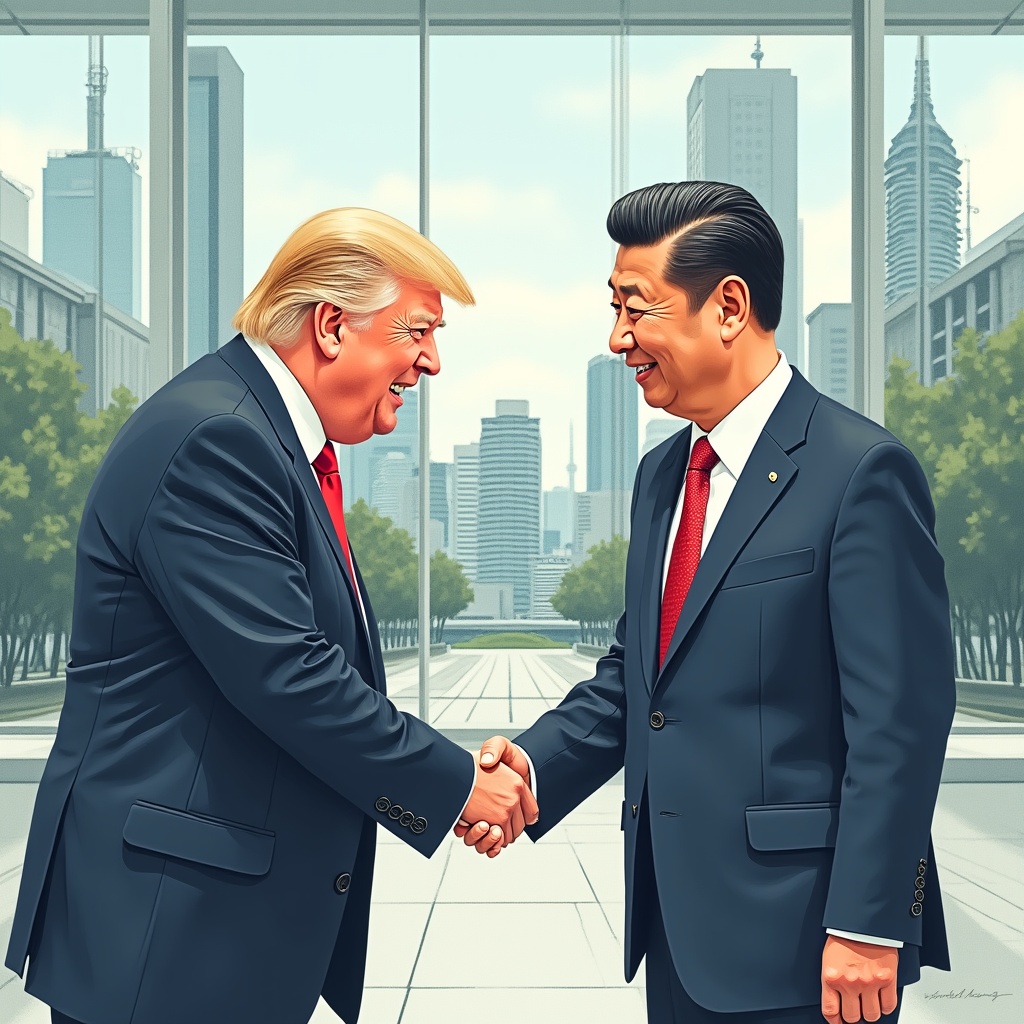
Asia-Pacific stocks traded mixed as U.S. President Donald Trump landed in Beijing for a closely watched meeting with Chinese President Xi Jinping, keeping markets on edge over the outlook for trade, technology restrictions, and capital flows. The market reaction underscores how quickly sentiment can shift when diplomacy at the highest level intersects with earnings, inflation trends and interest rate expectations across the region.
By the Thursday session on May 14, 2026, investors were parsing moves across three widely followed benchmarks—the Hang Seng in Hong Kong, Japan’s Nikkei 225, and South Korea’s Kospi—reflecting a split view on risk ahead of the talks. The summit comes eight years after the first round of U.S.–China tariff actions in 2018 and roughly six years after the Phase One agreement in 2020, timelines that matter because they frame investor expectations for what a realistic reset might look like now.
What changed vs prior baseline
- From statements to leader-level engagement: The shift from ministerial dialogue to a direct Trump–Xi meeting raises the probability of concrete headlines on tariffs and tech export rules, which can move markets intraday.
- Risk positioning into event: The mixed tape across Hong Kong, Japan, and South Korea suggests selective de-risking rather than broad capitulation, indicating investors expect incremental signals rather than a sweeping deal.
- Policy focus sharpened: Attention has pivoted to targeted areas—semiconductors, data controls, and market access—versus broad, across-the-board tariff changes, narrowing the range of immediate outcomes but elevating sector-specific impact.
Why it matters
U.S.–China policy adjustments can alter earnings trajectories for export-heavy sectors, influence global inflation through supply chains, and shape capital allocation across equities, credit, and ETFs. With two of the world’s largest economies at the table, even modest changes to tariffs or technology rules can affect pricing power, margins, and investment plans in Asia and beyond.
Market snapshot and context
Equity moves were uneven across the region, a typical pattern when binary policy events approach. Japan’s exporter-heavy index tends to benefit from clarity on trade flows, while Hong Kong-listed Chinese tech names are sensitive to any hints on chip access or data governance. South Korea’s benchmark, with its significant semiconductor exposure, often reacts to signals on equipment and design-tool restrictions.
The calendar context is also key. With 2018 marking the onset of the tariff cycle and 2020 bringing the Phase One framework, investors are using those two waypoints—eight and six years ago, respectively—to judge whether the current talks could deliver incremental relief or simply reaffirm existing controls. The date of May 14, 2026 matters because it anchors the discussions within the current macro backdrop of moderating inflation in several economies and ongoing debate about the path of interest rates.
Market implications
Equity investors
- Sector dispersion likely: Technology hardware, semiconductors, and logistics may react first to any mention of export controls or sourcing rules. Domestic-demand sectors could see relative resilience if external trade uncertainty lingers.
- Event-driven volatility: Headline risk around the meeting can drive rapid factor rotations—quality and low-volatility screens may serve as near-term defensives, while cyclicals could outperform if trade visibility improves.
Credit investors
- Spread sensitivity: Asia high-yield names tied to global supply chains could experience spread widening on tighter tech restrictions or tighten on signs of tariff stability.
- Funding channels: Any movement toward predictable trade rules can reduce refinancing risk for issuers reliant on cross-border cash flows, particularly in manufacturing hubs.
ETF and asset allocators
- Flows and hedges: Broad Asia and China-focused ETFs may see two-way flows around headlines, while semiconductor and industrials ETFs could exhibit amplified swings.
- Regional tilts: Allocators may balance Japan’s earnings visibility against China’s policy sensitivity, adjusting currency hedges as a secondary lever for risk control.
Risks and alternative scenario
- Limited deliverables: Talks could conclude with reaffirmations rather than new measures, leaving existing tariffs and controls in place and prolonging earnings uncertainty.
- Headline misreads: Early signals can be ambiguous; markets may overshoot on partial leaks, only to retrace when full text or specifics emerge.
- Sector-specific tightening: Even without broad tariff shifts, narrower technology restrictions could weigh on semiconductor equipment, AI infrastructure, and advanced materials supply chains.
- Macro crosscurrents: If inflation data or rate expectations shift concurrently, it could obscure the pure policy signal and complicate portfolio decisions.
What to watch next
- Language on tariff schedules and review timelines, which would guide revenue visibility for exporters.
- References to semiconductor export controls or licensing regimes, key for capex plans in chip supply chains.
- Any framework for working groups or follow-up milestones, which would signal whether this is a starting point or a one-off engagement.
FAQ
Why are Asia-Pacific markets mixed ahead of the Trump–Xi meeting?
Investors are balancing the possibility of policy clarity on trade and technology against the risk of limited progress. That uncertainty typically produces dispersion across indices and sectors rather than a uniform move.
Which indices are most sensitive to the talks?
Three benchmarks in focus are Hong Kong’s Hang Seng (China technology and consumer names), Japan’s Nikkei 225 (exporters and manufacturers), and South Korea’s Kospi (semiconductors). Each has different exposure to trade flows and tech rules, shaping varied performance.
How do past milestones—2018 tariffs and the 2020 Phase One deal—inform expectations?
They set the baseline. With the tariff regime launched in 2018 and partial commitments made in 2020, markets now look for incremental signals—such as review mechanisms or sector-specific adjustments—rather than sweeping reversals.
What could reduce volatility after the meeting?
Clear guidance on next steps, including timelines for policy reviews or defined areas of cooperation, would help investors model earnings and cash flows more confidently, narrowing bid-ask spreads and dampening swings.