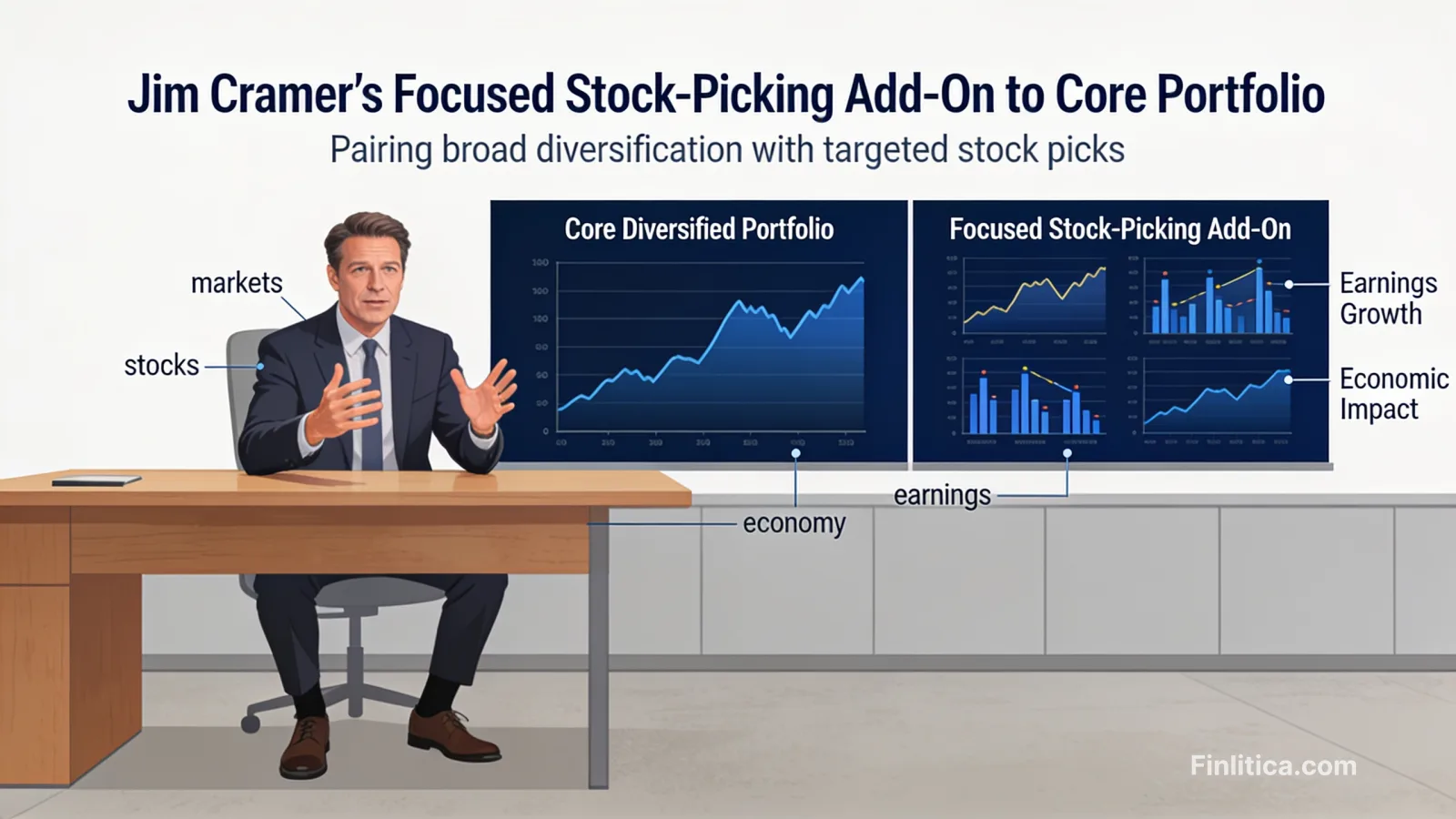
Jim Cramer lays out a focused stock-picking add‑on to a core diversified portfolio
In a new interview, Jim Cramer details how investors can pair a broad core portfolio with a small, handpicked list of individual stocks-aiming for clarity across earnings, inflation and rate cycles without abandoning diversification.
Television host and longtime market commentator Jim Cramer has outlined a practical approach for investors who want to complement diversified holdings with a short list of individual stocks. The framework, shared in a recent interview, centers on building a high-conviction shortlist that can be held through varied market conditions-from shifting inflation and interest rate paths to uneven earnings seasons-without abandoning the discipline of broad-based investing or low-cost ETFs. It aims to give investors a clearer way to act on research-driven ideas while keeping overall exposure aligned with the economy and markets.
Key takeaways
- Pair a diversified core with a small, researched list of single-name stocks to express targeted views.
- Use earnings quality, balance-sheet strength and durable demand as primary filters.
- Manage position sizes and rebalancing rules to prevent a handful of winners or laggards from dominating risk.
How the blueprint works
The concept starts with a core portfolio-commonly a mix of index funds or ETFs-designed to capture broad market returns at low cost. Around that core, investors add a compact basket of individual stocks selected for clear catalysts, resilient cash flows and credible management execution. The goal is to participate in specific company stories while keeping total portfolio risk tied to the broader market rather than any single sector.
Selection hinges on a few consistent pillars: evidence of pricing power when inflation is uneven, visibility into demand across the cycle, and balance sheets that can absorb a slower economy or higher funding costs. Earnings quality and guidance credibility carry extra weight when markets reprice on surprises.
What changed vs prior baseline
- More emphasis on durability over hype: screens tilt toward recurring revenue and free-cash-flow coverage, not just headline growth.
- Tighter list size and sizing: concentrated satellite positions are kept small relative to the core to control drawdowns.
- Process over prediction: systematic entry and review around earnings dates and macro prints, rather than short-term market calls.
- Explicit sell and trim rules: holdings are reduced when thesis milestones slip, not only when prices fall.
How to build the short list
1) Define the investable themes
Start with a few durable trends that intersect earnings and the real economy-such as enterprise software adoption, onshoring of supply chains, energy infrastructure upgrades or payment digitization. For tactical balance, consider macro-sensitive areas like financials that respond to interest rate shifts and defensives that can buffer profit volatility.
2) Apply fundamental filters
- Earnings and guidance: prioritize companies that meet or beat expectations and maintain guidance through the cycle.
- Balance sheet: look for net cash or staggered debt maturities to reduce refinancing risk if rates remain elevated.
- Unit economics: positive gross margins, improving operating leverage and cash conversion that supports reinvestment or buybacks.
3) Risk controls and maintenance
- Position sizing: cap any single stock at a modest share of total portfolio exposure to limit idiosyncratic risk.
- Event calendar: plan around earnings dates and macro reports (inflation, jobs, rate decisions) that can move prices.
- Review cadence: reassess theses after each quarterly update; trim if milestones slip or if valuation outruns fundamentals.
Market implications
- Equity investors: A core-satellite blend can reduce dispersion risk while preserving upside from stock picking. This is especially relevant when market breadth is narrow and index-level returns are driven by a small number of mega caps.
- ETF allocators: Low-cost market and sector ETFs remain the ballast; the satellite list lets allocators adjust factor tilts (quality, profitability) without overhauling the core.
- Credit investors: Emphasis on balance-sheet strength and cash flow can help equity holders avoid names with rising refinancing risk, a dynamic that also shows up in credit spreads.
- Sector allocators: A compact list enables targeted exposure to themes-such as semiconductors, healthcare tools or payments-while using sector ETFs to smooth volatility.
Why it matters
Markets increasingly swing on discrete data-earnings beats, inflation prints and policy rate cues. A structure that keeps most assets in diversified funds while reserving a small sleeve for researched convictions helps investors participate in specific opportunities without taking on concentrated portfolio risk. It promotes process discipline in a cycle where macro signals and company results can diverge.
Three numbers to anchor the process
- 252: There are roughly 252 trading days in a typical year. Spacing entries across this window supports dollar-cost averaging and reduces timing risk around earnings or macro announcements.
- 30: U.S. tax rules include a 30-day wash-sale window. Investors who harvest losses should avoid repurchasing substantially identical securities within 30 days to preserve the deduction.
- 12: A holding period of more than 12 months qualifies for long-term capital gains treatment in the U.S., which can materially change after-tax returns relative to short-term rates.
Where crypto fits
For investors using digital assets, the same core-satellite logic applies: broad exposure can be obtained via diversified vehicles, while any single-asset positions remain a small, high-risk sleeve. Volatility, liquidity and custody risks require stricter sizing and rebalancing than for most equities.
Practical workflow
- Build the core: choose broad market and international ETFs that reflect the desired equity and rate sensitivity across the economy.
- Curate the satellite: maintain a vetted watchlist and initiate positions only when valuation, earnings momentum and risk controls align.
- Schedule discipline: map trades and reviews to the company’s earnings calendar and major inflation or policy rate updates.
- Exit rules: define in advance the metrics that would invalidate the thesis-such as deteriorating margins, missed execution milestones or balance-sheet erosion.
Risks and alternative scenario
- Earnings shock risk: Single-name positions can gap lower on guidance cuts or unexpected costs, overwhelming fundamentals in the short term.
- Macro whiplash: Faster-than-expected swings in inflation or policy rates can compress multiples even for quality companies.
- Crowding and liquidity: Popular themes may be crowded; in stress, liquidity can vanish and widen bid-ask spreads.
- Thesis drift: Without strict review, positions can morph from targeted ideas into long-term holdings for the wrong reasons.
FAQ
How many stocks belong in the satellite sleeve?
Keep it small enough to monitor closely and large enough to diversify idiosyncratic risk. The key is that the satellite remains modest relative to the diversified core.
How should I time entries around earnings?
Consider phasing purchases to reduce outcome risk from a single report. Using the roughly 252 trading days in a year allows for staggered entries.
Do interest rates change the approach?
Higher rates raise the bar for valuation and refinancing. Favor balance sheets with manageable maturities and cash generation.
Can crypto be part of the satellite?
Yes, but size cautiously. Volatility and custody risks argue for smaller allocations and strict rebalancing rules.
What about taxes?
Mind the 30-day wash-sale rule when harvesting losses and the 12-month threshold for long-term capital gains to optimize after-tax returns.
Sources & Verification
-
View sourceCNBC Top Newswww.cnbc.com